



Key Findings
- Discovered in 1901 from an ancient Roman shipwreck off the Greek island of Antikythera, the device contains over 30 precision bronze gears dating to approximately 200 to 100 BCE.
- The front display tracked the positions of the Sun, the Moon, and the five known planets through an ingenious epicyclic pin-and-slot gear train reflecting ancient Babylonian and Greek astronomy.
- The rear dials calculated the 223-month Saros cycle to predict solar and lunar eclipses down to the specific hour, alongside tracking the four-year cycle of the Panhellenic Games.
- Recent 2021 reconstructions by University College London (UCL) solved the missing front gear train, while new physics simulations examine the friction and torque limits of triangular gear teeth.
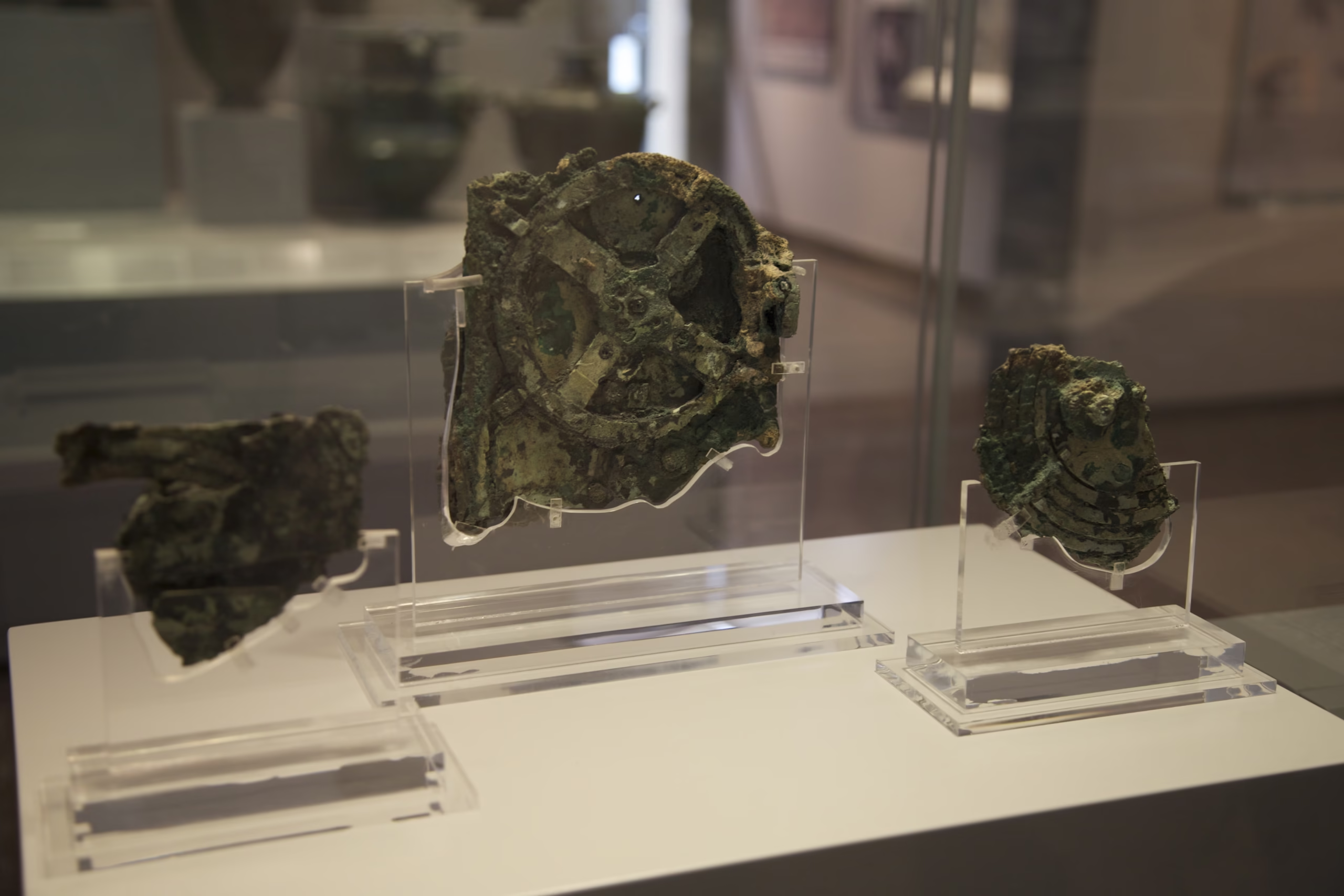
In the spring of 1901, Greek sponge divers sheltering from a storm off the Aegean island of Antikythera discovered the wreckage of a Roman merchant ship that sank around 70 to 60 BCE [1, 3]. Amid marble statues and bronze artworks, divers recovered heavily calcified green bronze lumps [1].
Initially set aside as unidentifiable debris, the artifact split open as it dried, revealing precision gear teeth and Greek inscriptions [1, 4]. For decades, historians maintained that miniature clockwork of this complexity was impossible before fourteenth-century Europe. However, modern 3D X-ray computed tomography has proven that the Antikythera Mechanism was a 2,200-year-old portable analog computer engineered by Hellenistic Greek scientists [1, 2].
The Discovery in the Depths of Antikythera
The Roman vessel was transporting Hellenistic luxury goods and political diplomatic gifts toward Rome when it foundered [1, 3]. When archaeologist Valerios Stais first examined the artifact in May 1902, the idea of ancient complex gearwork sparked widespread disbelief [3]. Early twentieth-century scholars suggested it was a medieval astrolabe dropped coincidentally over the ancient wreck [3]. However, epigraphical analysis of the Greek inscriptions on its bronze panels securely dated the text to between 150 and 100 BCE [1, 4].
Today, eighty-two corroded fragments survive, representing approximately one-third of a sophisticated mechanism originally housed inside a cedarwood case roughly the size of a standard shoebox [1, 4].
Anatomy of Bronze Gears and Differential Mechanisms
The internal engineering of the Antikythera Mechanism reflects remarkable metallurgical craftsmanship and applied geometry [1, 3]. Within its compact wooden frame, Greek craftsmen packed more than thirty bronze gear wheels hand-cut from low-tin bronze sheets (95 percent copper, 5 percent tin) [1, 2].
Unlike modern curved involute gears, the mechanism used equilateral triangular teeth with pitches between 1.5 and 3 millimeters [1, 5]. Each gear possessed an exact tooth count designed to compute astronomical mathematical ratios [1, 4]:
• Main Drive Wheel (b1): A large 64-tooth crown gear turned by a hand crank, driving the passage of solar calendar time [1].
• Epicyclic Pin-and-Slot Mechanism: Two 53-tooth gears mounted slightly off-center on a shared axis, connected by a sliding pin in a rectangular slot [1, 4]. This ingenious design replicated the Moon’s variable orbital speed, anticipating Kepler’s laws by eighteen centuries [1, 4].
• The 223-Tooth Saros Gear: A large spiral rear gear calculating lunar and solar eclipse periodicities [1].
Mechanical Specifications and Functional Displays
| Subsystem | Gear Complexity | Calculated Astronomical Phenomenon | Mechanical Innovation |
|---|---|---|---|
| Front Cosmos Dial | Over 15 interlocked bronze gears | Positions of Sun, Moon, and 5 visible planets | Epicyclic gearing with pin-and-slot anomaly simulation |
| Lunar Phase Sphere | Differential crown gearing | Waxing and waning synodic lunar phases | Two-tone rotating miniature metal sphere |
| Upper Metonic Dial | 5-turn Archimedean spiral | 19-year, 235-synodic-month lunisolar calendar | Sliding pointer follower guided by a spiral bronze groove |
| Lower Saros Dial | 4-turn spiral with 223 month cells | Solar and lunar eclipse occurrence and timing | Glyph inscriptions detailing eclipse hour and visibility |
| Olympiad Subdial | 4-quadrant geared pointer | 4-year cycle of Olympic and Panhellenic games | Civic-religious festival calendar synchronization |
The Front Cosmos Dial: Tracking Planets and Lunar Phases
The front face displayed the cosmos as understood in Hellenistic geocentric astronomy [1]. A circular bronze dial featured two concentric rings: an inner ring divided into the 360 degrees of the Greek Zodiac, and an outer ring engraved with the 365 days of the Egyptian calendar [1, 4].
Because the solar year is roughly 365.2422 days, the outer calendar ring could be rotated backward by one day every four years via an adjustable retaining pin, representing the earliest known mechanical leap year calendar [1, 4].
Multiple pointers swept across this dial [1]:
- Solar Pointer: Indicated the calendar date and the Sun’s position along the ecliptic [1].
- Lunar Pointer: Tracked the Moon’s celestial position and contained a miniature half-white, half-black revolving sphere that displayed current lunar phases [1, 4].
- Planetary Pointers: Tracked Mercury, Venus, Mars, Jupiter, and Saturn [1]. Epicyclic gearing accurately reproduced planetary retrograde motion, where planets appear to temporarily reverse course across the sky [1].
The Rear Dials: Eclipse Forecasting and the Olympic Calendar
The rear face featured two large spiral dials that calculated celestial cycles and civic events [1, 4].
The Upper Metonic Dial displayed the 19-year lunisolar cycle of 235 lunar months discovered by Meton of Athens [1, 3]. Arranged as a five-turn spiral with 235 monthly divisions, a sliding bronze pointer followed the groove inward and outward [1, 4]. Inside this dial was the four-year Olympiad subdial, tracking the timing of the Olympic, Pythian, Nemean, and Isthmian Games [1].
The Lower Saros Dial tracked the 18-year eclipse cycle across 223 synodic lunar months [1, 4]. Engraved glyphs predicted solar and lunar eclipse dates, times of day, and visibility [1, 2]. An adjacent Exeligmos subdial tracked the 54-year cycle that adjusted for the eight-hour fractional shift of the Saros cycle [1].
The 2021 UCL Breakthrough: Virtual Reconstruction of the Gear Train
While the rear gear trains were largely preserved in Fragment A, the front planetary display suffered severe damage, leaving two-thirds of the mechanism missing [1, 4].
In March 2021, researchers at University College London (UCL) published a reconstruction in Scientific Reports [1]. Using micro-CT scans and mathematical modeling, the team decoded inscriptions on the casing detailing planetary cycle periods derived from ancient Babylonian observations [1]. By solving complex period relations with optimization algorithms, UCL reconstructed an interlocking gear train that fit into the 25-millimeter clearance behind the front dial, proving Hellenistic engineers had built a complete mechanical universe [1].
The decoded front inscriptions revealed highly precise planetary period relations: Venus was recorded as completing 462 synodic cycles in 1,151 years, while Saturn completed 442 cycles in 465 years [1]. To execute these extraordinary astronomical ratios within a miniature bronze casing, ancient mathematicians mathematically factored these large numbers into prime products. They then manufactured specialized gear wheels possessing 127, 223, and 53 teeth, fitting complex epicyclic gear trains directly onto hollow concentric drive shafts that rotated independent planetary pointers across the front Zodiac dial [1, 4].
Mechanical Engineering Physics: Triangular Teeth and Friction
Modern engineering studies examine the practical functionality of the device [5]. A 2025 study in arXiv analyzed the mechanics of ancient hand-cut triangular gear teeth [5].
Unlike modern curved involute gears that roll smoothly, triangular teeth cause sliding friction, high pressure angles, and backlash [5]. When hand-cranking over thirty interconnected gears, cumulative friction and manufacturing inaccuracies would have caused significant mechanical resistance [5]. The study suggests that while small gear clusters operated effectively, driving the entire mechanism continuously without jamming was extremely challenging [5]. Many scholars conclude the device served as an elite educational demonstration tool or astronomical exhibition piece rather than a daily clock [1, 5].
Tribological simulations show that the lack of modern industrial lubricants compounded these mechanical challenges [5]. While ancient Greek mechanicians likely applied purified olive oil or animal tallow to ease bronze-on-bronze friction, organic oils degrade, oxidize, and attract atmospheric dust and particulate grime over time [5]. In the Mediterranean maritime climate, accumulated residue would have increased mechanical drag across the tightly packed gear train, requiring periodic manual maintenance and delicate tooth realignments by skilled craftsmen [1, 5].
The Lost Technological Renaissance of Antiquity
The Antikythera Mechanism demonstrates that ancient technology reached levels of mechanical sophistication previously thought impossible [3, 4]. Following the decline of Hellenistic science, this intricate gearing knowledge disappeared from the Mediterranean world [1, 3]. Over fourteen centuries elapsed before European clockmakers during the Renaissance rebuilt mechanisms of comparable complexity [3]. The mechanism remains enduring evidence of humanity’s ancient computational ingenuity [1, 4].
Historians of science attribute this technological amnesia to shifting cultural priorities following the Roman conquest of the Greek Mediterranean [1, 3]. While Roman engineers excelled in monumental civil architecture, concrete formulation, arched aqueducts, and military fortifications, they showed little interest in theoretical mathematics, precision metallurgy, or miniature mechanical computing [3]. As scientific academies in Alexandria and Syracuse deteriorated, the specialized guild knowledge required to manufacture thirty-gear bronze calculators vanished, leaving only cryptic textual references in the philosophical writings of Cicero and Archimedes until twentieth-century sponge divers hauled the physical truth from the seabed [1, 3].
Frequently Asked Questions
Primary Sources and References
A Model of the Cosmos in the ancient Greek Antikythera Mechanism
- Journal
- Scientific Reports
- Study Type
- Archaeoastronomy
- Year
- 2021
DOI10.1038/s41598-021-84310-w
Frequently Asked Questions
Common reader questions about this study
What is the Antikythera Mechanism?
The Antikythera Mechanism is a 2,200-year-old ancient Greek mechanical computing device discovered in 1901 inside a sunken Roman shipwreck off the Greek island of Antikythera. Built from precision bronze gears inside a compact wooden casing, it calculated celestial cycles, planetary positions, lunar phases, and eclipse predictions.
Who built the Antikythera Mechanism?
While the exact craftsman remains unknown, historical and epigraphical evidence points to the Hellenistic mechanical and astronomical traditions of Syracuse, Corinth, or Rhodes. Scholars frequently link its design principles to the workshops of the mathematician Archimedes or the astronomer Hipparchus.
How was the Antikythera Mechanism operated?
The mechanism was operated manually by turning a small bronze hand crank or crown wheel mounted on the side of its wooden case. Turning the crank rotated the main drive gear, which simultaneously set more than thirty intermeshed gear wheels in motion to calculate past or future astronomical dates.
Why is it described as the world's first analog computer?
It is recognized as an analog computer because it used physical gear ratios and differential gear mechanics to perform complex mathematical calculations of celestial cycles, outputting dynamic astronomical coordinates on calibrated front and rear dials without electronic components.
Where is the original Antikythera Mechanism kept today?
The 82 surviving fragments of the original bronze mechanism are permanently conserved and exhibited in climate-controlled, high-security glass displays at the National Archaeological Museum in Athens, Greece.
References
- ↩ Freeth, T., Higgon, D., Dacanalis, A., et al. (2021). A Model of the Cosmos in the ancient Greek Antikythera Mechanism. Scientific Reports, 11(1), 5821.
- ↩ Anastasiou, M., et al. (2014). The Antikythera mechanism: decoding an astonishing ancient Greek astronomical computer. Physica Medica, 30, e32.
- ↩ Price, D. J. de S. (1974). Gears from the Greeks: The Antikythera Mechanism—A Calendar Computer from ca. 80 B.C. Transactions of the American Philosophical Society, 64(7), 1-70.
- ↩ Freeth, T., Bitsakis, Y., Moussas, X., et al. (2006). Decoding the ancient Greek astronomical calculator known as the Antikythera Mechanism. Nature, 444(7119), 587-591.
- ↩ Iriarte, R. A., et al. (2025). The Impact of Triangular-Toothed Gears on the Functionality of the Antikythera Mechanism. arXiv preprint, arXiv:2504.00327.



No comments yet. Be the first to join the conversation.