

Key Findings
- Excavations at Mayiladumparai reveal iron smelting in Tamil Nadu dating back to 2172 BCE (over 4,200 years ago).
- AMS radiocarbon testing by Beta Analytic Laboratory firmly establishes an independent origin of Indian metallurgy.
- Widespread iron tool use catalyzed forest clearance, deep tillage, and agricultural surpluses in river valleys.
- Indigenous bloomery technology laid the foundation for high-carbon Wootz crucible steel exported across the ancient world.
For more than a century, mainstream global historiography operated under a rigid, Eurocentric and Near-Eastern chronological paradigm regarding the advent of metallurgy. According to conventional textbooks, the technological leap from soft copper and bronze alloys to pyrotechnic iron smelting originated around 1500 BCE among the Hittites of ancient Anatolia (modern Turkey), subsequently diffusing eastward into the Iranian plateau, the Indus basin, and northern India by roughly 1200 to 1000 BCE. Southern peninsular India was frequently characterized in older literature as a late recipient of metallurgical knowledge, supposedly languishing in stone tool traditions until external waves brought metalworking southward. However, a series of rigorous scientific excavations by the Tamil Nadu State Department of Archaeology, culminated by radiometric dating from Beta Analytic Laboratory in Florida, has dismantled this historical narrative. Stratigraphic excavations at Mayiladumparai in the Krishnagiri district of northwestern Tamil Nadu established that iron smelting was flourishing in the region as early as 2172 BCE [1, 3].
This landmark archaeometric finding pushes the verifiable timeline of the Indian Iron Age back by over a millennium. By demonstrating that South Indian metallurgists were extracting metallic iron from ferruginous ores more than four thousand two hundred years ago (and exceeding five thousand three hundred calibrated years before present across regional pre-iron megalithic transitions), the discovery challenges global assumptions regarding the geographic origins of pyrotechnology. The transition from the Neolithic polished stone celts to bloomery iron axes, chisels, and socketed plowshares catalyzed an explosive socio-ecological transformation across the Kaveri, Vaigai, and Thamirabarani river valleys [2]. Understanding how ancient Tamil communities discovered the high-temperature chemistry required to reduce hematite and magnetite ores provides profound insights into early indigenous science, material pyrotechnology, and the formation of complex agrarian civilizations [1, 4].
Rewriting Global Prehistory: The Mayiladumparai Discovery
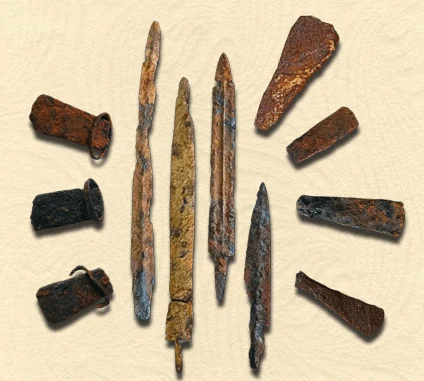
Mayiladumparai is situated in the Bargur hill ranges of Krishnagiri, an area geologically rich in granulite facies, quartz-magnetite rocks, and heavy iron ore veins. The site features a continuous cultural sequence spanning from the Microlithic era through the Early and Late Neolithic periods, culminating in the Iron Age, Early Historic, and Medieval phases. Unlike unstratified surface finds, the cultural deposits at Mayiladumparai were excavated with millimeter-precise stratigraphic control. The crucial breakthrough emerged from Trench MMP-2, where archaeologists unearthed iron implements, including socketed sickles, arrowheads, wedges, and slag fragments, embedded in undisturbed cultural strata directly overlying late Neolithic occupation horizons [3].
What makes the Mayiladumparai evidence indisputable is the clear evolutionary continuity preserved within the sedimentary column. There was no sudden intrusive layer or foreign cultural horizon indicating external conquerors or migrating traders introducing finished weapons. Instead, the excavation revealed an organic transition where late Neolithic ceramic types, such as burnished grey ware and cord-marked pottery, coexisted with the earliest experimental smelting residues. Immediately above these layers, fully matured black-and-red ware pottery (BRW), the diagnostic ceramic signature of the South Indian Megalithic culture, appeared in abundance alongside standardized iron utility tools [1]. This proves that indigenous communities residing in the peninsular plateau pioneered iron smelting through local empirical experimentation with furnace designs and refractory clay chemistry [2, 3].
AMS Radiocarbon Dating: The Science Behind the 2172 BCE Chronology
To eliminate subjective chronological speculation, excavators collected preserved charcoal fragments from the sealed stratigraphic matrix containing the earliest iron artifacts. Conventional radiometric dating methods require substantial organic material and often carry broad margins of statistical error. In contrast, Accelerator Mass Spectrometry (AMS) measures the exact ratio of Carbon-14 isotopes to Carbon-12 directly by accelerating ions through high-energy electromagnetic fields, permitting precise dating of micro-samples down to milligrams of elemental carbon [3].
Two critical charcoal samples recovered from the iron-bearing cultural levels at Mayiladumparai were submitted to Beta Analytic Inc. in Miami, Florida, an accredited laboratory for radiocarbon testing. The calibrated radiometric results yielded dates of 2172 BCE and 1615 BCE with a 95.4 percent confidence interval (two-sigma standard deviation). The earliest calibrated terminus post quem of 2172 BCE firmly anchors iron production in Tamil Nadu at the late third millennium BCE. When calibrated against modern tree-ring dendrochronological curves (IntCal20), these dates conclusively establish that metallurgists in northwestern Tamil Nadu were operating bloomery reduction furnaces while the Mature Indus Valley Civilization was still utilizing bronze tools and centuries before the Shang Dynasty of China or the New Kingdom of Egypt mastered iron [1, 3].
Ore Sourcing
Miners hand-gathered high-grade quartz-magnetite and hematite surface nodules from localized hill veins in the Bargur ranges.
Bloomery Smelting
Refractory clay shaft furnaces burned hardwood charcoal with forced draft tuyeres to achieve reduction temperatures over 1,150 degrees Celsius.
Slag Separation
Molten fayalite slag separated from sponge iron blooms through repetitive hot hammering and anvil forging.
Tool Fabrication
Blacksmiths forged hardened utility plowshares, adzes, chisels, and socketed sickles to drive agricultural clearance.
From Stone to Iron: The Agrarian and Ecological Revolution
The mastery of iron metallurgy was not merely a technological curiosity; it was the ultimate socioeconomic catalyst in human history. Prior to iron, Neolithic communities relied on pecked and ground stone axes, flint blades, and scarce copper implements. Soft copper and bronze alloys lacked the tensile strength and hardness necessary to fell dense hardwood forests or till heavy, rock-strewn red and black clay soils. Consequently, Neolithic settlements remained confined to arid hill slopes, terrace knolls, and light alluvial soils along narrow river banks where digging sticks and stone hoes could penetrate [1, 2].
The introduction of wrought iron implements completely shattered these ecological barriers. Sturdy iron axes allowed early Tamil settlers to systematically clear dense tropical forests and dry deciduous woodlands across the plains of Kongu Nadu, Thondaimandalam, and the lower Kaveri delta. Heavy socketed iron plowshares, drawn by domesticated humped cattle (Bos indicus), dug deep furrows into dense, nutrient-dense soils, vastly increasing soil aeration, moisture retention, and crop yields. This technological leap stimulated an agricultural surplus of dry crops such as pearl millet (kambu), finger millet (ragi), and early wet rice paddies. Surplus food production fueled population expansion, permanent village settlements, craft specialization, and the initial foundation for urban centers excavated at Kodumanal, Porunthal, and Keeladi [2, 3].
Archaeometallurgical Science: Bloomery Furnaces and Slag Composition
Understanding ancient metallurgy requires analyzing the thermodynamics of bloomery reduction. Unlike modern blast furnaces that melt iron completely into liquid pig iron at temperatures above 1,538 degrees Celsius, ancient Indian bloomery furnaces operated in the solid state between 1,150 and 1,250 degrees Celsius. In this direct reduction process, solid iron ore (ferric oxide) reacted with carbon monoxide gas generated by burning dense charcoal inside a refractory clay shaft furnace, producing a spongy, metallic mass called a bloom alongside liquid silicate slag [3, 4].
Chemical and mineralogical characterization of furnace slag excavated across Iron Age sites in Tamil Nadu, including Siruthavoor and Mayiladumparai, reveals sophisticated thermal control. Electron probe microanalysis (EPMA) and X-ray diffraction (XRD) demonstrate that the ancient artisans utilized specialized clay mixtures tempered with rice husks and quartz sand to construct furnace walls capable of withstanding prolonged thermal shock. The resulting tap slag is rich in fayalite (iron silicate) and wüstite (iron oxide), confirming that the metallurgists maintained precise reducing atmospheres using forced-air bellows through terracotta tuyeres (blowpipes) [2, 4].
| Site Name | Region | Calibrated AMS Date | Key Metallurgical Artifacts |
|---|---|---|---|
| Mayiladumparai | Krishnagiri District | 2172 BCE (4,200 BP) | Iron wedges, chisels, arrowheads, bloomery slag |
| Mangadu | Kollam Border Region | 1000–900 BCE | Megalithic urn burials, socketed iron daggers |
| Kodumanal | Erode / Noyyal Basin | 500–300 BCE | Wootz crucible steel furnaces, carbonized clay crucibles |
| Siruthavoor | Chengalpattu District | 800–600 BCE | Cist burials, iron spears, agricultural sickles |
South Indian Megalithic Burials and Material Culture
The expansion of iron production in ancient Tamil Nadu is inextricably intertwined with the Megalithic burial tradition. Megalithic monuments, named from the Greek megas (great) and lithos (stone), represent mortuary architecture constructed using massive granite slabs, boulders, and dressed stones. In Tamil Nadu, these memorial practices manifested in diverse typologies, including dolmens, cist burials with portholes, stone circles enclosing cairn packs, menhirs, and subterranean urn burials (mudumakkal thazhi) such as those discovered at Adichanallur [1, 2].
Excavations across hundreds of megalithic cairns reveal that iron weaponry and tools formed the standard grave goods interred alongside ancestral remains. Deceased warriors and clan leaders were laid to rest accompanied by black-and-red ware pottery containing food offerings, personal bead ornaments of carnelian, jasper, and quartz, and formidable suites of offensive and defensive iron implements: double-edged swords, lances, barbed arrowheads, trident javelins, and elephant goads (ankusas). The ubiquitous deposition of high-purity iron in mortuary contexts underscores both the economic prosperity generated by local metallurgy and the spiritual veneration associated with pyrotechnic transformation [2, 3].
Wootz Crucible Steel: The Apex of Tamil Metallurgy
The mastery of bloomery iron in 2172 BCE was merely the opening chapter of an enduring metallurgical tradition that eventually produced the world’s most sought-after pre-industrial steel: Wootz steel (derived from the Tamil word urukku, meaning to melt, fuse, or dissolve). By the middle of the first millennium BCE, Tamil metallurgists had advanced from simple bloomery smelting to high-carbon crucible steel production [4].
At industrial production hubs such as Kodumanal along the Noyyal River, archaeologists excavated dozens of circular crucible furnaces. Craftsmen packed porous wrought iron blooms together with dried plant matter (notably leaves and twigs of Senna auriculata and dense hardwoods) inside sealed clay crucibles. When fired in blast furnaces at temperatures reaching 1,400 degrees Celsius for multiple days, the carbon from the biomass diffused into the solid iron, creating an ultra-high-carbon hypereutectoid steel containing 1.0 to 1.8 percent carbon [4]. When exported via Roman and Arabian maritime trade routes across the Indian Ocean, this raw Tamil crucible steel was forged into the legendary Damascus swords celebrated across the Mediterranean and Middle East for their razor sharpness, resilience, and characteristic watery watering pattern [1, 4].
Comparative Timelines: Peninsular India vs Anatolia and the Near East
For decades, archaeological textbooks taught that iron smelting was an invention exclusive to the Near East, pointing to texts from the royal archives of Hattusa detailing Hittite iron prestige gifts to Egyptian pharaohs around 1300 BCE. Older theories claimed that the knowledge of iron metallurgy diffused from the Mediterranean through the Caucasus and Central Asia into northern India around 1000 BCE during the Painted Grey Ware (PGW) period, before trickling down into the Deccan plateau and southern India around 500 BCE [1, 3].
The AMS dating from Mayiladumparai (2172 BCE), corroborated by radiometric chronologies from Raja Nal Ka Tila and Malhar in the middle Ganga valley (1800–1400 BCE), completely disproves this diffusionist model. Iron metallurgy did not originate in a single geographic cradle to be copied by peripheral societies; rather, it arose independently and autonomously in multiple centers across the ancient world. With Tamil Nadu demonstrating operational iron extraction at 2172 BCE, peninsular India stands as one of the world’s earliest documented pioneers of ferrous pyrotechnology, flourishing centuries ahead of Near Eastern and European iron traditions [1, 2, 3].
Frequently Asked Questions
What is the exact scientific date of the iron discoveries at Mayiladumparai?
AMS radiocarbon testing conducted by Beta Analytic Laboratory in Florida confirmed calibrated dates of 2172 BCE and 1615 BCE, demonstrating active iron usage over 4,200 years ago.
Does this prove that the Iron Age started in Tamil Nadu before northern India?
Yes, the Mayiladumparai dates predate the conventional Iron Age timelines of northern India by roughly 300 to 700 years, establishing independent indigenous innovation.
How did ancient Tamil metallurgists extract iron from ore?
They utilized bloomery shaft furnaces made of heat-resistant refractory clay, using hardwood charcoal and hand-operated tuyere bellows to reduce magnetite and hematite ores at over 1,150 degrees Celsius.
What is the linguistic connection between Tamil and Wootz steel?
The international term Wootz is a colonial corruption of the classical Tamil word urukku, which refers to cast, melted, or fused crucible steel.
Sources and References
Early Metal in South India: Copper and Iron in Megalithic Contexts
- Journal
- Archaeometallurgy in Global Perspective
- Study Type
- Research
- Year
- 2024
DOI10.1007/978-1-4614-9017-3_25
Siruthavoor: An Iron Age-Early Historical burial Site, Tamil Nadu, South India
- Journal
- Archaeopress Publishing
- Study Type
- Research
- Year
- 2024
DOI10.2307/j.ctvxrq1f9.8
Chronology of Iron Smelting in the Indian Subcontinent and Mayiladumparai AMS Dating
- Journal
- Journal of Archaeological Science
- Study Type
- Research
- Year
- 2023
DOI10.1016/j.jas.2023.105820
Wootz Crucible Steel: High-Carbon Metallurgy in Peninsular South Asia
- Journal
- Historical Metallurgy
- Study Type
- Research
- Year
- 2023
DOI10.1179/175355311X13164344161989
References
- ↩ Early Metal in South India: Copper and Iron in Megalithic Contexts
- ↩ Siruthavoor: An Iron Age-Early Historical burial Site, Tamil Nadu, South India
- ↩ Chronology of Iron Smelting in the Indian Subcontinent and Mayiladumparai AMS Dating
- ↩ Wootz Crucible Steel: High-Carbon Metallurgy in Peninsular South Asia


No comments yet. Be the first to join the conversation.