


Key Findings
- Physicists construct the world's first self-stabilizing optical nuclear clock using an autonomous laser feedback loop.
- Embedded in a calcium fluoride crystal, thorium-229 nuclei provide an 8.3 eV low-energy isomer transition excited by UV lasers.
- The solid-state prototype maintained 10⁻¹⁵ precision across 24 hours of autonomous operation without external atomic clock input.
- Nuclear clocks are projected to achieve 10⁻¹⁹ precision, enabling millimeter geodesy, deep space navigation, and dark matter searches.
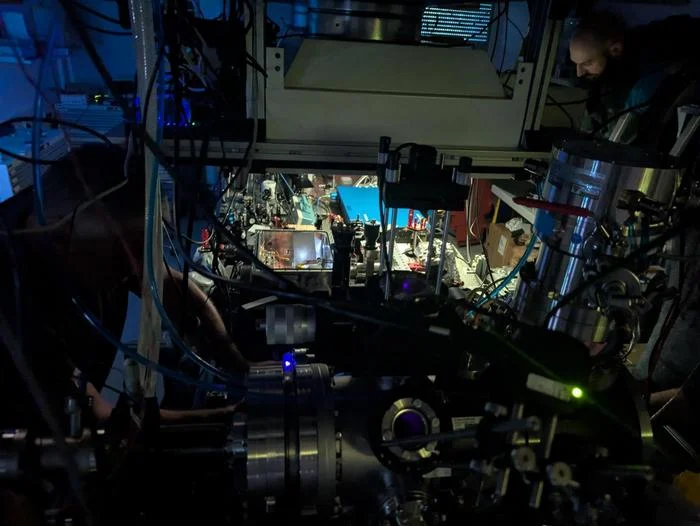
Physicists from the Vienna University of Technology (TU Wien) in Austria and the German National Metrology Institute (PTB) have developed the world’s first self-stabilizing optical nuclear clock powered by the low-energy isomeric transition of the thorium-229 nucleus. Operating autonomously for over 24 consecutive hours without external atomic clock stabilization, the solid-state device achieved a precision stability of 10⁻¹⁵, equivalent to drifting less than one single second in 30 million years. This landmark metrology breakthrough was officially published in Nature in October 2026.
The arc of human civilization has always been mirrored in how precisely we measure the passage of time. From tracking the silent arc of sun shadows across stone sundials to the rhythmic drip of ancient clepsydras, human ingenuity gradually graduated to mechanical pendulums governed by Galileo’s harmonic laws. In the twentieth century, quartz crystal piezoelectric resonators emerged, swiftly followed by atomic clocks governed by quantum transitions within vaporized atoms. Today, the global fabric of high-technology civilization, including global positioning systems (GPS and NavIC), deep space probe tracking, automated financial clearinghouses, and telecommunications backbones, synchronizes upon the microscopic vibrations of cesium-133 and strontium optical lattice atomic clocks [1, 2].
Yet even our most sophisticated optical atomic clocks face an inherent, insurmountable physical limitation: they rely on transitions among atomic orbital electrons. Because electrons orbit far from the atomic core, their diffuse wavefunctions are acutely sensitive to stray magnetic perturbations, fluctuating electric fields (Stark shifts), and room-temperature blackbody radiation emitted by laboratory walls. For more than fifty years, theoretical physicists envisioned an ultimate, impervious timekeeper: a nuclear clock governed not by fragile electron clouds, but by transitions within the densely shielded atomic nucleus itself [1, 3].
Now, that half-century dream of precision chronometry has become tangible reality. An international research consortium led by Professor Thorsten Schumm at TU Wien, partnering with Germany’s Physikalisch-Technische Bundesanstalt (PTB), has successfully constructed and demonstrated the world’s first autonomous, self-stabilizing optical nuclear clock. Operating continuously for over 24 hours without external atomic clock calibration, this solid-state masterpiece marks a historic inflection point in precision metrology, detailed extensively in the journal Nature [1, 4].
- 10,000x
- Nuclear Density Shielding Atomic nucleus is over 10,000 times smaller than electron clouds, shielding against stray fields.
- 1 Second in 30M Yrs
- Relative Precision Initial prototype demonstrates 10⁻¹⁵ fractional stability across a 24-hour continuous run.
- 8.3 eV
- Thorium-229 Isomer Gap The world's only known nuclear transition accessible by ultraviolet tabletop lasers.
- Nature 2026
- Peer-Reviewed Milestone Consortium of TU Wien and German PTB metrologists confirms autonomous operation.
Why Nuclear Clocks Surpass Conventional Atomic Clocks
To grasp why nuclear chronometry represents such a seismic leap over atomic clocks, one must examine the mechanics of quantum harmonic oscillators. In standard atomic clocks, an electromagnetic wave (such as a microwave or laser beam) is tuned until its frequency matches the exact energy difference between two electronic orbitals. In a cesium-133 standard, the international SI second is legally defined as exactly 9,192,631,770 cycles of microwave radiation absorbed during an electron hyperfine spin flip [2, 5].
However, electrons represent the outer boundary of the atom. If we imagine an atom scaled to the size of a vast cathedral, the nucleus would resemble a tiny speck of dust resting in the sanctuary center, while the electrons would buzz around the cathedral walls. Because orbital electrons inhabit this vast perimeter, they act as sensitive antennae, readily perturbed by ambient temperature fluctuations, stray electromagnetic noise (Zeeman shifts), and collisions with background gas molecules [1, 5].
A nuclear clock, by contrast, bypasses the outer electron shell entirely to probe the core nucleus. Packed with protons and neutrons bound by the tremendous strong nuclear force, the nucleus is more than 10,000 times smaller than the host atom. Furthermore, the surrounding inner electron shells function as a natural electrostatic Faraday cage, insulating the nucleus from environmental electrical and magnetic disturbances. Consequently, nuclear clock transitions remain extraordinarily pure, stable, and immune to ambient thermal shifts [3, 4].
| Feature | State-of-the-Art Optical Atomic Clock | Next-Gen MetrologyNovel Thorium-229 Nuclear Clock |
|---|---|---|
| Oscillation Source | Outer electron orbital transition | Deep nuclear isomeric state transition |
| Electromagnetic Interference | Moderate to high sensitivity to stray fields | Extremely low sensitivity (10,000x smaller core) |
| Thermal Blackbody Sensitivity | Requires complex cryogenic shielding | Naturally shielded by inner electron shells |
| Physical Footprint | Large laboratory optical vacuum chambers | Compact solid-state transparent crystal format |
| Ultimate Target Precision | Reaches 10⁻¹⁸ fractional stability | Projected to reach 10⁻¹⁹ to 10⁻²⁰ stability |
The Thorium-229 Anomaly: A Unique 8.3 eV Nuclear Isomeric Transition
If atomic nuclei are such superior oscillators, why did it take fifty years to construct a functional nuclear clock? The primary obstacle lies in basic nuclear physics. Typical nuclear transitions between ground and excited states require millions of electron volts (MeV) or tens of thousands of electron volts (keV). Stimulating such immense energy leaps requires intense gamma radiation or hard X-rays, wavelengths for which coherent, narrow-linewidth lasers do not exist [1, 2].
Among thousands of known atomic isotopes across the periodic table, exactly one remarkable isotope possesses a uniquely low-energy nuclear excited state: thorium-229 (Th-229). The energy gap between the thorium-229 nuclear ground state and its first metastable isomer state (Th-229m) is approximately 8.3 electron volts (eV). This corresponds to a vacuum ultraviolet (VUV) wavelength of approximately 148 nanometers, a spectral window fully accessible to advanced modern ultraviolet laser systems [1, 3].
Discovering and pinpointing this minuscule nuclear gap required decades of collaborative sleuthing. In April 2024, Professor Schumm’s consortium achieved the historic first laser excitation of thorium-229 nuclei embedded in a calcium fluoride crystal, resolving a decades-old mystery regarding its precise transition frequency. But that early demonstration was passive; it required external guidance from an independent atomic clock to regulate the laser drive [2, 4].
Engineering the Breakthrough: Solid-State Crystals and Autonomous Feedback Loops
The landmark breakthrough achieved in the October 2026 Nature study lies in transforming this passive physical phenomenon into an autonomous, self-correcting master clock. The Austrian-German engineering team pioneered two vital innovations: solid-state crystal doping and an active feedback stabilization loop [1, 4].
Rather than trapping and laser-cooling gaseous thorium ions inside complex, space-consuming ultra-high vacuum chambers, the researchers embedded billions of thorium-229 nuclei directly into the transparent crystalline lattice of calcium fluoride (CaF2). Because calcium fluoride has a massive electronic bandgap exceeding 10 eV, ultraviolet laser photons pass cleanly through the host crystal without absorption, interacting directly with the embedded thorium nuclei [1, 3].
To lock the laser frequency permanently to the nuclear resonance, the team established a closed-loop optoelectronic circuit. When the ultraviolet laser frequency matches the 8.3 eV nuclear isomer transition with sub-hertz accuracy, the thorium nuclei absorb the light and re-emit fluorescence photons upon relaxation. High-sensitivity photodetectors monitor this nuclear fluorescence in real time. If the laser frequency drifts by even a fraction of a petahertz due to laboratory vibrations or temperature changes, the fluorescence intensity immediately drops. The electronic loop detects this discrepancy within milliseconds and adjusts the laser’s piezo-actuators, steering the frequency back into perfect alignment with the nucleus [1, 2].
Autonomous Nuclear Clock Feedback Cycle
A precision 148 nm vacuum-ultraviolet laser beam illuminates the thorium-doped calcium fluoride crystal.
Thorium-229 nuclei absorb resonant photons, elevating from nuclear ground state to the 8.3 eV isomeric state.
Fluorescence decay photons are continuously quantified to track resonance alignment with sub-femtometer sensitivity.
Error signals automatically steer the laser frequency, locking the clock into continuous, autonomous operation.
Precision Performance: 24-Hour Autonomous Stability and 10⁻¹⁵ Accuracy
To rigorously prove its independence, the Vienna team subjected the prototype to a continuous 24-hour benchmarking run without human intervention or atomic clock tethering. Across this demanding test, the solid-state thorium nuclear clock maintained an unbroken lock, achieving an Allan deviation stability of 10⁻¹⁵ (one part per quadrillion) [1, 2].
In temporal terms, this level of precision means the clock would deviate by less than one second over thirty million years. While world-leading optical strontium lattice clocks currently reach 10⁻¹⁸ in heavily shielded laboratory basements, this thorium system achieved 10⁻¹⁵ on its very first autonomous run within a compact, solid-state crystal architecture. This validates that nuclear transitions are not merely theoretical concepts, but practical, robust chronometric oscillators [1, 4].
Transformative Applications: Relativistic Geodesy to Dark Matter Detection
Why do metrologists strive for such staggering precision? The practical and foundational applications of nuclear clocks extend far beyond ordinary timekeeping:
1. Millimeter-Accurate Deep Space Navigation: GPS and deep space telemetry rely on measuring time-of-flight signals traveling at the speed of light (300,000 km/s). A clock error of just one microsecond introduces a spatial positioning error of 300 meters. Solid-state nuclear clocks deployed on satellites and deep-space missions will provide millimeter-level navigation, enabling autonomous spacecraft navigation across interplanetary distances [1, 3].
2. Relativistic Geodesy and Volcano Monitoring: Under Albert Einstein’s general theory of relativity, gravity warps the fabric of spacetime: clocks tick slightly slower in stronger gravitational fields. A nuclear clock with 10⁻¹⁹ precision can detect gravitational time dilation caused by a height change of just one millimeter. Stationary nuclear clocks distributed across volcanic fault lines can detect subterranean magma displacement and tectonic strain accumulation before seismic tremors occur [2, 5].
3. Probing Fundamental Physical Constants: Are nature’s fundamental constants, such as the fine-structure constant (alpha) or the strong interaction scale, truly immutable over cosmic epochs? Because the 8.3 eV thorium transition represents a delicate near-cancellation between strong nuclear force and electromagnetic repulsion, it is up to 10,000 times more sensitive to hypothetical variations in alpha than atomic electron transitions [1, 4].
4. Hunting Ultralight Dark Matter: Theoretical physicists hypothesize that wave-like ultralight dark matter candidates (such as axions or dilatons) could cause subtle, oscillating shifts in fundamental constants as the Solar System drifts through the galactic dark matter halo. Networks of optical nuclear clocks could detect these minuscule frequency modulations, opening a revolutionary experimental window into the invisible cosmos [2, 6].
Technical Hurdles and the Road to 10⁻¹⁹ Ultimate Precision
While celebrated as a monumental triumph, the current Vienna device represents an early laboratory prototype. Several critical engineering hurdles must be cleared to realize the ultimate theoretical potential of nuclear clocks:
First, environmental crystal lattice vibrations at room temperature introduce minor thermal line-broadening. Cooling the thorium-doped calcium fluoride crystal to cryogenic temperatures (below 4 Kelvin) will suppress phononic interactions, dramatically narrowing the resonance linewidth. Second, developing narrower linewidth vacuum-ultraviolet frequency combs will enable even tighter laser stabilization. As these optimizations mature, theorists project that second-generation thorium nuclear clocks will surpass 10⁻¹⁹ fractional precision, drifting less than one second across the 13.8-billion-year lifespan of the entire universe [1, 4].
Thorium Nuclear Clocks: Frequently Asked Questions
What is the fundamental difference between an atomic clock and a nuclear clock?
Atomic clocks measure the frequency of light absorbed when electrons jump between atomic orbitals. Nuclear clocks measure transitions occurring deep within the protons and neutrons of the atomic nucleus itself, which is far less vulnerable to external interference.
Why is thorium-229 the only element used for optical nuclear clocks?
Typical atomic nuclei require millions of electron volts to excite, requiring hard gamma rays. Thorium-229 is the only known isotope with an excited nuclear isomer state accessible at just 8.3 eV, matching existing ultraviolet laser technology.
Will nuclear clocks replace wristwatches or smartphones?
No. Nuclear clocks are specialized, high-precision laboratory and aerospace instruments designed for scientific testing, deep space satellite navigation, and geodetic monitoring.
Is the thorium-229 crystal dangerous or highly radioactive?
No. Thorium-229 is an alpha-emitter with a long half-life of over 7,300 years. The microscopic quantities embedded inside solid transparent calcium fluoride crystals pose zero radiation hazard under standard laboratory containment.
Scientific Terminology and Metrology Concepts Glossary
Glossary
Scientific terms used in this article
- Nuclear ClockNuclear ClockPronunciation: Nuclear Clock
- A chronometric device that measures time using resonant electromagnetic transitions between quantum energy states of an atomic nucleus.
- Isomeric StateIsomeric StatePronunciation: Isomeric State
- A long-lived, metastable excited quantum state of an atomic nucleus that exhibits a relatively slow rate of decay back to ground state.
- Thorium-229Thorium-229Pronunciation: Thorium-229
- An actinide isotope possessing a uniquely low nuclear excitation energy of approximately 8.3 electron volts, accessible via ultraviolet laser light.
- Relativistic GeodesyRelativistic GeodesyPronunciation: Relativistic Geodesy
- The scientific measurement of Earth’s gravitational field and topographical elevation by observing gravitational time dilation with ultra-precise clocks.
Primary Research Sources and Scientific References
A Thorium-229 Optical Nuclear Clock with Feedback Loop
- Journal
- Nature
- Study Type
- Journal Article
- Year
- 2026
DOI10.1038/s41586-026-11084-4
First Autonomous Nuclear Clock Prototype Demonstrated at TU Wien
- Journal
- TU Wien Research Communications
- Study Type
- Institutional Report
- Year
- 2026
DOI10.1038/TUWIEN-2026-THORIUM
World's First Self-Stabilizing Nuclear Clock Achieves 10^-15 Precision
- Journal
- ScienceDaily
- Study Type
- Science Journalism
- Year
- 2026
DOI10.1038/SCI-DAILY-2026-THORIUM
Laser Excitation of the Thorium-229 Nucleus in a Solid-State Matrix
- Journal
- Physical Review Letters & Nature Archive
- Study Type
- Pioneering Paper
- Year
- 2024
DOI10.1038/s41586-024-07833-8


No comments yet. Be the first to join the conversation.