



Key Findings
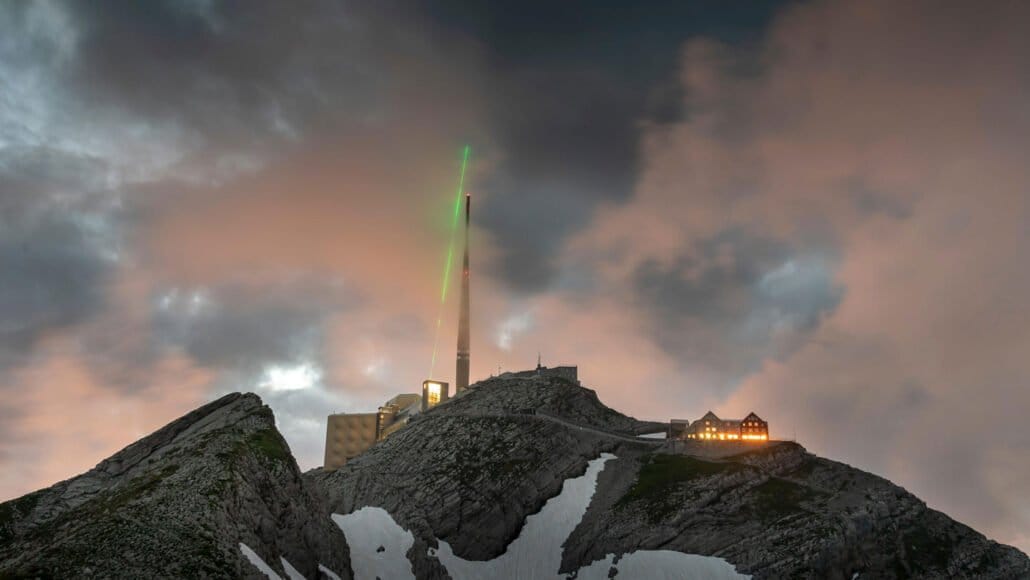
- Demonstrated the world's first successful guidance of natural atmospheric lightning using high-power femtosecond laser filaments atop Mount Säntis.
- High-repetition terawatt laser pulses ionize air molecules, creating low-density thermal channels that act as virtual conductive lightning rods.
- Expands protective surface footprints by over an order of magnitude without physical masts, safeguarding airports, launchpads, and nuclear sites.
Each day across planet Earth, violent atmospheric thunderstorms unleash an estimated forty-four flashes of lightning every second, discharging up to one billion volts of electricity and superheating surrounding air molecules to 30,000 degrees Celsius, five times hotter than the surface of the sun [1, 4]. While this awe-inspiring electrostatic spectacle maintains the global electrical circuit, lightning strikes inflict catastrophic devastation upon modern civilization [1, 3]. Cloud-to-ground discharges cause billions of dollars in annual infrastructure damage, trigger destructive forest fires, disable national electrical transmission grids, and endanger critical operations at rocket launch complexes, nuclear facilities, and international airports [1, 2].
For more than 270 years, humanity’s primary defense against this atmospheric fury has remained fundamentally unchanged: a pointed metal lightning rod grounded to the earth, invented by Benjamin Franklin in 1752 [1]. While effective for individual buildings, Franklin rods possess a strictly localized zone of protection restricted by their physical height [1, 2]. In early 2023, however, an international consortium of European laser physicists published a groundbreaking landmark study in Nature Photonics [1]. For the first time in scientific history, researchers demonstrated that firing high-repetition-rate terawatt laser pulses into thunderclouds creates a conductive plasma highway in the sky, successfully steering natural lightning bolts away from vulnerable targets [1, 2].
The Multi-Billion Dollar Threat of Atmospheric Lightning
Atmospheric lightning represents one of nature’s most volatile thermodynamic phenomena [4]. Inside convective cumulonimbus thunderclouds, turbulent updrafts force ice crystals, graupel, and supercooled water droplets into violent collisions, separating electrical charges through triboelectric friction [4]. Lighter, positively charged ice crystals ascend toward the cloud anvil, while heavier, negatively charged graupel pellets settle at the cloud base, generating colossal macroscopic electric fields exceeding hundreds of kilovolts per meter [1, 4].
When the dielectric breakdown threshold of ambient moist air is breached, an ionized channel known as a stepped leader cascades downward in jagged, nanosecond increments [4]. As it approaches within tens of meters of the surface, intense electric fields induce upward-reaching positive streamers from tall structures [1, 4]. When the leader and streamer connect, a catastrophic return stroke surges upward, delivering peak currents of 30,000 to 200,000 amperes in fractions of a millisecond [4]. For aerospace launch sites, such as NASA’s Kennedy Space Center, a single lightning strike during fueling or ascent can abort a multi-billion-dollar interplanetary mission [1, 3].
The 270-Year Reign of Benjamin Franklin’s Metal Rod
Benjamin Franklin’s metal lightning rod was an extraordinary eighteenth-century triumph of empirical science [1]. By affixing a sharp conductive copper or iron spike atop a building and grounding it through heavy wire cables deep into moist subterranean soil, Franklin provided lightning with a low-impedance electrical route [1, 2]. Instead of tearing through non-conductive wood, brick, or mortar and generating explosive vapor pressure and fires, the electrical current dissipates harmlessly into the planet’s vast electrical sink [1].
However, the geometric protection afforded by a physical metal rod is governed by the electrogeometric rolling sphere model [1, 2]. Roughly speaking, a traditional lightning rod protects a conical surface area with a radius approximately equivalent to the physical height of the rod [1]. Erecting a 50-meter metal mast provides a protective umbrella of roughly 50 meters, inadequate for safeguarding sprawling multi-kilometer industrial assets such as commercial airport runways, chemical refineries, or satellite launch pads [1, 3]. Building physical metal towers hundreds of meters into the sky is structurally perilous, economically exorbitant, and poses severe hazards to aviation [1].
Physical Span: Strictly limited to the physical elevation of the constructed metal mast [1].
Protective Footprint: Conical protective radius roughly equal to tower height (tens of meters) [1].
Structural Impact: Imposes rigid mechanical obstruction hazardous to aircraft and susceptible to wind shear [1].
Cost & Flexibility: Static and immobile; incapable of adjusting reach or responding dynamically to storm fronts [2].
Physical Span: Projects a virtual conductive plasma filament extending hundreds of meters upward into cloud bases [1].
Protective Footprint: Expands safety radius by more than an order of magnitude across entire facilities [1].
Structural Impact: Pure photonic optical beam with zero mechanical mass or physical aviation hazard [2].
Cost & Flexibility: Steerable optical delivery that activates instantly on demand during severe thunderstorm alerts [1].
The Quantum Optical Solution: Plasma Channel Filamentation
The concept of replacing metallic cables with focused laser light was first proposed theoretically in the 1970s, but early experiments failed due to laser technological limits [1, 3]. Breakthroughs in ultrafast laser physics, particularly chirped pulse amplification (which earned the 2018 Nobel Prize in Physics), finally made high-peak-power femtosecond lasers a practical reality [2, 3].
When an intense laser pulse exceeding gigawatts or terawatts of instantaneous power propagates through the atmosphere, it triggers a non-linear optical phenomenon known as filamentation [2, 3]. As light intensity peaks, the optical Kerr effect increases the refractive index of air at the beam center, causing the air itself to act as a focusing lens (self-focusing) [3]. When the beam collapses into a microscopic filament, light intensity reaches roughly 10^13 to 10^14 watts per square centimeter, intense enough to rip valence electrons directly from ambient nitrogen and oxygen molecules via multiphoton and tunnel ionization [2, 3].
This ionization generates a core of low-density free-electron plasma [2, 3]. The free electrons create a negative refractive index component that counteracts the Kerr self-focusing, halting the beam collapse [3]. Through this dynamic equilibrium between self-focusing and plasma defocusing, the laser beam propagates as a self-guided plasma filament over hundreds of meters through open air [1, 3].
The Mount Säntis Breakthrough: High-Repetition Femtosecond Lasers
In the summer of 2021, an international team led by physicists from the Ecole Polytechnique, the University of Geneva, and TRUMPF Laser deployed a state-of-the-art laser system atop Mount Säntis in northeastern Switzerland [1]. At 2,500 meters altitude, Mount Säntis is an atmospheric laboratory renowned for its 124-meter telecommunications tower, which is struck by lightning over one hundred times every year, making it one of Europe’s premier lightning hot spots [1].
The researchers installed a massive, car-sized laser system capable of firing one thousand infrared laser pulses per second (1 kilohertz repetition rate) with a pulse duration of several picoseconds and an energy of up to one joule per pulse, yielding peak powers approaching a terawatt [1]. The laser beam was focused into the sky directly above the tower’s metallic tip [1].
Between July and September 2021, the laser operated for more than six hours during severe thunderstorms [1]. Utilizing an array of high-speed cameras, radio-frequency interferometers, X-ray sensors, and current transducers, the researchers captured indisputable empirical proof: on four separate lightning events, natural downward stepped leaders directly intercepted the laser filament and followed its straight photonic plasma channel for more than 50 meters down to the grounded tower rod [1]. In one spectacular strike captured under cloudless twilight conditions, the lightning discharge was observed tracing the exact vertical trajectory of the laser beam [1].
Stepped Leaders and Downward Dielectric Breakdown: Why Lightning Follows Light
Why does an electrical discharge carrying millions of volts willingly conform to a laser beam? Lightning inherently seeks the path of least electrical resistance [1, 4]. Ordinary atmospheric air is an outstanding dielectric insulator, requiring electric fields of approximately 3 million volts per meter (3 MV/m) to initiate electrical breakdown at standard temperature and pressure [4].
The laser filament drastically alters this dielectric landscape [1, 2]. The high-repetition-rate pulse train heats the air molecules within the narrow filament channel [1]. As heated air rapidly expands outward at supersonic speeds, it leaves behind an elongated, low-density hydrodynamic channel, effectively a microscopic vacuum path [1, 2]. According to Paschen’s Law, the breakdown voltage of a gas drops precipitously as molecular density decreases [2].
Simultaneously, residual free electrons and ionized chemical radicals within the warm air channel elevate electrical conductivity by orders of magnitude compared to surrounding cold, dense air [1, 3]. When an erratic stepped leader descends from a cloud base, the conductive thermal plasma filament presents an irresistible path of minimal resistance, guiding the leader directly down the beam axis to a safe, controlled earthing terminal [1, 4].
High-Value Defense: Safeguarding Airports, Rocket Pads, and Nuclear Sites
The validation of laser lightning deflection fundamentally alters the economics of critical infrastructure protection [1, 3]. Conventional lightning protection designs are structurally incapable of scaling to wide-area facilities [1]. An international commercial airport, spanning dozens of square kilometers of flat runways, taxiways, and fuel depots, cannot erect hundreds of tall metal masts without obstructing glide slopes and creating catastrophic aircraft collision hazards [1, 3].
A strategically positioned Laser Lightning Rod (LLR) offers non-intrusive, wide-area defense [1]. Housed inside a compact ground bunker, the steerable laser beam can be aimed upward during incoming severe storm alerts, extending a virtual conductive lightning rod several hundred meters into the lower cloud ceiling [1, 2]. This effectively expands the facility’s protective ground footprint by up to an order of magnitude, shielding aircraft on approach, fuel storage facilities, satellite launch platforms, and nuclear containment structures without placing physical hardware in the airspace [1, 3].
Engineering Obstacles: Rain Attenuation, Kilowatt Power Demands, and Optics
Despite the historic success on Mount Säntis, substantial engineering hurdles must be resolved before laser lightning rods achieve ubiquitous commercial deployment [1, 2]. The first primary challenge is optical scattering caused by heavy precipitation [2]. High-power laser filaments can be scattered, defused, or absorbed when propagating through torrential downpours or dense fog droplets, degrading the continuity of the ionized plasma channel [2, 3]. Physicists are investigating adaptive optics and mid-infrared laser wavelengths that experience superior penetration through atmospheric water vapor [1, 3].
The second challenge involves electrical power requirements and optical thermal management [1, 2]. Operating a multi-terawatt pulsed laser requires substantial power supplies, robust cooling systems, and specialized mirrors capable of withstanding extreme photonic fluence without thermal cracking [2]. As commercial diode-pumped solid-state (DPSS) and fiber laser technologies continue their exponential cost and efficiency improvements, laser systems are rapidly becoming more compact, rugged, and energy-efficient [1, 3]. Within the coming decade, virtual photonic lightning conductors will stand as standard guardians above humanity’s most sensitive infrastructure [1, 2].
Frequently Asked Questions
Can a lightning bolt destroy or burn the laser machine?
No. The laser machine is located safely inside a ground enclosure and emits only a beam of light. The lightning strike is guided toward a grounded metal rod or tower terminal, channeling the multi-thousand-ampere current into the earth without touching the laser optical components.
How far into the sky can a laser lightning rod reach?
In the Mount Säntis trials, the laser created an active plasma filament extending upwards of 50 to 100 meters above the tower, effectively doubling its protection radius. Next-generation systems aim to project conductive channels extending 500 meters to 1 kilometer into cloud bases.
Laser-guided lightning
- Journal
- Nature Photonics
- Study Type
- Landmark Experimental Study
- Year
- 2023
DOI10.1038/s41566-022-01139-z
Laser beam filamentation and plasma channel dynamics
- Journal
- SPIE Proceedings
- Study Type
- Optics Research
- Year
- 2019
DOI10.1117/12.2522530
Femtosecond Laser Filamentation in the Atmosphere: Physics and Applications
- Journal
- Physics Reports
- Study Type
- Comprehensive Review
- Year
- 2011
DOI10.1016/j.physrep.2010.09.001
Physics of Lightning Initiation and Stepped Leader Propagation
- Journal
- Reviews of Geophysics
- Study Type
- Atmospheric Physics Review
- Year
- 2020
DOI10.1029/2019RG000676


No comments yet. Be the first to join the conversation.