

Key Findings
- Black snake fireworks expand through thermal decomposition, turning small pellets into voluminous serpentine columns.
- The formulation relies on a precise 4 to 1 ratio of sucrose (table sugar) and sodium bicarbonate (baking soda).
- Heat caramelizes sugar into an elastic viscous fluid while decomposing baking soda releases steam and carbon dioxide.
- Trapped gas bubbles propel the carbonizing mass outward, solidifying it into an ultra-lightweight porous carbon foam.
- Modern sugar-based formulations completely replaced toxic 19th-century mercury thiocyanate Pharaoh's Serpent pellets.
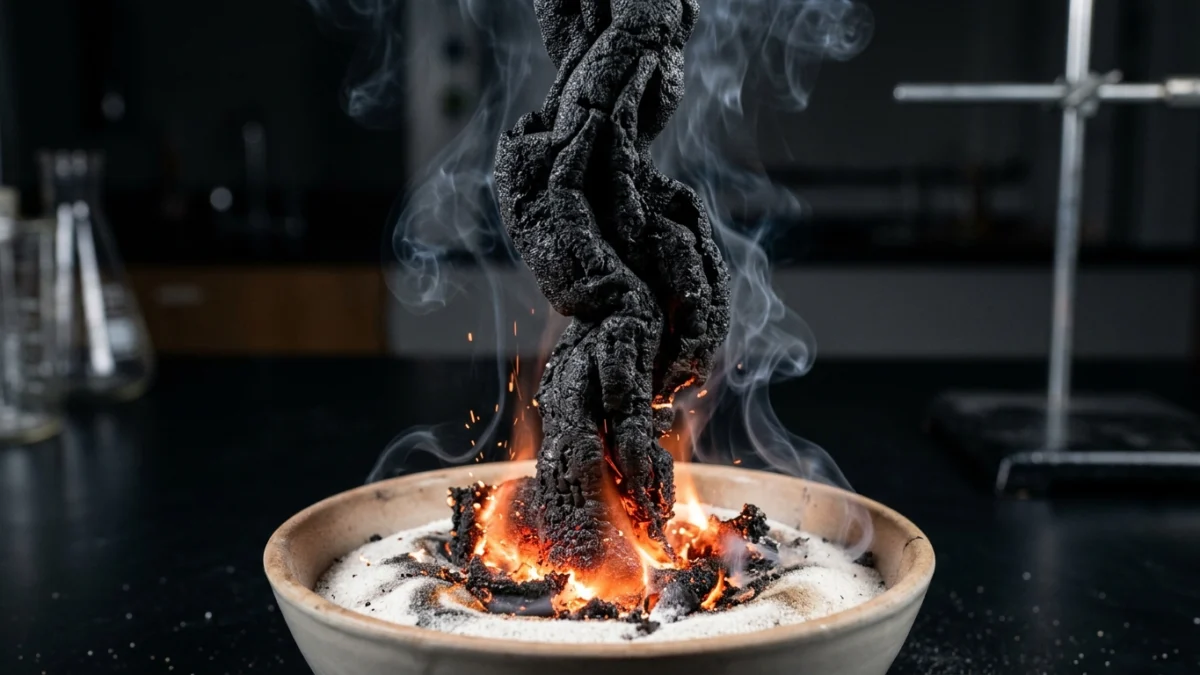
Every festive season, children and adults alike marvel at one of the most mesmerizing demonstrations in casual pyrotechnics: the black snake firework. Unlike explosive aerial rockets, whistling ground spinners, or dazzling sparklers, this quiet pellet produces no deafening acoustic blast, no blinding flashes of light, and no shower of high-velocity burning metallic sparks. Instead, a small, unassuming black disk resembling an ordinary medical tablet is placed on the ground and ignited. Within seconds, an astonishing physical transformation unfolds before the spectator. A massive, coiled, serpentine column of black ash appears to writhe and crawl upward from the pellet, expanding to dozens of times its original dimensions in an eerily biological fashion [1].
To the casual observer, the sudden eruption of a miniature black serpent from a hard coin-sized pellet seems closer to stage magic than physical science. Yet beneath this deceptive visual spectacle lies a masterclass in thermal decomposition, simultaneous combustion kinetics, intumescent foaming, and gas trapping physics. What occurs on the pavement is an elegant balance of organic carbonization and synchronized gaseous expansion that transforms everyday household pantry ingredients into an engineering marvel of porous carbon aerogels.
Chemical Ingredients in Modern Black Snake Fireworks
Historically, the earliest iterations of this pyrotechnic novelty relied on dangerous and heavy chemical formulations. However, modern commercial black snake pellets and classic classroom chemistry demonstrations utilize a remarkably safe, accessible formulation founded entirely upon green chemistry principles. The active mixture consists predominantly of two common substances found in domestic kitchens: sucrose, commonly known as table sugar (C12H22O11), and sodium bicarbonate, universally recognized as household baking soda (NaHCO3) [2].
In standard manufacturing, finely milled sucrose and sodium bicarbonate are blended together in an approximate 4 to 1 mass ratio, often bound with a minimal volume of combustible binder such as lighter fluid, ethanol, or linseed oil to facilitate pressing into firm, compact tablets. Sucrose acts as the primary carbon donor and fuel source, while sodium bicarbonate serves as the critical gas blowing agent. Without the sugar, there would be no solid structural backbone to build the serpent; without the baking soda, the sugar would merely burn into a flat puddle of sticky caramel and brittle charcoal [3].
The choice of particle size is also vital for uniform performance. When sucrose is ground into confectioners powder rather than coarse granulated crystals, the surface contact area between the carbohydrate fuel and the bicarbonate salt increases exponentially. This intimate contact ensures that heat conducted through the tablet triggers gas release at the exact microscopic boundary where sugar is undergoing caramelization, preventing uneven blistering or structural collapse during vertical growth.
Thermal Decomposition: The Synchronized Chemical Reactions
When an open flame is applied to the tablet, it initiates a cascading sequence of concurrent chemical reactions that proceed at slightly different temperature thresholds. Understanding how these reactions synchronize is essential to deciphering why the snake grows upward and outward rather than exploding or burning away into microscopic ash [1].
The first reaction is the partial combustion and thermal dehydration of sucrose. At temperatures surpassing 186 degrees Celsius, sucrose melts and begins rapid thermal decomposition. Under the limited oxygen conditions within the core of the compact tablet, incomplete combustion takes place according to the following reaction mechanism:
C12H22O11 (heat) → 12 C + 11 H2O
Simultaneously, a minor fraction of the sucrose reacts directly with atmospheric oxygen to sustain the ignition temperature through exothermic oxidation, releasing thermal energy, carbon dioxide, and additional superheated water vapor:
C12H22O11 + 12 O2 → 12 CO2 + 11 H2O + Thermal Energy
At the exact same time, the intense heat triggers the endothermic thermal breakdown of sodium bicarbonate. Baking soda begins decomposing rapidly around 80 degrees Celsius and reaches peak gas output above 150 degrees Celsius, decomposing into solid sodium carbonate, water vapor, and copious volumes of gaseous carbon dioxide [2]:
2 NaHCO3 (heat) → Na2CO3 + H2O(g) + CO2(g) ↑
The thermodynamic balance between these processes is remarkably delicate. The exothermic oxidation of a small fraction of the sugar supplies the heat required to drive both the endothermic dehydration of the remaining sucrose and the decomposition of the bicarbonate. If too much oxygen reaches the core, the sugar burns completely to gaseous CO2, leaving no char behind. If too little heat is generated, the bicarbonate fails to liberate sufficient gas, stalling the snake’s outward journey.
The Intumescent Mechanism: How Porous Carbon Foam Grows
The secret behind the snake’s dramatic vertical growth is a phenomenon known in material science as intumescence. Intumescent materials swell significantly upon exposure to heat, producing a light, cellular protective char. In industrial applications, this exact principle is engineered into fire-retardant structural coatings that insulate steel girders in skyscrapers against collapsing during building fires [3].
In the black snake tablet, intumescence occurs because the rate of gas release from baking soda matches the exact phase window during which sugar transitions into a molten, highly viscous fluid. As the sucrose melts into a thick caramel sludge, the rapidly decomposing baking soda generates vigorous streams of carbon dioxide gas and steam. These expanding gases cannot escape freely; instead, they become trapped inside the thick, syrupy sugar matrix, inflating thousands of microscopic bubbles.
As the sustained heat strips away hydrogen and oxygen atoms from the sugar molecules, the liquid caramel undergoes rapid pyrolysis, solidifying almost instantaneously into a rigid network of elemental carbon. Because this solidification occurs while the gas bubbles are trapped under expansion, the final structure is not a dense lump of coal, but rather an ultra-lightweight, extremely porous carbon foam. Continuous generation of hot gases from the unburned core pushes this porous foam upward through the tablet’s burning surface, extruding a long, curling cylinder with a diameter dictated by the pellet itself [4].
Rheological studies indicate that the viscosity of the molten carbohydrate phase is the defining parameter of the entire process. If the fluid is too watery, gas bubbles coalesce and burst through the surface without lifting the mass. If the fluid is excessively rigid, gas pressure builds internally until the pellet fractures into small pieces. The unique viscoelastic properties of molten sucrose allow it to stretch into thin cellular membranes that hold their shape just long enough for carbonization to lock the porous matrix permanently into place.
Historical Evolution: Pharaoh’s Serpent vs Modern Formulations
Long before sugar and baking soda became the standard formulation for children’s fireworks, 19th-century pyrotechnicians captivated Victorian audiences with a vastly more spectacular, yet lethal, precursor known as Pharaoh’s Serpent (Pharaoh’s Snake). Discovered in 1821 by German chemist Friedrich Wohler, this early demonstration utilized mercury(II) thiocyanate [Hg(SCN)2] [1].
When ignited, mercury thiocyanate decomposes into a pale, yellowish-tan snake-like mass composed of carbon nitride and mercury sulfide. While the physical expansion was extraordinary, the thermal reaction liberated highly toxic mercury vapor, sulfur dioxide, and traces of deadly hydrogen cyanide gas. Following numerous severe poisoning incidents across European parlors and novelty shops, mercury thiocyanate was universally banned from commercial fireworks, paving the way for our modern, non-toxic sucrose-based alternatives.
Pharaoh’s Serpent (Historical Mercury Method)
Utilized toxic mercury(II) thiocyanate pellets. Yielded a massive pale yellow ash column but produced hazardous mercury vapors, cyanogen, and sulfur dioxide. Completely banned worldwide from public pyrotechnics due to acute toxicity.
Modern Black Snake (Green Sugar Chemistry)
Formulated from edible sucrose and baking soda in a 4 to 1 ratio. Produces harmless steam, carbon dioxide, and a sterile, highly porous black elemental carbon foam that is non-toxic and environmentally safe for celebratory display.
Physical Properties and Microstructure of the Extruded Snake
Scanning electron microscopy (SEM) investigations into the residual snake structure reveal that the ash is not a continuous solid but an elaborate aerogel-like network. The material exhibits an open-cell porous carbon morphology with wall thicknesses measuring mere micrometers. Despite expanding up to 50 times the original volume of the starting pellet, the total mass of the extruded snake is actually lower than the initial tablet, as substantial weight is lost to airborne water vapor and carbon dioxide gas [4].
This cellular architecture explains why the snake feels astonishingly light, fragile, and brittle to the touch. The density of the expanded carbon foam frequently measures under 0.05 grams per cubic centimeter, making it light enough to float effortlessly on water. Furthermore, because elemental carbon possesses strong adsorptive characteristics, the resulting foam shares structural similarities with activated charcoal, possessing a vast internal surface area relative to its minuscule mass [1].
Because the internal carbon framework is permeated with microscopic voids, it acts as an outstanding acoustic and thermal insulator. Even while the lower sections of the tablet remain in active combustion at temperatures exceeding several hundred degrees Celsius, the newly formed tip of the snake cools rapidly as ambient air circulates through its porous channels, demonstrating the remarkable heat dissipation capabilities of low-density carbon chars [3].
Safety Considerations and Environmental Best Practices
While modern sugar-based black snakes eliminate the severe heavy-metal toxicity of historical formulas, basic pyrotechnic safety protocols remain indispensable during celebrations and classroom demonstrations [2]:
Ventilation and Inhalation: Although the gas emitted consists primarily of water vapor and carbon dioxide, the partial combustion of sugar also produces fine airborne carbon particulate matter and volatile organic aromatics associated with caramelization. These pyrotechnics must always be ignited outdoors or within a certified laboratory fume hood to avoid respiratory irritation.
Substrate Protection: The combustion core generates significant thermal energy capable of scorching concrete, melting plastic, or setting grass ablaze. Always place the tablet atop a heat-resistant surface, such as an inverted ceramic tile, metal pie tray, or a bed of dry play sand.
Post-Combustion Handling: Even after active flames subside, the unburned interior core of the tablet can remain dangerously hot for several minutes. Allow the entire structure to cool completely before touching the ash. The resulting carbon leaves stubborn black soot stains on skin and clothing, which can be readily removed with regular soap and water.
Safe Cleanup and Disposal: Because modern black snake residue consists entirely of elemental carbon and sodium carbonate (washing soda), it poses zero ecological hazard. Unlike commercial fireworks that leave behind heavy metals such as barium, copper, or strontium, black snake ash can be safely swept up and discarded with standard household compost or municipal waste.
Frequently Asked Questions
Frequently Asked Questions
Why does the black snake firework make no sound when burning?
Conventional fireworks produce loud bangs because expanding gases are confined inside tightly sealed cardboard casings until catastrophic pressure ruptures the container. In a black snake, the gases escape continuously through open porous foam into the surrounding air, generating no sonic boom or pressure wave.
Can you replicate this experiment at home using kitchen supplies?
Yes, under adult supervision in an outdoor setting. Mixing 4 parts powdered confectioners sugar with 1 part baking soda, mounding it over a small hill of sand saturated with rubbing alcohol, and carefully igniting the base will produce an authentic black carbon serpent.
Is the remaining black snake ash toxic to the environment?
No. Modern black snake residue is composed of pure elemental carbon (charcoal) and non-toxic sodium carbonate. It poses no chemical contamination threat to garden soil, though it should be disposed of in regular waste bins to maintain cleanliness.
Why does the snake grow in a coiled shape rather than a straight pillar?
Thermal gradients and minor inconsistencies in fuel distribution cause different sides of the tablet to burn and release gas at slightly uneven rates. This localized differential expansion causes the extruded carbon foam to bend, curve, and twist into its signature snake-like coils.
Scientific References
Carbon Nanoparticles from Sugar and Baking Soda: A Green Chemistry Experiment
- Journal
- Journal of Chemical Education
- Study Type
- Journal Article
- Year
- 2020
DOI10.1021/acs.jchemed.9b00823
Thermal Decomposition Kinetics of Pyrotechnic Mixtures
- Journal
- Combustion and Flame
- Study Type
- Journal Article
- Year
- 2005
DOI10.1016/j.combustflame.2005.01.002
Intumescent Char Formation and Flame Retardant Porous Carbon Dynamics
- Journal
- Polymer Degradation and Stability
- Study Type
- Journal Article
- Year
- 2014
DOI10.1016/j.polymdegradstab.2014.04.015
Structural Evolution and Entrapped Gas Bubbles in Porous Carbon Foams
- Journal
- Journal of Materials Chemistry
- Study Type
- Journal Article
- Year
- 2012
DOI10.1039/c2jm32483h



No comments yet. Be the first to join the conversation.