


Key Findings
- Yanliaomyzon fossils from the Jurassic Yanliao Biota prove ancient lampreys were active flesh-eating predators, not blood-suckers.
- Yanliaomyzon occisor reached 64.2 cm in length, making it the largest fossil lamprey discovered in the global geological record.
- Gut contents preserved ingested fish bones and scales, providing direct empirical proof of non-jawed macroscopic predation.
- Flesh-eating carnivory represents the ancestral feeding state of modern predatory lampreys, with blood-sucking evolving later.
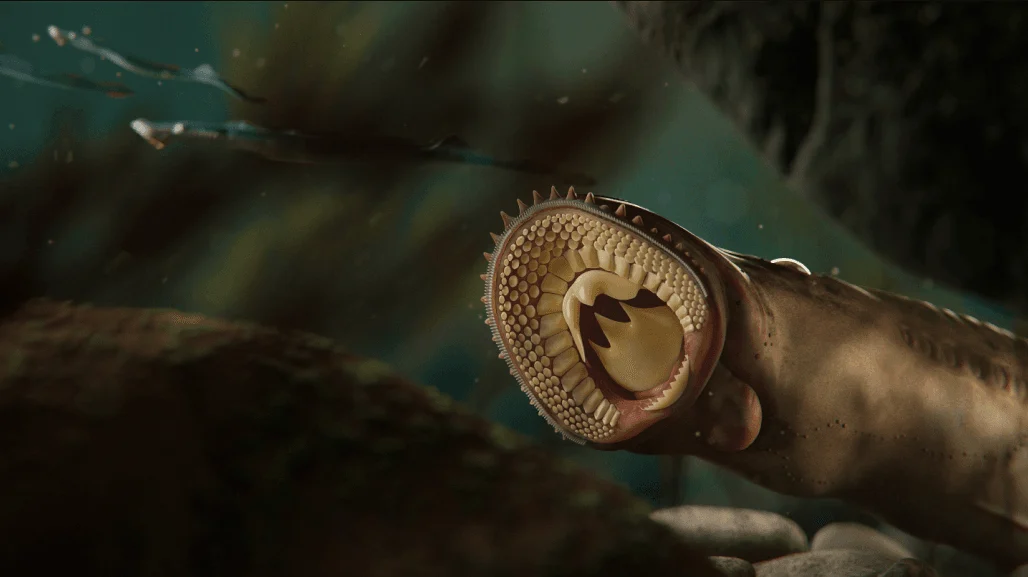
Roughly 160 million years ago, during the Middle to Late Jurassic period, freshwater lakes and rivers across what is now northeastern China were inhabited by a terrifying aquatic predator. Long before the extinction of the dinosaurs, these waterways were prowled by primitive, eel-like jawless creatures possessing suction oral discs armed with razor-sharp tooth cusps capable of tearing chunks of flesh directly from living fish. The extraordinary discovery of exceptionally preserved fossils belonging to the newly identified genus *Yanliaomyzon* has revolutionized our understanding of vertebrate evolution [1].
Published in *Nature Communications*, paleontological analyses of two pristine specimens, *Yanliaomyzon occisor* and *Yanliaomyzon ingensdentes*, excavated from the famous Yanliao Biota in Liaoning and Hebei provinces have rewritten the dietary history of cyclostomes (jawless vertebrates). For over a century, evolutionary biologists assumed that ancient lampreys were simple micro-filter feeders or specialized blood parasites like modern sea lampreys. The discovery of *Yanliaomyzon* proves that Jurassic lampreys were ferocious carnivorous predators that gouged flesh, providing a missing phylogenetic bridge in the evolutionary origin of modern vertebrates [1, 2].
- Age of Jurassic Yanliao Biota Fossil Beds
- Maximum Adult Length of Yanliaomyzon occisor
- Sharply Serrated Keratinized Teeth in Oral Disc
- Total Evolutionary Lifespan of the Lamprey Lineage
The Yanliao Biota Discovery: Unearthing Yanliaomyzon Fossils
The Yanliao Biota represents one of the world’s most scientifically significant fossil deposits (Lagerstatten), renowned for preserving delicate soft-tissue structures of feathered dinosaurs, pterosaurs, early mammals, and insects. Because modern and ancient lampreys lack true calcified bones and possess skeletons constructed entirely of pliable cartilage, their remains rarely survive fossilization. Prior to this discovery, fossil lampreys from the Paleozoic and Mesozoic eras were exceptionally sparse and offered negligible clarity regarding internal oral anatomy [1].
The Yanliao specimens overturned this historical scarcity through immaculate fossil preservation. Fine-grained volcanic ash and lakebed silt captured not merely the cylindrical silhouettes of the creatures, but the delicate keratinous tooth impressions, circular sucking discs, piston cartilage, branchial gill baskets, and fossilized gut contents in microscopic detail. The largest specimen, *Yanliaomyzon occisor*, measured an astonishing 64.2 centimetres in length, making it the largest fossil lamprey ever uncovered in the global paleontological record and demonstrating that ancient lampreys attained formidable physical dimensions [1, 3].
Predatory Oral Discs: Flesh-Gouging vs Blood-Sucking Feeding Ecology
To grasp why this discovery stunned evolutionary biologists, one must analyze the morphology of the feeding apparatus. Modern lampreys (*Petromyzontiformes*) are notorious ectoparasites. Species like the modern sea lamprey (*Petromyzon marinus*) use a circular sucking disc to attach to host fish, rasp through scales using small tongue teeth, and secrete anticoagulants to suck blood without rapidly killing the host [2].
In contrast, the dentition of *Yanliaomyzon* reveals a fundamentally different feeding ecology. Its oral disc was lined with formidable, multi-cusped keratinized teeth arranged in concentric radial rows, anchored to heavily reinforced piston cartilage. The tongue-like central piston featured robust, serrated cutting plates designed to shear through dense muscle tissue rather than merely draw fluids. Most conclusively, paleontologists discovered fossilized fish bones, scales, and skeletal fragments packed inside the intestinal tract of *Yanliaomyzon occisor*. This empirical evidence proves conclusively that Jurassic lampreys were true flesh-eating carnivores that actively dismembered their prey [1].
Evolutionary Origins: Rewriting the Early Vertebrate Timeline
The emergence of jawed vertebrates (gnathostomes), a lineage that encompasses sharks, bony fish, reptiles, birds, and mammals, was historically viewed as the pivotal evolutionary breakthrough that unlocked apex predation. Before jaws evolved, primitive vertebrates were thought to be sluggish mud-sifters or passive parasites incapable of macroscopic predation [3].
*Yanliaomyzon* shatters this simplistic evolutionary dichotomy. It demonstrates that jawless cyclostomes developed apex predatory feeding habits independently, utilizing muscular piston cartilage and keratinized biting plates to fill top carnivore niches in freshwater ecosystems long before modern jawed predatory fish diversified. Phylogenetic reconstruction indicates that flesh-eating carnivory represents the ancestral feeding state of modern predatory lampreys, with hematophagous blood-sucking evolving subsequently as a specialized miniaturized adaptation during the Cretaceous period [1, 4].
Ancient Jurassic Yanliaomyzon vs Modern Lampreys
Comparing the morphological and ecological traits of Jurassic *Yanliaomyzon* against contemporary living lampreys illustrates profound evolutionary adaptations:
| Anatomical / Ecological Feature | Jurassic Yanliaomyzon (Fossil) | Modern Sea Lamprey (Living) |
|---|---|---|
| Primary Feeding Mode | Macrophagous carnivore (bites & gouges fish flesh) | Hematophagous parasite (rasps flesh to suck blood) |
| Oral Dentition | Large serrated shear blades & reinforced keratin cusps | Fine concentric rasping teeth on tongue and oral hood |
| Body Length | Up to 64.2 cm (exceptionally large fossil cyclostome) | Typically 30-100 cm depending on marine/freshwater species |
| Gut Contents | Preserved fish skeletal bones and dermal scales | Liquid host blood and bodily fluids; zero bones |
| Ecological Role | Apex active predator in Jurassic lake ecosystems | Specialized parasite attached to pelagic marine fish |
The Evolution of Jaws and Non-Jaw Biting Mechanisms
In comparative vertebrate anatomy, the transition from jawless agnathans to jawed gnathostomes represents one of the most critical structural leaps in natural history. Jaws arose via the evolutionary modification of anterior branchial gill arches, which hinged to form biting mandibles. Before *Yanliaomyzon*, scientists assumed that without hinged jaws, jawless vertebrates were incapable of generating significant biting force [3].
Biomechanical modeling of *Yanliaomyzon*’s cranial anatomy reveals an extraordinary alternative engineering solution. Operating without hinged mandibles, the creature utilized a powerful longitudinal cartilaginous piston powered by massive retractor and protractor cranial muscles. When pressed against prey, the muscular disc created hydraulic vacuum suction while the central piston drove serrated keratin plates forward and backward in a powerful gouging motion. This biomechanical piston generated sufficient shear force to strip muscle fibres from armored prehistoric teleost fish, proving that nature invented effective macroscopic biting mechanisms long before jaws achieved ecological dominance [1, 3].
From an evolutionary developmental biology (evo-devo) perspective, the divergence between jawless cyclostomes and jawed gnathostomes is rooted in homeobox gene regulation. While modern vertebrates express a cluster of six Dlx genes governing mandibular patterning, lampreys maintain a more ancestral Dlx genomic cluster. Comparative embryology indicates that the neural crest cells migrating into the first pharyngeal arch in lampreys lack the specific dorsal-ventral signaling cues that form hinged jaw joints in sharks and bony fishes. Instead, these embryonic crest cells differentiate into robust circumoral cartilage plates and lingual piston supports, demonstrating how nature fashioned versatile predatory tools through alternative regulatory wiring [1, 3].
Metamorphosis and Life Cycle Evolution Across 160 Million Years
Modern lampreys undergo a dramatic biphasic lifecycle. They hatch as blind, toothless worm-like larvae known as ammocoetes, burrowing into muddy riverbeds to filter-feed on detritus and micro-algae for up to seven years. They then undergo radical physiological metamorphosis, developing large complex eyes, specialized kidneys, and tooth-studded suction mouths before migrating to oceans or lakes as predatory adults [2].
The Yanliao discoveries, combined with earlier fossil ammocoete specimens from Cretaceous beds, shed invaluable light on the antiquity of this metamorphic strategy. Phylogenetic analyses show that the three-stage lifecycle, sedentary filter-feeding larva, predatory free-swimming adult, and anadromous spawning migration, was already fully operational during the Jurassic era. This remarkable developmental plasticity enabled lampreys to survive four mass extinction events, including the catastrophic Cretaceous-Paleogene asteroid impact that wiped out non-avian dinosaurs [1, 2].
In immunology, lampreys have yielded one of the most stunning discoveries in evolutionary medicine: an alternative adaptive immune system. While all jawed vertebrates rely on antibodies and T-cell receptors constructed from immunoglobulin domains generated via RAG-mediated V(D)J recombination, lampreys lack RAG enzymes entirely. Instead, they produce Variable Lymphocyte Receptors (VLRs) composed of diverse leucine-rich repeat (LRR) cassettes assembled through somatic DNA rearrangement. This non-canonical adaptive immune machinery generates an astronomical diversity of antigen-binding molecules, which biomedical researchers now engineer into specialized monoclonals for targeted cancer diagnostics and therapeutic drug delivery [4].
In modern aquatic conservation, understanding lamprey biology has become paramount due to their devastating ecological impact as an invasive apex parasite. Following the opening of shipping canals into the North American Laurentian Great Lakes during the mid-twentieth century, introduced sea lampreys decimated indigenous lake trout and whitefish populations within decades. To combat this ecological catastrophe, fisheries biologists developed selective bi-functional lampricides, specifically 3-trifluoromethyl-4-nitrophenol (TFM), which targets the unique metabolic detoxification deficiencies of larval lampreys without harming sympatric teleost fishes [1, 2].
Why Lampreys Matter in Modern Comparative Genomics and Neuroscience
Beyond paleontology, lampreys occupy a uniquely exalted status in contemporary biomedical research. Because cyclostomes represent the sister group to all living jawed vertebrates, their genomes and nervous systems provide a living snapshot of early vertebrate ancestry. Neuroscientists study lamprey spinal cords because these primitive creatures possess an extraordinary capacity to completely regenerate functional severed spinal cords, restoring swimming locomotion within weeks [4].
Furthermore, comparative genomic sequencing reveals that lampreys share core developmental gene regulatory networks with humans, including *Hox* gene clusters and neural crest migration pathways. By studying how Jurassic predators like *Yanliaomyzon* lived and evolved, scientists decode the foundational anatomical innovations that paved the way for vertebrate sensory evolution, cognitive specialization, and the eventual rise of terrestrial animal life [1, 4].
Frequently Asked Questions
The Jurassic fossil lamprey Yanliaomyzon and the evolutionary origin of feeding ecology in cyclostomes
- Journal
- Nature Communications
- Study Type
- journal
- Year
- 2023
DOI10.1038/s41467-023-42251-0



No comments yet. Be the first to join the conversation.