


Key Findings
- Sivagalai excavations along the Thamirabarani river establish terrestrial bloomery iron artifacts dated to 3345 BCE via Beta Analytic AMS radiocarbon dating.
- Mayiladumparai stratified sequences confirm continuous local iron smelting across cultural layers dated from 2172 BCE to 1615 BCE.
- SEM-EDX metallurgical slag analysis reveals a self-fluxing direct bloomery reduction process operating at 1,200°C using indigenous magnetite ore.
- 3345 to 2953 BCE
- Reported Sivagalai dates AMS on charcoal linked to iron objects
- 2172 BCE
- Reported Mayiladumparai date Charcoal from the iron-bearing layer
- 24 trenches
- Excavated at Sivagalai About 160 urns exposed, 2019 to 2022
- 1,538°C
- Melting point of pure iron Ancient bloomeries stayed below it
Iron changed what people could build and grow, much as the tools described in our guide to the scientific inventions that changed history. Bronze depended on copper and on tin that often travelled long distances, and it was too costly for everyday farm tools. Iron ore is common, so once people learned to turn it into metal, axes, ploughshares, chisels and weapons became affordable. The question of when and where that skill first appeared has therefore mattered to historians for a long time. For the wider story of how living things became complex, see our explainer on the Asgard archaea and the origin of complex life; here the subject is a human technology, and the evidence is archaeological.
The older textbook view placed the start of the Iron Age in the Near East around 1200 BCE and treated India as a later recipient [7]. Work in northern and southern India over recent decades has weakened that picture [2], and the 2025 report pushes the debate much further back. Whether the new dates will stand depends on how well they are tied to the iron itself, which is the point we examine below.
What the 2025 Report Claims (The Claim)
According to the report, the Tamil Nadu State Department of Archaeology excavated Sivagalai, in the Thamirabarani river valley of Thoothukudi district, between 2019 and 2022. The work covered eight locations, five habitation mounds and three burial sites. In all, 24 trenches were opened and about 160 urns were exposed, most of them red ware [1].
The report describes iron chisels, an axe and swords from the graves. Charcoal samples from three urn burials that held iron objects were sent to Beta Analytic in Florida for AMS radiocarbon dating. The charcoal from Urn 10 in trench B3 gave 3345 BCE, Urn 1 in trench A2 gave 3259 BCE, and trench C3/1 gave 2953 BCE. On that basis the authors place the introduction of iron in Tamil Nadu in the first quarter of the fourth millennium BCE [1].
The report also checked Sivagalai with luminescence dating, which estimates when buried pottery or soil was last heated or exposed to light. Three laboratories dated material from the same grave, Urn 1 in trench A2, and returned about 2459, 2427 and 2590 BCE, all in the middle of the third millennium BCE. The authors read this as consistent. It is also about 800 years younger than the 3259 BCE charcoal from that very urn, a gap we return to below. For Urn 3 in trench A2, which was intact and lidded and held a skeleton, iron objects and paddy grains, the paddy gave 1155 BCE by AMS and the pottery gave 1284 BCE by luminescence [1].
Other sites contribute dates as well. Charcoal found with an iron object in the habitation mound at Adichanallur gave 2517 BCE, a habitation layer at Mayiladumparai gave 2172 BCE, and a burial at Kilnamandi gave 1692 BCE. A sword from Thelunganur gave two different ranges, 2900 to 2627 BCE for carbon taken from the hilt and 1435 to 1233 BCE for carbon from the blade. The authors say they accept the younger range only reluctantly and with reservation [1]. Overall the report lists 20 dated samples from iron-bearing contexts, 13 by AMS and 7 by luminescence, from five laboratories, and takes 2500 to 3000 BCE as a mid-range value. Chart 1 shows the oldest end of each reported range.
| Chart 1: Oldest Reported Date at Each Tamil Nadu Site (BCE) | AMS Radiocarbon Dating |
|---|---|
| Sivagalai charcoal, Urn 10 | 3,345BCE |
| Sivagalai charcoal, Urn 1 | 3,259BCE |
| Sivagalai charcoal, C3/1 | 2,953BCE |
| Thelunganur sword hilt | 2,900BCE |
| Adichanallur charcoal | 2,517BCE |
| Mayiladumparai habitation | 2,172BCE |
| Kilnamandi burial | 1,692BCE |
| Sivagalai paddy, Urn 3 | 1,155BCE |
| Sivagalai pottery sediment | 2,459BCE |
Guide: Blue bars denote accelerator mass spectrometry (AMS) radiocarbon determinations on charcoal and organic seeds; violet bars denote luminescence (OSL) dates on sediment. Higher bar = older calibrated date. Source: Department of Archaeology, Government of Tamil Nadu (2025).
Table 1 summarizes the primary radiometric and luminescence measurements across the excavated Tamil Nadu sites, documenting sample materials, analytical laboratories, and calibrated age determinations.
| Excavation Site & Context | Sample Material | Dating Method | Reported Calibrated Date (BCE) |
|---|---|---|---|
| Sivagalai, B3 Urn 10 | Charcoal | AMS (Beta-582914) | 3345 |
| Sivagalai, A2 Urn 1 | Charcoal | AMS (Beta-582913) | 3259 |
| Sivagalai, C3/1 | Charcoal | AMS (Beta-582912) | 2953 |
| Sivagalai, A2 Urn 1 | Pottery sediment | OSL (Vadodara) | 2427 to 2590 |
| Sivagalai, A2 Urn 3 | Paddy grains | AMS (Beta-641528) | 1155 |
| Adichanallur | Habitation charcoal | AMS | 2517 |
| Mayiladumparai | Habitation layer with slag | AMS | 2172 |
| Kilnamandi | Burial charcoal | AMS | 1692 |
| Thelunganur | Sword hilt organic residue | AMS | 2900 to 2627 |
| Thelunganur | Sword blade layer | AMS | 1435 to 1233 |
Source: Department of Archaeology, Government of Tamil Nadu (2025). All AMS determinations conducted by Beta Analytic, Miami.

How the Dates Were Obtained (Method)
Radiocarbon dating measures how much carbon-14 is left in material that was once alive, such as charcoal, seeds or husks. Iron itself is not normally dated this way, because the metal contains almost no carbon from that period. Archaeologists therefore date organic material found in the same layer and argue that the iron is the same age. AMS is the modern version of the method, and it can measure very small samples with high precision. The raw result is then calibrated against tree-ring and other records to give a calendar date in BCE.
This is why the layer matters as much as the lab. A date describes the charcoal. It describes the iron only if the two were laid down together and nothing moved them later. Roots, burrowing animals, pits dug into older layers and later burials can all mix material of different ages. Archaeologists test this by checking stratigraphy, that is, whether deeper layers are older, and by looking for agreement between independent methods. The OSL result mentioned above is one such cross-check, because it dates when the soil last saw sunlight rather than the age of carbon [1].
What Critics Ask (The Debate)
Reading the report closely raises several questions. The main ones are these.
The samples are not the iron. The dated material at Sivagalai was charcoal, paddy grains and pottery, not iron objects. The link to iron rests on the claim that each sample came from the same sealed context as iron objects. Iron objects themselves were dated directly only at Thelunganur and Mangadu, and the report notes that the Mangadu sword came from a disturbed cist burial and the better-preserved Thelunganur sword from a disturbed pit. The two ranges for the Thelunganur sword, 2900 to 2627 BCE and 1435 to 1233 BCE, are more than a thousand years apart, and the report’s authors themselves accept the younger one only with reservation [1].
Methods disagree inside one grave. Urn 1 in trench A2 gave 3259 BCE on charcoal but about 2450 BCE on pottery by luminescence, in three laboratories. Urn 3 in the same trench gave 1155 BCE on paddy and 1284 BCE on pottery. These results can all be real if charcoal in a grave is older than the burial, for example when old wood is burned or old soil is mixed in. In that case the charcoal dates the wood or the soil, not the burial and its iron. Careful readers therefore ask whether the middle of the third millennium BCE, rather than the fourth, is the safer date for the burials [1].
The report is not a journal paper. Peer review lets other specialists check the data, the calibration and the context before a claim is widely accepted. The report is a government publication, and the full datasets and sample descriptions have not yet been through that process. Journal publication and independent re-dating are the usual next steps. The report’s authors themselves say future excavations in iron-ore zones and metallurgical analysis of the objects may further consolidate or strengthen their findings [1].
None of this shows that the dates are wrong. It shows that the strongest claim, that iron was in use in Tamil Nadu by around 3300 BCE, needs a tighter link between sample and object than the current public record gives. Until then the careful reading is that Tamil Nadu has produced early dates for iron-bearing contexts, that the middle of the third millennium BCE is well supported by several methods, and that the oldest figures, from the fourth millennium BCE, are still to be confirmed.
How This Compares With Other Regions (Global Context)
Anatolia and the Near East. Scattered iron objects are known from Anatolia in the third millennium BCE, but they are rare, and some of the earliest were made from meteoritic iron. Iron became a regular working metal across the region only around the end of the second millennium BCE [7].
Northern India. Rakesh Tewari’s work on sites in the Central Ganga Plain and the Eastern Vindhyas reported iron artefacts, furnaces, tuyeres and slag in Uttar Pradesh in layers radiocarbon dated between 1800 and 1000 BCE. He asked whether ironworking was brought to India by migrations in the second millennium BCE or developed there independently [2]. That work already challenged the idea of a single Near Eastern origin.
Africa. Whether ironworking in Africa arose independently, and how early, is also debated. Reviews of the African evidence describe metallurgy spreading through eastern and southern Africa in the first millennium BCE and later, which is far younger than the Tamil Nadu dates [8].
Taken together, the safe summary is that iron technology probably arose or spread in more than one place, and that the dates for the earliest cases remain disputed in every region, not only in India. A claim of “first in the world” depends on settling these disputes, and the evidence does not yet do that.
How Early Iron Was Made (Bloomery Process)

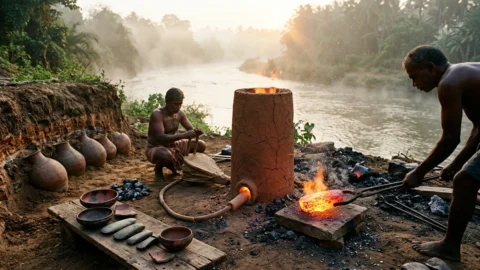
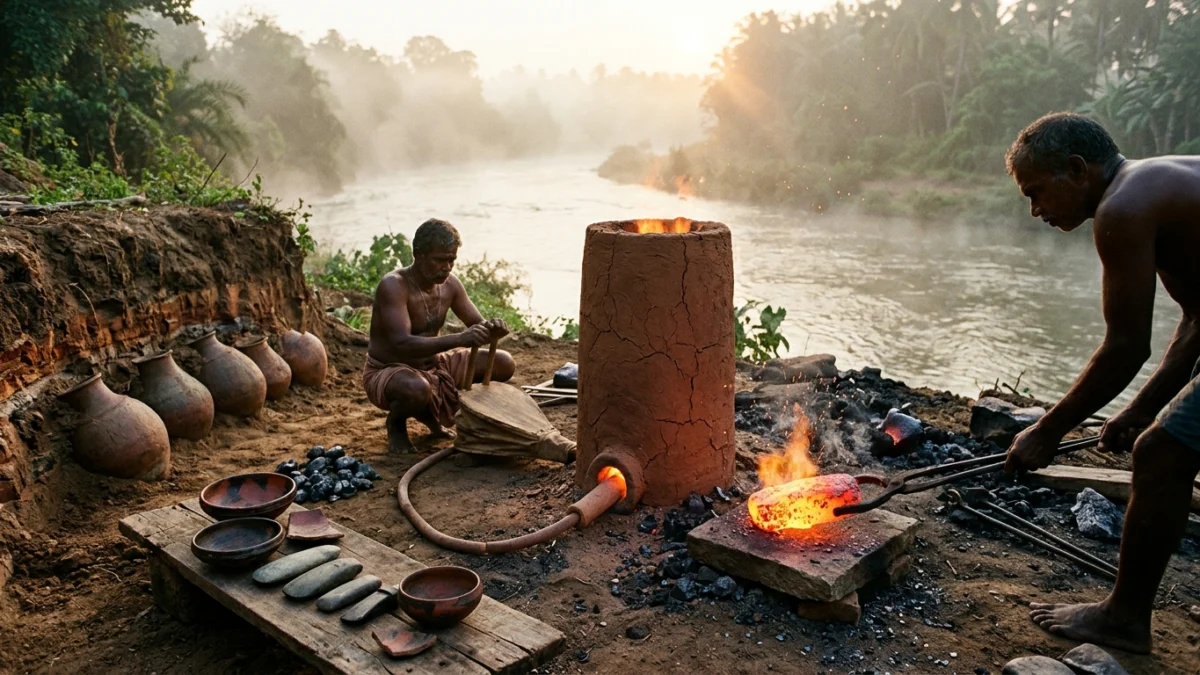
Ancient iron was not melted. Pure iron melts at 1,538°C, which early furnaces could not reach. Smiths instead used the bloomery process: iron ore and charcoal were burned in a clay furnace with air blown in through pipes called tuyeres. Carbon monoxide from the burning charcoal took oxygen away from the ore, leaving a spongy lump of iron called a bloom. Silica and other impurities formed a liquid slag that ran out of the furnace, and the smith then hammered the hot bloom to squeeze out the remaining slag. The main reaction can be written as follows.
Steps in a Bloomery Smelt
- Step 1
Prepare the ore
Iron ore is crushed and often roasted so that it reduces more easily. - Step 2
Load the furnace
Layers of charcoal and ore go into a clay shaft with a slag tap and air pipes. - Step 3
Blow air and reduce
Bellows drive air through the charcoal and carbon monoxide strips oxygen from the ore. - Step 4
Tap the slag
Molten impurities drain away while the iron stays solid and gathers as a bloom. - Step 5
Hammer the bloom
The hot bloom is forged repeatedly to remove trapped slag and shape the metal.
Why southern India could move to iron without a long copper age is a fair question. The report’s authors suggest that, because commercially usable copper ore was limited south of the Vindhyas, the region may have entered the Iron Age while northern cultures were still in the Copper Age [1]. Other work shows that copper and iron both occur in South Indian megalithic burials, so the picture is mixed rather than a simple jump from stone to iron [5]. The report also points to iron-ore-bearing zones as the places to excavate next [1].
From Iron to Wootz Steel (Crucible Steel)

Southern India is also known for wootz, a high-carbon crucible steel. In this process, small pieces of iron were sealed in clay crucibles with carbon-rich plant material and heated until the metal absorbed carbon and became a hard, tough steel. Sharada Srinivasan’s research on crucible remains at Mel-siruvalur and other South Indian sites shows that such production took place in the region [3], [4]. Her analysis of the Mel-siruvalur material describes ultrahigh-carbon steel made by carburizing molten iron [6].
Wootz ingots were traded widely, and the steel later became linked with the watered-pattern blades often called Damascus swords. The origin of the word “wootz” is debated, and some scholars connect it with the Tamil urukku and related southern words for melting or fusing, while others point to different roots. Dating wootz is a separate question from dating the first iron. The state report itself cites ultrahigh-carbon steel from Thelunganur and Mangadu from about the 13th century BCE, far later than the Sivagalai claim [1].
What the Evidence Cannot Tell Us (Limitations)
Several things remain out of reach with the present data. Radiocarbon and luminescence dates give a time for the sample, and not for the moment someone first smelted iron. A burial with iron objects shows that iron was in use by then, but it does not say whether the metal was smelted nearby, made earlier, or traded in. The report does not publish the full metallographic study of most of the iron objects, so we cannot yet say how they were made. The dates also come from a small number of trenches in one river valley and a few other sites, so they cannot show how widely iron was used in Tamil Nadu at that time. Finally, a single country’s early dates do not by themselves settle a world ranking, because other regions have disputed early claims of their own.
What Would Settle the Question (Next Steps)
Several steps would move the debate forward. First, the full sample records should be published in a peer-reviewed journal, with context drawings, photographs and calibration details. Second, independent laboratories should re-date retained samples, ideally charcoal or seeds taken from directly touching an iron object. Third, more sites in the same river valley and in other regions should be excavated using the same standards, so that the early dates are not resting on a few trenches. Finally, metallographic analysis of the iron objects themselves can show how they were made, which helps to judge whether they are the product of local smelting or something else.
These checks are routine in archaeology, and they apply equally to claims of early iron in Africa, the Near East and northern India. We follow new findings of this kind in our weekly science and technology roundup.
Frequently Asked Questions (FAQ)
What did the 2025 Tamil Nadu report find at Sivagalai?
The state archaeology department reported AMS radiocarbon dates of 3345, 3259 and 2953 BCE on charcoal from three urn burials with iron objects at Sivagalai. The report is a government publication and has not yet been through peer review.
Does this prove the Iron Age began in Tamil Nadu?
Not yet. The dates are early and important, but the dated samples were charcoal, paddy and pottery rather than iron, and luminescence dates from the same grave as the 3259 BCE charcoal came out about 800 years younger. Independent re-dating and journal publication are needed.
How is iron dated if radiocarbon needs carbon?
Archaeologists date organic material such as charcoal or seeds found in the same layer as the iron. The date applies to the iron only if both were deposited together and not disturbed later.
What is wootz steel?
Wootz is a high-carbon crucible steel made by heating iron with carbon-rich material in sealed clay crucibles. Crucible remains at Mel-siruvalur and other South Indian sites show it was made in the region.
Glossary
Scientific terms used in this article
- AMS Radiocarbon Dating
- A method that counts carbon-14 atoms in a tiny sample of charcoal, seed or bone to estimate its age.
- Bloomery
- A clay furnace that turns iron ore into a solid, spongy lump of iron without melting the metal.
- Slag
- The glassy waste that forms from impurities in the ore during smelting and drains out of the furnace.
- Optically Stimulated Luminescence (OSL)
- A method that estimates when buried soil or pottery grains were last exposed to sunlight.
- Wootz Steel
- A high-carbon steel made in sealed clay crucibles, known for the banded pattern on finished blades.
Antiquity of Iron: Recent Radiometric Dates from Tamil Nadu
- Journal
- Tamil Nadu State Department of Archaeology
- Study Type
- Report
- Year
- 2025
The origins of iron working in India: new evidence from the Central Ganga Plain and the Eastern Vindhyas
- Journal
- Antiquity
- Study Type
- Review
- Year
- 2003
Wootz Crucible Steel: A Newly Discovered Production Site in South India
- Journal
- Papers from the Institute of Archaeology
- Study Type
- Review
- Year
- 1994
Early Metal in South India: Copper and Iron in Megalithic Contexts
- Journal
- Archaeometallurgy in Global Perspective
- Study Type
- Review
- Year
- 2014
Ultrahigh-carbon wootz from crucible carburization of molten iron: Hypereutectoid steel from the Tamil Nadu Process at Mel-siruvalur
- Journal
- Materials and Manufacturing Processes
- Study Type
- Review
- Year
- 2016
Early iron metallurgy in Anatolia
- Journal
- Anatolian Studies
- Study Type
- Review
- Year
- 1999
Cairo to Cape: The Spread of Metallurgy Through Eastern and Southern Africa
- Journal
- Journal of World Prehistory
- Study Type
- Review
- Year
- 2009
References
- ↩ Rajan, K., & Sivanantham, R. (2025). Antiquity of Iron: Recent Radiometric Dates from Tamil Nadu. Tamil Nadu State Department of Archaeology.
- ↩ Tewari, R. (2003). The origins of iron working in India: new evidence from the Central Ganga Plain and the Eastern Vindhyas. Antiquity, 77(297), 536-544.
- ↩ Srinivasan, S. (1994). Wootz Crucible Steel: A Newly Discovered Production Site in South India. Papers from the Institute of Archaeology.
- ↩ Ranganathan, S., & Srinivasan, S. (2006). A tale of Wootz steel. Resonance, 11, 67-77.
- ↩ Gullapalli, P. (2014). Early Metal in South India: Copper and Iron in Megalithic Contexts. In Archaeometallurgy in Global Perspective, 729-753.
- ↩ Srinivasan, S. (2016). Ultrahigh-carbon wootz from crucible carburization of molten iron: Hypereutectoid steel from the Tamil Nadu Process at Mel-siruvalur. Materials and Manufacturing Processes, 909-915.
- ↩ Yalcin, U. (1999). Early iron metallurgy in Anatolia. Anatolian Studies, 49, 177-187.
- ↩ Killick, D. (2009). Cairo to Cape: The Spread of Metallurgy Through Eastern and Southern Africa. Journal of World Prehistory, 22, 399-414.

No comments yet. Be the first to join the conversation.