



Key Findings
- Pristine samples from asteroid Bennu contain magnesium-sodium phosphates, solving the prebiotic 'phosphate bottleneck' for DNA and ATP.
- Hydrated clay minerals prove that liquid hydrothermal fluids circulated abundantly through Bennu's parent body 4.5 billion years ago.
- These findings substantiate the delivery hypothesis: ancient carbonaceous asteroids seeded early Earth with water, amino acids, and genetic backbones.
Every living organism on our planet, from microscopic oceanic phytoplankton to towering redwood trees and blue whales, is built around an identical chemical blueprint. Our genetic code is written in long molecular chains of deoxyribonucleic acid (DNA), fueled by adenosine triphosphate (ATP), and encased within lipid membranes. Yet, when astrophysicists look back 4.5 billion years to the formation of the young Earth, they see a molten sphere of bubbling magma, intensely radiated by ultraviolet flares and stripped of volatile water and delicate organic molecules. Where, then, did the raw biochemical ingredients for terrestrial life originate [1] [2]? Did life’s primordial building blocks emerge spontaneously from volcanic vents, or were the seeds of biology delivered from the outer cosmos aboard primitive asteroids? In September 2023, NASA’s OSIRIS-REx spacecraft delivered an extraordinary treasure from deep space that is revolutionizing astrobiology: pristine 4.5-billion-year-old dust collected directly from the carbonaceous asteroid Bennu [1] [3].
The Cosmic Seeds of Life and Chemical Evolution
For more than a century, evolutionary biologists debated the “primordial soup” hypothesis proposed by Alexander Oparin and J.B.S. Haldane, later tested by the famous 1952 Miller-Urey experiment. While spark-discharge experiments proved that simple electrical discharges could synthesize amino acids from methane, ammonia, and water vapor, geochemical modeling of Earth’s early atmosphere revealed a major roadblock: prebiotic Earth was likely dominated by carbon dioxide and nitrogen, conditions far less conducive to generating complex organics [1] [3].
This led planetary scientists to look upward into interplanetary space. Asteroids and comets represent frozen cosmic time capsules preserved since the earliest infancy of our solar system [1]. If carbon-rich asteroids harbored water, amino acids, and essential biochemical backbones, then massive cosmic impacts during early planetary accretion could have seeded the young, cooling Earth with ready-made prebiotic precursors [2] [5].
However, testing this hypothesis using meteorites discovered on Earth has always been fraught with uncertainty. When space rocks plunge through our atmosphere, friction superheats their outer crusts, and once they land in soil or ice, terrestrial bacteria and rainwater immediately contaminate their porous interiors. To understand the true cosmic inventory, scientists needed an uncontaminated sample scooped directly from an asteroid in space [1] [3].
The 7-Year OSIRIS-REx Journey to Bennu
To capture that pristine extraterrestrial archive, NASA launched the OSIRIS-REx (Origins, Spectral Interpretation, Resource Identification, Security-Regolith Explorer) mission in September 2016 [1]. Its target was (101955) Bennu, a diamond-shaped, carbonaceous near-Earth asteroid measuring approximately 500 meters across, categorized as a “rubble pile” held together by gentle mutual gravitation [1] [4].
After a two-year journey covering over two billion kilometers, the spacecraft arrived at Bennu in late 2018. Detailed spectroscopy revealed a surface peppered with boulders, ancient hydrothermal veins, and surprisingly low mechanical resistance, the surface reacted like a fluid ball of plastic beads rather than solid rock [1] [4].
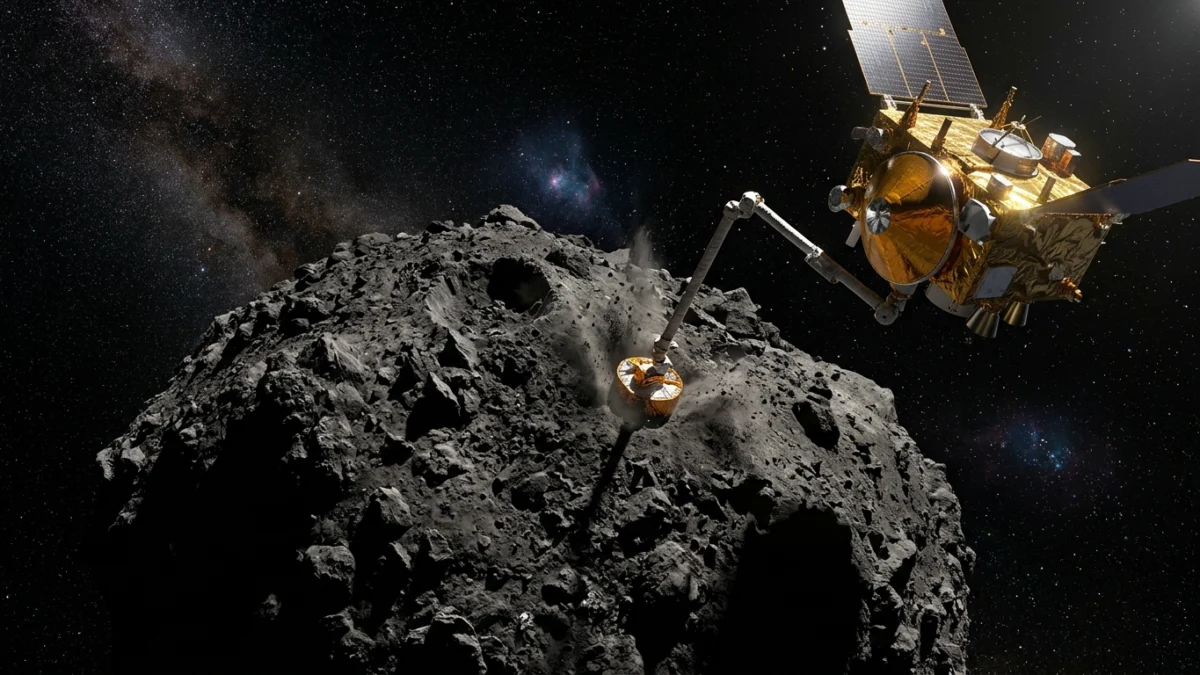
In October 2020, OSIRIS-REx executed its daring Touch-And-Go (TAG) maneuver. Extending its robotic sampling arm, the probe fired a high-pressure blast of nitrogen gas into the asteroid’s surface regolith, fluidizing dust and pebbles into its collection chamber before firing back-away thrusters [1]. On September 24, 2023, the spacecraft released its sample return capsule over the Utah desert. Parachuting safely through Earth’s atmosphere, the capsule delivered 121.6 grams of pure, unadulterated cosmic material, more than double the mission’s minimum target [1].
Phosphates: The Molecular Backbone of DNA
When international research consortia opened the nitrogen-purged curation chambers at NASA’s Johnson Space Center in Houston, spectroscopic and isotopic analyses yielded a stunning revelation: the Bennu samples contained substantial concentrations of pure magnesium-sodium phosphate minerals [1] [2].
To biologists, this is a profound finding. While amino acids (the building blocks of proteins) and purine/pyrimidine bases (the letters of genetic code) have been observed in meteorites before, phosphorus has always been the critical limiting bottleneck in prebiotic chemistry [2]. Known as the “phosphate problem,” inorganic phosphorus on early Earth was thought to be locked away in insoluble calcium apatite minerals, chemically inaccessible to nascent proto-cells.
Phosphate is indispensable for life as we know it:
1. The DNA/RNA Backbone: Alternating phosphate and deoxyribose sugar groups form the structural spiral handrails that stabilize the double helix, protecting genetic information [2].
2. Cellular Energy Currency: Every metabolic reaction in biology relies on adenosine triphosphate (ATP). The high-energy phosphoanhydride bonds between phosphate groups store and transfer the energy that powers muscular contraction, enzyme synthesis, and nerve impulses [2].
3. Cell Membranes: Phospholipid bilayers create impermeable boundaries that protect cellular contents from hostile external environments [2].
The discovery of water-soluble sodium-magnesium phosphates on Bennu proves that accessible phosphorus was widespread in the outer protoplanetary disk, capable of raining down on early planets in bioavailable form [1] [2].
Prebiotic Chemical Inventory Discovered in Bennu Samples
| Compound Class | Identified Molecules | Planetary Mechanism | Biological Significance |
|---|---|---|---|
| Inorganic Phosphates | Magnesium-sodium phosphates (water-soluble salts) | Aqueous alteration within parent planetesimal | Forms DNA/RNA structural backbone and ATP energy currency |
| Hydrated Clays | Serpentine, smectite, and phyllosilicate minerals | Percolating liquid water at 50–150°C | Direct evidence of abundant liquid water in the early solar system |
| Organic Carbon | Polycyclic aromatic hydrocarbons, aliphatic chains (~4.7 wt% C) | Photochemical gas-grain Fischer-Tropsch catalysis | Carbon reservoir necessary to construct organic molecules |
| Amino Acids | Glycine, alanine, beta-alanine, amine derivatives | Strecker-type synthesis in hydrothermal brine solutions | Primary monomeric subunits for peptide and protein synthesis |
| Nitrogen Heterocycles | Purines, pyrimidines, and ammonia derivatives | Hydrogen cyanide polymerisation in ice mantles | Nucleobases (A, T, G, C, U) carrying genetic information |
Ancient Water in Clay Minerals (4.5 Billion Year History)
Bennu today is an airless, bone-dry rock orbiting through the freezing vacuum of space. Yet, when laboratory mineralogists examined its fine dust grains under transmission electron microscopes, they found that over ten percent of the sample by mass consists of hydrated phyllosilicates, clay minerals such as serpentine and saponite [1] [4].
Phyllosilicates can only form through one specific geological mechanism: prolonged interaction between anhydrous silicate rock and warm liquid water. Oxygen and hydrogen isotopic ratios confirm that 4.5 billion years ago, Bennu’s parent body was permeated by circulating hydrothermal fluids at temperatures between 50 and 150 degrees Celsius [1] [4]. Liquid water once flowed copiously through subterranean fractures inside this ancient cosmic parent asteroid, dissolving minerals and driving organic synthesis millions of years before Earth had cooled [2] [4].
Birthplace Near the Jupiter Snowline
Where did this water-rich celestial body originate? Geochemists analyzed rare stable isotopes of chromium (Cr-54) and titanium (Ti-50) inside the Bennu regolith [5]. These isotopic ratios act as distinct forensic fingerprints, revealing where an object formed relative to the young Sun.
The isotopic signature matches carbonaceous chondrites from the outer solar system, indicating that Bennu’s parent planetesimal accreted beyond the “snowline”, the volatile freezing boundary located beyond the orbit of proto-Jupiter [5]. In this frigid nursery, water ice, frozen methane, and ammonia condensed into growing rocky planetesimals. As radioactive decay from short-lived aluminum-26 heated the core, ice melted into liquid oceans, creating warm hydrothermal chambers [2] [5]. Gravitational interactions with giant gas planets eventually deflected fragments of this broken parent body inward toward the inner solar system, placing Bennu in its current near-Earth orbit [1] [5].
The Delivery Hypothesis: Seeding Early Earth
The Bennu discoveries provide compelling physical evidence supporting the Late Heavy Bombardment delivery hypothesis [1] [3]. Between 4.1 and 3.8 billion years ago, planetary migrations destabilized outer asteroid belts, sending millions of carbonaceous asteroids crashing into the young inner planets, including Earth and the Moon [2].
These catastrophic collisions delivered two indispensable gifts:
First, isotopic deuterium-to-hydrogen (D/H) ratios in Bennu’s clays closely match the isotopic profile of modern terrestrial ocean water, supporting the model that a substantial portion of Earth’s hydrosphere was delivered by carbonaceous asteroids [1] [4].
Second, this cosmic bombardment deposited millions of metric tons of bioavailable organic carbon, nitrogen compounds, amino acids, and water-soluble phosphates directly into early tidal pools and coastal lagoons [2] [3]. In these mineral-rich littoral zones, evaporating clay matrices acted as catalytic templates, concentrating extraterrestrial monomers into the first self-replicating ribonucleic acid (RNA) polymers [1] [2].
Curating Pristine Extraterrestrial Samples
To ensure that these invaluable samples remain uncontaminated for future generations, NASA constructed an ultra-clean ISO Class 5 cleanroom at the Astromaterials Research and Exploration Science (ARES) division in Houston [1]. Technicians work exclusively through sealed, high-purity nitrogen gloveboxes using instruments crafted only from high-purity aluminum, stainless steel, and Teflon.
More than seventy percent of the pristine Bennu sample has been sealed and placed into long-term cryogenic storage [1]. Just as Apollo lunar rocks returned in 1969 are being analyzed today using advanced instruments unimagined fifty years ago, portions of Bennu will be preserved for 21st and 22nd-century scientists equipped with future analytical technologies [1].
The Next Frontier: OSIRIS-APEX and Apophis
Having dropped off its sample return capsule over Earth, the OSIRIS-REx mothership was far from finished. With its thrusters and scientific sensors functioning flawlessly, NASA extended the spacecraft’s journey under a new operational title: OSIRIS-APEX (Apophis Explorer) [1].
The spacecraft is currently cruising toward asteroid 99942 Apophis, a notorious 340-meter rocky asteroid scheduled to make an astonishingly close flyby of Earth on April 13, 2029 [1]. Apophis will pass within 32,000 kilometers of Earth’s surface, closer than geostationary telecommunications satellites. OSIRIS-APEX will enter orbit around Apophis shortly after the flyby, observing firsthand how Earth’s gravitational tidal forces induce landslides and alter the asteroid’s spin, unlocking the final secrets of planetary defense and asteroid evolution [1].
Frequently Asked Questions
Primary Sources and References
Asteroid (101955) Bennu in the laboratory: Properties of the returned sample from OSIRIS-REx
- Journal
- Meteoritics & Planetary Science
- Study Type
- Lab
- Year
- 2024
DOI10.1111/maps.14147
References
- ↩ Asteroid (101955) Bennu in the laboratory: Properties of the returned sample from OSIRIS-REx
- ↩ Fluid-driven phosphate mineral formation on Bennu's parent body
- ↩ Abundant soluble organics and amino acids in asteroid Bennu pristine samples
- ↩ Widespread hydrated minerals on Bennu indicating ancient hydrothermal circulation
- ↩ Chromium and titanium isotopic heterogeneity in Bennu: Tracking its origin near Jupiter's orbit



No comments yet. Be the first to join the conversation.