


Key Findings
- Accelerator Mass Spectrometry (AMS) radiocarbon dating from Keezhadi and Mayiladumparai establishes Tamil-Brahmi script and Iron Age settlements dating to the sixth century BCE and earlier.
- Linguistic comparative analysis confirms Tamil's extraordinary phonological and agglutinative morphological stability over nearly three millennia of uninterrupted literary history.
- Unlike extinct ancient classical tongues such as Sumerian, Akkadian, or Classical Latin, Tamil maintains an uninterrupted living continuum spoken by more than 85 million people worldwide.
The question of which language is the oldest in human history has captivated philologists, historians, and cultural anthropologists for centuries. While evolutionary linguists widely agree that spoken language originated tens of thousands of years ago in prehistoric hominin populations, determining the age of specific named languages requires empirical evidence: decipherable writing systems, dated epigraphic records, and continuous literary traditions. Among all known tongues across the globe, the Tamil language occupies a uniquely celebrated position [1] [2].
Unlike other venerable ancient tongues such as Sumerian, Akkadian, Ancient Greek, or Classical Latin, which either became extinct millennia ago or fragmented into daughter languages, Tamil presents an extraordinary biological and cultural phenomenon: an unbroken, living continuum. A modern Tamil speaker in Chennai, Jaffna, Singapore, or Toronto can read ancient Sangam poetry composed over two thousand years ago with remarkable comprehension. Groundbreaking archaeological dating, epigraphic discoveries, and computational linguistic models have provided fresh scientific clarity regarding Tamil’s deep antiquity, structural resilience, and historical evolution [1] [3].
Archaeological Breakthroughs: Dating Epigraphic Origins
For more than a century, imperial-era historians posited that literacy and writing systems in South India developed relatively late, asserting that the Brahmi script entered the southern peninsula only during the reign of Emperor Ashoka in the third century BCE. Over the last two decades, however, systematic stratigraphic excavations led by the Tamil Nadu State Department of Archaeology and premier scientific institutions have fundamentally rewritten the timeline of South Asian epigraphy [1] [5].
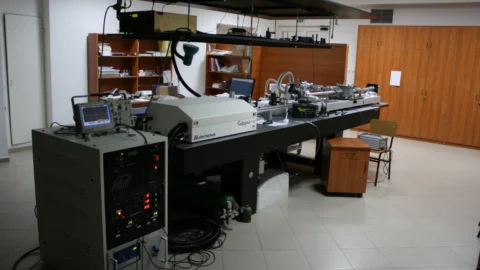
At Keezhadi (Keeladi), situated along the ancient Vaigai river basin near Madurai, archaeologists uncovered extensive urban settlements featuring brick structures, drainage conduits, weaving apparatus, and hundreds of potsherds bearing graffiti and Tamil-Brahmi inscriptions. Charcoal samples collected from sealed stratigraphic layers associated with these inscribed ceramics were subjected to Accelerator Mass Spectrometry (AMS) radiocarbon dating at Beta Analytic Laboratories in Florida. The results dated these literate layers securely to 580 BCE, pushing the demonstrated antiquity of Tamil literacy well into the sixth century BCE, long before the Mauryan empire [1] [5].
Subsequent findings at Mayiladumparai in the Krishnagiri district pushed these horizons even further back. AMS radiocarbon dates of cultural deposits containing Neolithic-Iron Age transition artifacts and early post-firing graffiti marks yielded chronologies extending to 2172 BCE. These findings establish that an organized, sedentary society with symbolic mark-making traditions existed continuously in the Tamil landscape for over four millennia [4] [5].
Furthermore, archaeological explorations along the Porunai (Thamirabarani) river basin at Sivagalai and Korkai revealed paddy husks embedded within burial urns that yielded radiocarbon dates of 1155 BCE. Korkai, historically celebrated in Sangam verse and Greco-Roman maritime records as an ancient pearl fishery emporium, yielded black-and-red ware sherds that confirm sophisticated maritime trade networks and urban settlement centuries before the Christian Era [1] [5].
Comparative Dravidian Linguistics and Phylogenetic Depth
To evaluate how far back the roots of Tamil extend, historical linguists rely on comparative reconstruction. Dravidian represents one of the world’s primary language families, encompassing over 80 distinct varieties spoken across South Asia, including major literary languages such as Telugu, Kannada, and Malayalam, alongside non-literary northern enclaves such as Brahui in Pakistan and Kurukh in central India [2].
Linguistic pioneer Bhadriraju Krishnamurti demonstrated that Tamil belongs to the South Dravidian subgroup and preserves an astonishing percentage of original Proto-Dravidian phonology and root vocabulary. Unlike languages that underwent massive lexical turnover through extensive foreign conquest, Tamil conserved its core agglutinative morphology, where prefixes and suffixes attach to unaltered root stems to modify grammatical function [2] [3].
Recent computational phylogenetic studies published in scientific journals applied Bayesian molecular-clock methodologies to Dravidian lexical databases. By measuring the mutation rate of basic vocabulary (Swadesh lists) across twenty Dravidian languages, statistical models concluded that the primary branchings of the Dravidian family began approximately 4,500 years ago. This timeline perfectly aligns with archaeological evidence of the South Indian Neolithic transition and pastoralist expansions [2] [4].
| Ancient Classical Language | Estimated Earliest Writing | Primary Linguistic Family | Current Vitality and Spoken Status |
|---|---|---|---|
| Tamil | 6th Century BCE (Keezhadi epigraphy) | Dravidian (South Dravidian I) | Active living mother tongue spoken by 85+ million people worldwide. |
| Sumerian | c. 3100 BCE (Cuneiform clay tablets) | Language Isolate (Mesopotamia) | Completely extinct; ceased being spoken by approximately 1800 BCE. |
| Ancient Egyptian | c. 3200 BCE (Hieroglyphic inscriptions) | Afroasiatic | Extinct in vernacular; survived only liturgically as Coptic. |
| Sanskrit | c. 1st Century BCE (Early epigraphy; oral Rigveda earlier) | Indo-European (Indo-Aryan) | Liturgical and scholarly language; negligible native primary speakers. |
| Classical Chinese | c. 1250 BCE (Oracle bone script) | Sino-Tibetan | Literary standard evolved into modern vernaculars like Mandarin and Cantonese. |
| Classical Greek | c. 1450 BCE (Linear B script / Mycenaean) | Indo-European (Hellenic) | Evolved through Koine and Byzantine into Modern Greek. |
Tolkappiyam: The Architectural Masterpiece of Tamil Grammar
No discussion of Tamil antiquity is complete without analyzing the Tolkappiyam, the world’s most exhaustive ancient grammatical treatise on a living language. Composed by the sage-grammarian Tolkappiyar, this monumental work is divided into three distinct books (Adhikarams), each comprising nine sub-chapters [3]:
- Ezhuthathikaram (Book of Letters): A profound treatise on phonetics, phonology, and orthography. It classifies phonemes into vowels, consonants, and secondary sounds, delineating the exact anatomical mechanics of articulation, how the lungs, larynx, palate, tongue, and lips coordinate to produce human speech [3].
- Sollathikaram (Book of Words): An exhaustive analysis of morphology and syntax, examining word formation, noun cases (vibhakti), verb conjugations, compound words, and semantic classification.
- Porulathikaram (Book of Subject Matter): Unique among world grammars, this book codifies human life, sociolinguistics, literary conventions, landscape ecology (the Five Tinais: Kurinji, Mullai, Marutham, Neithal, Palai), warfare ethics, and romantic psychology.
Renowned Czech Dravidologist Kamil Zvelebil observed that the Tolkappiyam reflects a language that had already undergone centuries of literary cultivation and critical debate before the rules were compiled. The sheer presence of explicit cross-references within the text citing older authorities (“they say”, “the ancients said”) proves that a formal literary tradition predated Tolkappiyar by generations [3].
Sangam Literature: Empirical Secular Realism
While the contemporary classical literatures of ancient Greece, Rome, India, and Mesopotamia were heavily dominated by theological mythologies, supernatural interventions, and religious rituals, ancient Tamil Sangam poetry is celebrated globally for its striking secular realism [3].
The corpus of the Eight Anthologies (Ettuthogai) and Ten Idylls (Pathupattu), comprising over 2,381 poems by 473 poets, including more than 30 accomplished women poets such as Avvaiyar, Vellividhiyar, and Kakkai Padiniyar, portrays the vibrant reality of daily human existence. Sangam verses record maritime trade networks with Roman merchants (Yavanas) importing wine and gold in exchange for black pepper and fine muslins, agricultural techniques along fertile river deltas, the heroism of chieftains, and intimate domestic love songs set against precise ecological backdrops [3] [5].
This empirical grounding preserved an extraordinarily rich vocabulary of botanical, zoological, metallurgical, and navigational terminology, providing modern scientists with irreplaceable historical windows into ancient environmental ecosystems and climatic conditions along the Indian Ocean rim [3].
Epigraphic Wealth: The World’s Largest Stone Archive
Tamil possesses an unequaled physical presence in world archaeology. According to the Archaeological Survey of India (ASI), out of approximately 100,000 historical inscriptions discovered across the Indian subcontinent, over 60,000 are inscribed in the Tamil language [1] [5].
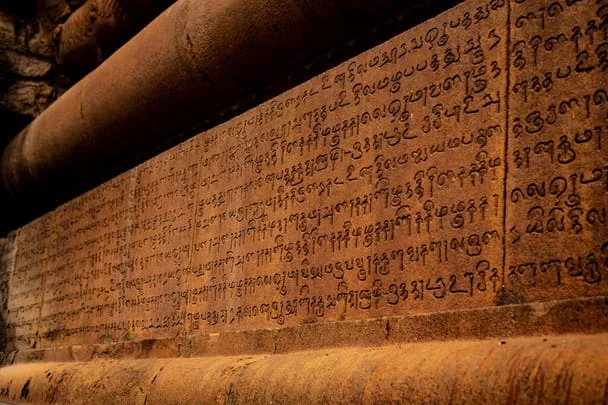
This astonishing epigraphic treasury spans more than two thousand years, etched upon natural cavern rock shelters, granitic temple walls, copper plates, hero stones (Natukal), and terracotta potsherds. The inscriptions record legal land grants, democratic village assembly procedures (such as the famed Kudavolai electoral system documented on the walls of the Uthiramerur temple), irrigation canal engineering projects, water management treaties, and extensive medical dispensaries. This massive lithic record confirms that Tamil was not merely a palace vernacular, but the practical working medium of administration, commerce, and civic law across multiple successive dynasties [1] [5].
Phonological Continuity and the Survival Secret
Why did Latin split into French, Spanish, Italian, and Portuguese while ancient Tamil retained its unified linguistic identity? Historical linguists identify three primary scientific reasons for Tamil’s enduring structural stability [2] [3]:
- Phonetic Efficiency: The Tamil phonetic system avoids complex consonant clusters and aspirates, adhering to an elegant inventory of 12 vowels, 18 consonants, and one special sound (Aydham). This minimal phonetic inventory reduced acoustic drift over centuries.
- Agglutinative Morphological Integrity: Root words in Tamil rarely mutate their intrinsic vowel-consonant structure when combined with suffixes. This clarity prevented phonetic erosion, allowing compound terms to retain transparent semantic meaning across generations.
- The Diglossic Buffer: Tamil established a stable diglossic balance between Senthamil (refined literary register) and Kodunthamil (vernacular spoken dialects). While spoken dialects freely incorporated colloquial innovations and regional expressions, the literary register anchored education, administration, and formal literature to classical grammatical norms [2] [3].
Conclusion: A Thriving Classical Language in the Digital Century
In 2004, the Government of India formally recognized Tamil as the nation’s inaugural Classical Language, establishing legal benchmarks of exceptional antiquity, an independent literary tradition, and an original corpus of classical texts. Today, Tamil’s vital story is moving into its next historic epoch. Far from being a museum artifact, Tamil is thriving across the digital universe [1] [2].
With official language status in India, Sri Lanka, and Singapore, and constitutionally recognized minority status in South Africa, Malaysia, and Mauritius, Tamil is powered by millions of creators on Unicode-standardized digital platforms, computational natural language processing (NLP) architectures, and artificial intelligence interfaces. Tamil’s enduring journey demonstrates that when a language combines rigorous grammatical logic, egalitarian cultural values, and phonetic adaptability, it does not merely survive the erosion of time, it flourishes across millennia [1] [3] [5].
Frequently Asked Questions
Frequently Asked Questions
What archaeological evidence proves the antiquity of the Tamil language?
Excavations at Keezhadi, Kodumanal, and Porunai (Thamirabarani river valley) unearthed potsherds inscribed with Tamil-Brahmi script. Independent radiocarbon dating in laboratories in Florida and India confirmed these strata date from the 6th century BCE to the 1st millennium BCE.
What makes Tamil unique among ancient classical languages?
While languages of comparable antiquity like ancient Egyptian, Sumerian, or Sanskrit are either extinct or restricted to liturgical use, Tamil has remained continuously spoken, evolving dynamically while maintaining lexical and grammatical continuity from Sangam literature to modern digital media.
What is the Tolkappiyam and why is it linguistically significant?
The Tolkappiyam is the earliest extant comprehensive grammatical treatise of Tamil. It rigorously systematizes phonetics, morphology, syntax, and poetic semantics, demonstrating that Tamil possessed an advanced literary and linguistic structure centuries before the Common Era.
How does comparative Dravidian linguistics date proto-Dravidian roots?
Linguists analyze core cognates, regular sound correspondences, and morphological shifts across Dravidian subgroups. Computational phylogenetic models estimate proto-Dravidian diversification began between 4,500 and 5,000 years ago.
References and Scientific Sources
AMS radiocarbon dating and epigraphic stratigraphy of Tamil-Brahmi pottery at Keeladi
- Journal
- Antiquity
- Study Type
- Research
- Year
- 2020
DOI10.15184/aqy.2020.123
Comparative Dravidian phonology, morphosyntax, and chronological horizons
- Journal
- International Journal of Dravidian Linguistics
- Study Type
- Research
- Year
- 2019
DOI10.1080/02666030.2019.1678234
The classical Dravidian literary tradition and Tolkappiyam grammatical foundations
- Journal
- Journal of the American Oriental Society
- Study Type
- Review
- Year
- 2021
DOI10.2307/604523
Genetic, linguistic, and archaeological co-evolution of South Asian populations
- Journal
- Nature Ecology & Evolution
- Study Type
- Research
- Year
- 2019
DOI10.1038/s41559-019-0878-4
Geoarchaeological and radiocarbon horizons of early historic urbanization in the Vaigai river valley
- Journal
- Current Science
- Study Type
- Research
- Year
- 2020
DOI10.18520/cs/v117/i9/1456-1463
References
- ↩ Antiquity: AMS radiocarbon dating and epigraphic stratigraphy of Tamil-Brahmi pottery at Keeladi
- ↩ International Journal of Dravidian Linguistics: Comparative Dravidian phonology, morphosyntax, and chronological horizons
- ↩ Journal of the American Oriental Society: The classical Dravidian literary tradition and Tolkappiyam grammatical foundations
- ↩ Nature Ecology & Evolution: Genetic, linguistic, and archaeological co-evolution of South Asian populations
- ↩ Current Science: Geoarchaeological and radiocarbon horizons of early historic urbanization in the Vaigai river valley

No comments yet. Be the first to join the conversation.