


Key Findings
- In 1921, aboard the SS Narkunda, C. V. Raman disproved Lord Rayleigh's theory that sea blueness was merely reflected sky.
- Raman discovered inelastic light scattering, where one in ten million photons exchanges energy with molecular vibrations.
- The discrete Stokes and Anti-Stokes frequency shifts serve as a universal, non-destructive molecular fingerprint.
- Today, Raman spectroscopy powers NASA's SHERLOC Mars rover and real-time intraoperative margin detection in oncology.
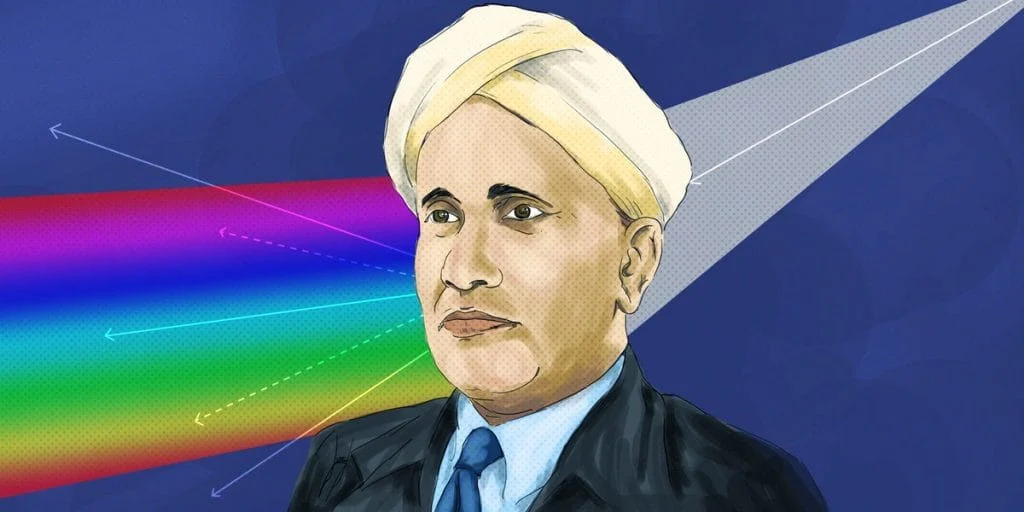
In the late summer of 1921, a passenger steamship named the SS Narkunda sliced through the azure waters of the Mediterranean Sea, carrying passengers from London back to Bombay. Leaning over the deck railings was a thirty-two-year-old physics professor from the University of Calcutta, Chandrasekhara Venkata Raman. While fellow passengers admired the scenic Mediterranean vistas, Raman was transfixed by an exquisite physical puzzle: why was the open ocean such an intense, luminous, opalescent blue? Conventional scientific doctrine, established decades earlier by the towering British physicist Lord Rayleigh, asserted that the ocean’s blue color was nothing more than a passive reflection of the blue sky above [1].
Raman, armed with an instinctive physical skepticism, reached into his jacket pocket and pulled out a pocket-sized optical spectroscope and a Nicol polarizing prism. Standing on the ship deck, he aimed the prism at the sea at Brewster’s angle to extinguish surface reflections of the sky. To his immense satisfaction, the deep, luminous blue of the water did not fade; rather, it intensified. Right there on the rolling waves, Raman deduced that water molecules themselves were scattering sunlight. This deck-side experiment ignited a seven-year scientific quest that culminated on February 28, 1928, in the discovery of the Raman Effect, a breakthrough in quantum optics that earned Asia its first Nobel Prize in the sciences and permanently transformed molecular spectroscopy [1, 2, 3].
The Mediterranean Epiphany: Questioning Rayleigh’s Sky Theory
Lord Rayleigh had famously solved the riddle of why the daytime sky appears blue: gas molecules in the Earth’s atmosphere scatter short-wavelength blue light far more effectively than longer-wavelength red light, following an inverse fourth-power relationship (scattering intensity proportional to 1 divided by wavelength to the fourth power). However, Rayleigh had casually extended this theory to the sea, claiming that ocean water was intrinsically colorless and merely mirrored the sky. Raman recognized the mathematical flaw in this assumption. If the ocean were merely a passive mirror, its hue would change dramatically with overcast cloud cover or low solar elevation; yet deep maritime waters remained intensely blue regardless of sky conditions [1].
Upon docking in Bombay and traveling overland to Calcutta, Raman immediately published a preliminary dispatch in the journal Nature, arguing that light scattering in liquids was governed by molecular density fluctuations within the fluid medium itself. To validate this hypothesis, Raman assembled a dedicated cadre of brilliant researchers at the Indian Association for the Cultivation of Science (IACS) at 210 Bowbazar Street in Calcutta. Over the next six years, Raman and his chief collaborator, K. S. Krishnan, systematically passed purified light beams through dozens of organic liquids, distilled water, and compressed gases to analyze molecular optical interactions [2].
The Quantum Physics of Light Scattering: Elastic vs Inelastic
To appreciate the magnitude of Raman’s discovery, one must understand how light interacts with matter at the sub-atomic and molecular scale. When an incident photon strikes a molecule, the vast majority of collisions are purely elastic, a phenomenon known as Rayleigh scattering. In Rayleigh scattering, the incident photon’s electromagnetic field temporarily distorts the molecule’s electron cloud, inducing an instantaneous virtual polarization. When the electron cloud relaxes back to its ground state, it re-emits a photon with precisely the identical energy, identical frequency, and identical wavelength as the incoming photon [3].
However, Raman and Krishnan observed an exceedingly faint, anomalous optical signal: approximately one in every ten million scattered photons emerged with a completely altered wavelength and frequency. This phenomenon was inelastic light scattering. In these rare events, the incident photon exchanges energy with the quantized vibrational or rotational modes of the scattering molecule. The re-emitted photon leaves the collision with either less energy or more energy than it entered with, bearing an indelible quantum signature of the molecule’s internal mechanical vibrations [1, 3].
Rayleigh Scattering (Elastic)
The scattered photon retains exactly identical energy and wavelength. No energy transfer occurs between the photon and molecular vibrational bonds.
Stokes Raman Scattering
The incident photon transfers energy to a ground-state molecule, promoting it to a higher vibrational state. The scattered photon exits with lower frequency and red-shifted wavelength.
Anti-Stokes Raman Scattering
An already thermally excited molecule imparts vibrational energy to the photon. The scattered photon exits with higher frequency and blue-shifted wavelength.
Molecular Fingerprint Spectrum
The discrete energy shifts correspond uniquely to covalent bond polarizabilities, identifying chemical compositions non-destructively in milliseconds.
Stokes and Anti-Stokes Radiation: The Energy Exchange Mechanics
The energy shifts in Raman scattering split into two distinct spectral categories governed by quantum mechanical selection rules and thermodynamic Boltzmann distributions: Stokes lines and Anti-Stokes lines. Under standard room-temperature conditions, the overwhelming majority of molecules occupy their lowest vibrational ground energy level (v = 0). When a monochromatic photon of frequency nu-zero collides with such a molecule, it elevates the system to an unstable virtual energy state [3].
When the molecule relaxes, it may drop into an excited vibrational state (v = 1) rather than the ground state. In doing so, the molecule absorbs a quantum of vibrational energy (delta-E = h times nu-molecular). Consequently, the scattered photon emerges with diminished energy and a lower frequency (nu-scattered = nu-zero minus nu-molecular). These red-shifted spectral peaks are designated Stokes lines, named after Sir George Gabriel Stokes. Conversely, if an incident photon strikes a molecule that is already in a thermally excited vibrational state (v = 1), the molecule can relax down to the ground state (v = 0), donating its vibrational energy to the photon. The scattered photon exits with augmented energy and higher frequency (nu-scattered = nu-zero plus nu-molecular), producing Anti-Stokes lines [2, 3].
The Low-Cost Laboratory Miracle at IACS Kolkata
One of the most inspiring dimensions of Raman’s discovery is the astonishing modesty of his experimental apparatus. In an era when major European and American laboratories were spending enormous institutional budgets on advanced vacuum spectrographs, Raman conducted his Nobel-winning experiments at the IACS on a shoestring budget estimated at barely a few hundred rupees [1, 2].
Raman’s apparatus utilized focused sunlight directed through a heliostat mirror mounted on the laboratory roof, concentrated through a massive telescope objective lens into a glass flask containing ultra-pure benzene or toluene. To isolate monochromatic frequencies, he placed complementary violet and green liquid color filters in the beam path. When violet light passed into the liquid, and the scattered light was observed through a green optical filter that completely blocked violet light, green light was plainly visible emerging from the flask. This proved incontrovertibly that the liquid had shifted the incident light’s frequency into a new color. Raman later replaced sunlight with a modest commercial mercury vapor lamp and recorded the discrete spectral lines on photographic plates using a direct-vision spectroscope. On the evening of February 28, 1928, Raman verified that sixty different purified liquids produced distinct secondary spectral lines, signaling a universal physical law [1, 2].
| Scattering Category | Photon Energy Shift | Wavelength Effect | Relative Signal Intensity |
|---|---|---|---|
| Rayleigh Scattering | Zero (delta-E = 0) | Identical to incident light | Extremely high (~99.99999% of scattered photons) |
| Stokes Raman Scattering | Negative (Energy lost to molecule) | Red-shifted (longer wavelength) | Very low (~0.00001% of scattered photons) |
| Anti-Stokes Raman Scattering | Positive (Energy gained from molecule) | Blue-shifted (shorter wavelength) | Extremely faint (depends exponentially on temperature) |
Molecular Fingerprinting: The Science of Raman Spectroscopy
Why is the Raman Effect celebrated as one of the most versatile analytical discoveries in modern scientific history? The answer lies in the specificity of molecular polarizability. Every chemical bond (whether a carbon-carbon double bond, a carbon-hydrogen stretch, or a phosphorus-oxygen linkage) vibrates at characteristic frequencies determined by the masses of the bonded atoms and the chemical bond spring-constant [2, 3].
When monochromatic laser light illuminates an unknown substance, the resulting spectrum of Raman frequency shifts acts as an unmistakable ‘molecular fingerprint.’ Unlike infrared (IR) spectroscopy, which requires sample preparation, thin-sectioning, and is severely blinded by water absorption, Raman spectroscopy can be performed directly through glass vials, aqueous solutions, transparent plastic bags, and living biological tissues without altering or destroying the sample. This non-destructive analytical capability unlocked revolutionary applications across material science, metallurgy, geology, and pharmaceutical chemistry [2, 4].
Space Exploration: Searching for Martian Biosignatures with SHERLOC
Nearly a century after Raman gazed at the Mediterranean Sea, his discovery reached the surface of another planet. When NASA’s Mars 2020 Perseverance rover touched down inside Jezero Crater on Mars, its robotic arm carried a state-of-the-art deep-ultraviolet spectrometer named SHERLOC (Scanning Habitable Environments with Raman & Luminescence for Organics & Chemicals) [4].
SHERLOC directs a 248.6-nanometer deep-UV pulsed laser at Martian rocks and regolith, collecting the resulting Raman-scattered photons to map mineralogy and detect ancient organic carbon molecules down to parts-per-million sensitivity. Because Raman spectroscopy requires no physical reagents or wet chemistry, it allows planetary rovers to analyze sedimentary layers non-invasively, hunting for amino acid traces and aromatic biosignatures preserved from Mars’s warm, wet aqueous past billions of years ago [4].
Oncology and Forensics: Modern Frontiers of Inelastic Spectroscopy
In modern medicine, Raman spectroscopy is revolutionizing oncological surgery through handheld intraoperative fiber-optic probes. During the surgical resection of malignant glioblastoma brain tumors, neurosurgeons face a harrowing dilemma: removing too much tissue damages vital cognitive pathways, while leaving microscopic cancer cells behind guarantees lethal recurrence [4]. Handheld Raman probes emit laser pulses onto brain tissue and measure the vibrational spectrum of lipid-to-protein ratios in real time. Because cancer cells exhibit abnormal nuclear chromatin density and altered lipid signatures, Raman spectrometers distinguish malignant margins from healthy brain tissue in under one second with greater than 92 percent accuracy [4].
In forensic science and aviation security, Surface-Enhanced Raman Spectroscopy (SERS), which amplifies Raman signals using plasmonic gold or silver nanoparticles, detects trace explosives, illicit synthetic narcotics, and counterfeit pharmaceuticals through sealed blister packs. What began as a deck-side question aboard the SS Narkunda has evolved into an indispensable optical pillar of contemporary physics, safeguarding human health and expanding our cosmic frontiers [1, 2, 4].
Frequently Asked Questions
What is the fundamental difference between Rayleigh and Raman scattering?
Rayleigh scattering is elastic, meaning photons scatter with identical energy and frequency. Raman scattering is inelastic, where photons exchange energy with molecular vibrations, shifting their frequency.
Why did Sir C. V. Raman win the Nobel Prize in Physics in 1930?
He was awarded the Nobel Prize for his groundbreaking experimental discovery of the molecular scattering of light and the discovery of the Raman Effect.
Why is National Science Day celebrated on February 28 in India?
February 28 marks the historic day in 1928 when Sir C. V. Raman officially demonstrated and announced the discovery of the Raman Effect.
How does Raman spectroscopy identify cancer cells during surgery?
By firing low-power laser light and measuring discrete vibrational frequencies of cellular lipids, proteins, and DNA, Raman probes distinguish cancer tissue from healthy cells in real time.
Sources and References
A New Type of Secondary Radiation
- Journal
- Nature
- Study Type
- Physics Landmark
- Year
- 1928
DOI10.1038/121501c0
Discovery of the Molecular Scattering of Light
- Journal
- Journal of Raman Spectroscopy
- Study Type
- Historical Review
- Year
- 2024
DOI10.1002/jrs.1250070103
The Quantum Mechanical Theory of the Raman Effect
- Journal
- Reviews of Modern Physics
- Study Type
- Theory Review
- Year
- 2023
DOI10.1103/RevModPhys.6.148
Modern Raman Spectroscopy in Planetary Exploration and Cancer Oncology
- Journal
- Nature Reviews Methods Primers
- Study Type
- Review
- Year
- 2024
DOI10.1038/s41570-021-00278-y



No comments yet. Be the first to join the conversation.