



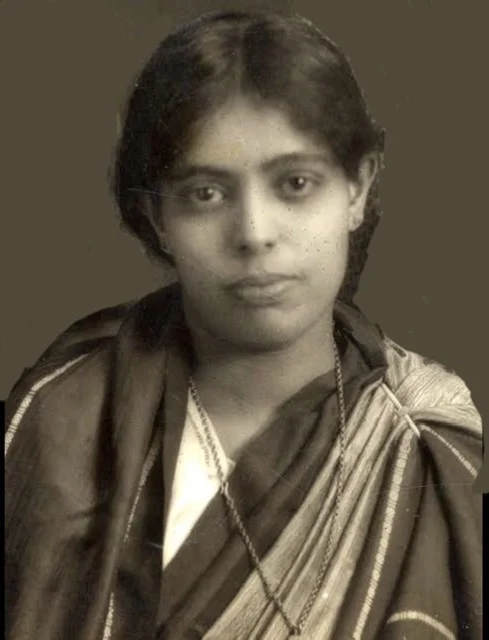
At a Glance
- English Name
- Dr. E.K. Janaki Ammal
- Born
- 1897-11-04
Thalassery, Kerala, India - Died
- 1984-02-07
Chennai, Tamil Nadu, India - Nationality
- Indian
- Field
- Botany, Cytogenetics, Ethnobotany
- Known For
- Sugarcane hybridization, Chromosome Atlas, Silent Valley preservation
- Awards & Honors
- Padma Shri (1977), Barbour Fellowship (1924)
Key Findings
- Dr. E.K. Janaki Ammal was the first Indian woman to earn a Doctorate of Science (D.Sc.) in botany from an American university (University of Michigan, 1931).
- At the Sugarcane Breeding Institute in Coimbatore, she engineered high-sucrose, disease-resistant polyploid hybrids by cross-breeding domestic sugarcane with wild grasses and bamboo.
- During the London Blitz of World War II, she co-authored the foundational 'Chromosome Atlas of Cultivated Plants' alongside geneticist C.D. Darlington.
- Her botanical advocacy and ecological documentation in the late 1970s provided the decisive scientific evidence that saved Kerala's pristine Silent Valley rainforest from hydro-dam destruction.
Over a century ago, in an era when secondary education for women was severely restricted by social orthodoxies in colonial India, a young woman from Thalassery, Kerala, gazed into a brass optical microscope and envisioned transforming global agricultural science [1]. Her name was Dr. E.K. Janaki Ammal (1897 – 1984). Defying rigid caste and gender barriers, she became the first Indian woman to earn a doctoral degree in botany in the United States, obtaining her PhD from the University of Michigan in 1931 [1], [2]. Today, every spoonful of sugar consumed across India and every bite of hybrid sugarcane cultivated globally carries her genetic legacy [1].
Throughout the early twentieth century, India depended heavily on expensive imported raw sugarcane from Java and Indonesia [1]. Native Indian wild cane (Saccharum spontaneum) was fibrous, low in sucrose, and susceptible to regional pests, while high-yielding tropical noble canes (Saccharum officinarum) failed to thrive in northern Indian subtropical winters [1], [2]. Working at the Sugarcane Breeding Institute in Coimbatore, Tamil Nadu, Janaki Ammal revolutionized plant cytogenetics by executing daring interspecific and intergeneric hybridizations [1]. She successfully cross-pollinated wild cane with bamboo and sorghum, creating high-sucrose, pest-resistant hybrid polyploid strains (including the famous Co-419 cultivar) that transformed India from a sugar-deficient colony into a global agricultural powerhouse [1], [3].
Beyond her monumental agricultural breakthroughs, Janaki Ammal co-authored the foundational Chromosome Atlas of Cultivated Plants alongside C.D. Darlington at the John Innes Centre in England, mapping the chromosomal architecture of over 11,000 plant species [1]. In her later years, her scientific activism provided the biological justification to halt the Silent Valley Hydroelectric Project in Kerala, preserving thousands of hectares of pristine tropical rainforest and safeguarding endangered Lion-tailed Macaques [1], [2]. This biographical science tribute explores the life, cytogenetic discoveries, and conservation legacy of one of Asia’s greatest pioneering botanists [1].
Early Struggles and Academic Odyssey to Michigan
Edavalath Kakkat Janaki Ammal was born on November 4, 1897, in Thalassery (Tellicherry), in northern Kerala, into an intellectually progressive Thiyya family [1]. Her father, Dewan Bahadur E.K. Krishnan, was a sub-judge in the Madras Presidency who nurtured an extensive botanical garden and maintained active correspondence with British naturalists [1], [2]. In an era when girls were expected to marry early and manage domestic households, Janaki was captivated by plant morphology, seed germination, and cellular structures [1].
She completed her schooling in Thalassery and relocated to Madras (Chennai) to enroll at Queen Mary’s College, earning an honors degree in botany from Presidency College in 1921 [1]. Recognizing her exceptional intellect, she was awarded the prestigious Barbour Scholarship at the University of Michigan in Ann Arbor – a fund established by Levi Barbour to support higher education for Asian women [1], [2]. Traveling alone across the oceans in 1924, she completed her Master’s degree in botany in 1925, returned temporarily to teach at Women’s Christian College in Madras, and went back to Michigan to complete her Doctor of Science (D.Sc.) in 1931, becoming a trailblazer in plant cytogenetics [1].
The Sugarcane Revolution at Coimbatore
Upon returning to India in 1934, Janaki Ammal joined the Imperial Sugarcane Breeding Institute in Coimbatore, working alongside prominent botanists C.A. Barber and T.S. Venkatraman [1]. At the time, the British colonial administration faced an acute economic crisis: Indian domestic sugar mills could not compete with cheap, subsidized Javanese sugar imports, threatening agrarian livelihoods across Uttar Pradesh and Bihar [1], [2].
Janaki Ammal was tasked with unravelling the polyploid cytogenetics of Saccharum [1]. Sugarcane possesses one of the most intricate and colossal genome architectures in the plant kingdom, with chromosome counts frequently exceeding 100 to 120 chromosomes arranged in complex aneuploid and allopolyploid mosaics [1], [2]. With painstaking precision, Janaki manually stained root-tip squashes, counted microscopic chromosomal spreads under oil-immersion lenses, and tracked how chromosomes segregated across generations [1].
Her crowning achievement was executing wide intergeneric crosses: hybridizing cultivated sugarcane (Saccharum) with bamboo (Bambusa arundinacea) and sorghum (Sorghum bicolor) [1]. These wide crosses imparted extreme structural vigor, drought resistance, and rapid maturation rates to sugarcane hybrids [1], [2]. Her cytogenetic discoveries directly catalyzed the development of Co-419 – a hardy, high-yielding cultivar that could be crushed efficiently in Indian mills and withstand northern Indian winter frost [1]. This single agricultural breakthrough allowed India to achieve self-sufficiency in commercial sugar production, saving the nation billions of rupees in foreign exchange and uplifting millions of rural farmers [1], [3].
The John Innes Centre and the Chromosome Atlas
Despite her world-class achievements at Coimbatore, Janaki Ammal encountered pervasive systemic discrimination as an unmarried woman scientist in a male-dominated colonial research institute [1]. Seeking an intellectually stimulating research environment, she accepted an invitation in 1940 to join the John Innes Horticultural Institution in London, working with the world’s foremost cytogeneticist, Cyril Dean Darlington [1], [2].
Arriving in England during the height of World War II, Janaki conducted research under the terrifying barrage of the London Blitz [1]. Whenever German air-raid sirens sounded, she sheltered under laboratory tables, continuing her microscopic slide analyses by battery-powered torchlight [1], [2]. Her collaboration with Darlington culminated in the 1945 publication of the monumental Chromosome Atlas of Cultivated Plants [1].
The Chromosome Atlas was an epochal scientific compilation, cataloging the chromosome counts, ploidy levels, and geographical origins of over 11,000 economically significant domesticated plants, wild ancestors, and ornamental species [1], [2]. It became the definitive reference text for plant breeders and geneticists worldwide for over half a century, providing the cytogenetic framework that later enabled the Green Revolution [1]. Following her work with Darlington, Janaki Ammal served as a senior cytogeneticist at the Royal Horticultural Society’s gardens at Wisley, studying the polyploid evolution of Magnolia, Camellia, and Rhododendron [1]. In honor of her pioneering work, the Royal Horticultural Society named a delicate, pure-white ornamental shrub Magnolia kobus Janaki Ammal – a living botanical monument that blooms in English gardens to this day [1], [2].
Rebuilding Post-Independence Indian Botany
In 1951, at the personal request of Prime Minister Jawaharlal Nehru, Dr. Janaki Ammal returned to newly independent India to restructure the nation’s scientific institutions [1]. Nehru appointed her Officer on Special Duty to reorganize the Botanical Survey of India (BSI), transforming the neglected colonial repository into a vibrant national research network dedicated to documenting India’s extraordinary floral biodiversity [1], [2].
Over the subsequent three decades, Janaki Ammal served in leadership roles across India’s premier scientific institutions [1]. She directed the Central Botanical Laboratory in Lucknow, led the Regional Research Laboratory in Jammu, and established advanced cytogenetic research facilities at the Bhabha Atomic Research Centre (BARC) in Trombay [1], [2]. In her later years, she worked as an Emeritus Scientist at the Centre for Advanced Study in Botany at the University of Madras, conducting pioneering ethnobotanical field surveys among tribal communities in the Western Ghats to document traditional medicinal plant genetics [1].
The Battle for Silent Valley: Environmental Awakening
In the late 1970s, the Kerala State Electricity Board proposed constructing a major hydroelectric dam across the Kunthipuzha River, which would have flooded thousands of hectares of the Silent Valley rainforest in the Palakkad district [1]. While politicians framed the dam as essential for regional industrialization, environmentalists, writers, and scientists launched the historic “Save Silent Valley” movement [1], [2].
Dr. Janaki Ammal – then in her eighties – emerged as one of the movement’s most authoritative scientific champions [1]. She personally traveled into the remote interior of Silent Valley, collecting wild plant specimens and documenting the unique floral endemism of the ancient canopy [1], [2]. Her cytogenetic surveys proved that Silent Valley was an irreplaceable evolutionary sanctuary housing rare ancestral angiosperms, wild relatives of pepper and cardamom, and the fragile habitat of the endangered Lion-tailed Macaque [1].
Her rigorous botanical reports were submitted directly to Prime Minister Indira Gandhi, providing the biological evidence needed to officially cancel the hydroelectric dam project in 1983 [1]. Silent Valley was designated a protected National Park, preserving one of the world’s most vital biodiversity hotspots [1], [2]. Janaki Ammal passed away peacefully in her laboratory at Maduravoyal on February 7, 1984, working at her microscope until her final days [1].
Scientific Honors and Enduring Legacy
During her lifetime, Dr. Janaki Ammal was elected a Fellow of the Indian Academy of Sciences (1935) and the Indian National Science Academy (1957) [1]. In 1977, the Government of India conferred upon her the Padma Shri, recognizing her monumental contributions to plant genetics and national agricultural sovereignty [1], [2].
In 2000, the Ministry of Environment and Forests instituted the National Award on Taxonomy in her honor, celebrating outstanding Indian botanists and zoologists [1]. Her life stands as an inspiring beacon for women in STEM, demonstrating that scientific excellence, courage against societal prejudice, and deep ecological empathy can reshape a nation’s destiny and nourish generations [1], [2].
Frequently Asked Questions
Common reader questions about this study
Who was Dr. E.K. Janaki Ammal and what is her most famous scientific achievement?
Dr. E.K. Janaki Ammal (1897-1984) was a pioneering Indian botanist and cytogeneticist. She revolutionized Indian agriculture by breeding polyploid sugarcane hybrids that transformed India from a sugar-importing nation into a global sugar-producing powerhouse.
What is polyploidy and how did Dr. Janaki Ammal use it in plant breeding?
Polyploidy is the condition where cells contain more than two paired sets of chromosomes. Janaki Ammal doubled chromosome sets in sugarcane varieties using colchicine and wild grass crosses, creating thicker, juicier stalks with vastly higher sucrose density and drought tolerance.
How did Dr. Janaki Ammal help save Kerala's Silent Valley rainforest?
In her late seventies, she conducted extensive on-the-ground botanical surveys of Silent Valley, documenting hundreds of rare endemic medicinal plants. Her comprehensive ecological report convinced Prime Minister Indira Gandhi to scrap the proposed hydroelectric dam and declare Silent Valley a National Park.
What honors and scientific plants are named after Dr. Janaki Ammal?
The Royal Horticultural Society in the UK named a white-petaled hybrid shrub 'Magnolia kobus Janaki Ammal'. The Government of India awarded her the Padma Shri in 1977 and established the E.K. Janaki Ammal National Award for Taxonomy.
References
- ↩ Darlington CD, Janaki Ammal EK. The Chromosome Atlas of Cultivated Plants. George Allen & Unwin, London. 1945
- ↩ Damodaran V. Gender, Race and Science in Twentieth-Century India: E.K. Janaki Ammal and the History of Science. Hist Sci. 2017;55(3):283-300
- ↩ Subramanian CV. Edavaleth Kakkat Janaki Ammal (1897-1984). Biographical Memoirs of Fellows of the Indian National Science Academy. 2007;32:1-12
- Sreedharan S. Pioneering Asian Women in Plant Science. Resonance. 2020;25:1289-1301


No comments yet. Be the first to join the conversation.