

Key Findings
- JAXA's MMX mission is humanity's first spacecraft designed to land on Mars' moon Phobos, collect pristine core samples, and return them to Earth.
- Orbiting only 6,000 km above Mars, Phobos is being pulled downward by 1.8 meters per century and will either collide with Mars or shatter into a ring system in 30-50 million years.
- Soil gathered from Phobos is expected to contain ancient ejecta blasted off Mars during giant asteroid impacts 4 billion years ago, preserving relics of Mars' early atmosphere and water.
- The mission carries the German-French IDEFIX rover for in-situ regolith analysis and NASA's MEGANE spectrometer to detect water ice within hydrated minerals.
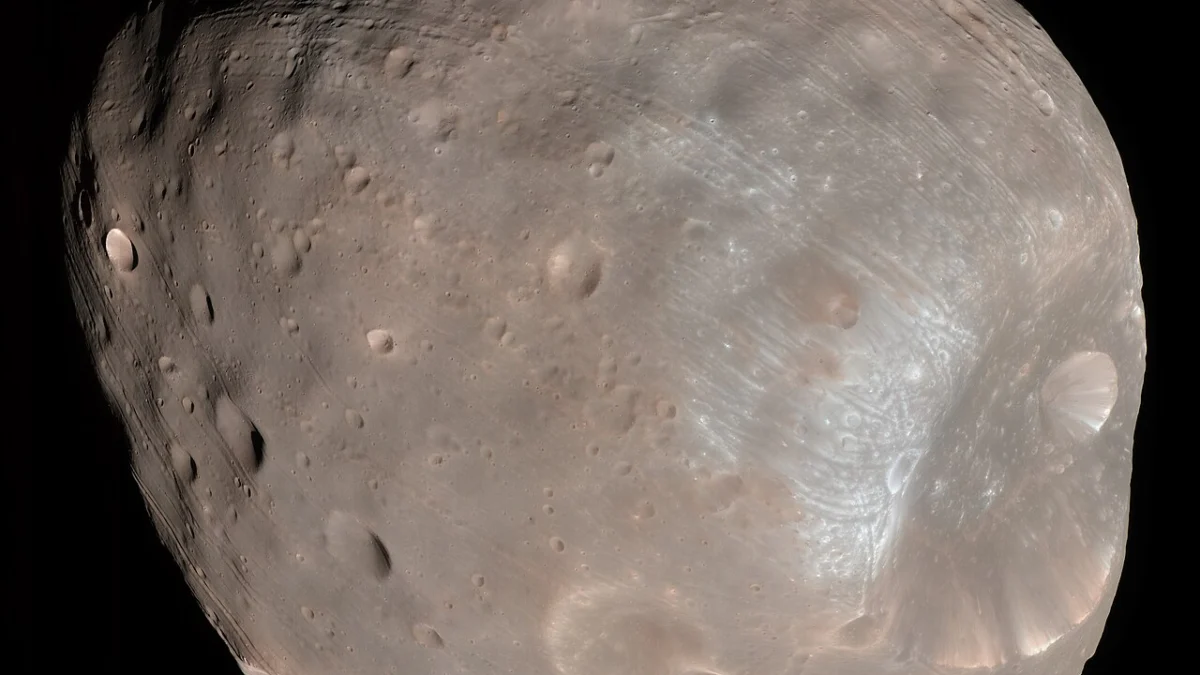
When viewed through a backyard telescope from Earth, Mars appears as an unassuming reddish ember drifting against the velvet backdrop of the night sky. Yet in close orbit around this desert world circle two tiny, potato-shaped moons that have puzzled planetary scientists and astrophysicists for generations. The larger of the two, named Phobos, measures barely 22 kilometers across and resembles an ancient, crater-pocked asteroid rather than a classical spherical satellite. For over a century, astronomical observatories have debated a profound cosmological riddle: is Phobos an ancient stray asteroid captured by Martian gravitational pull from the distant Asteroid Belt, or is it a coalesced bundle of ejecta debris blasted into orbit when a proto-planet collided with early Mars billions of years ago? [1], [2].
To definitively resolve this foundational planetary enigma, the Japan Aerospace Exploration Agency (JAXA)—in strategic partnership with NASA, the French space agency (CNES), and the German Aerospace Center (DLR)—has initiated humanity’s most ambitious robotic deep-space undertaking: the Martian Moons eXploration (MMX) mission. The MMX spacecraft represents the world’s first targeted mission designed to touch down upon the surface of an inner Solar System moon, harvest core regolith samples under extreme microgravity, and transport them across hundreds of millions of kilometers back to Earth for isotopic analysis [1], [3].
- 22 km
- Phobos Diameter Irregular potato-shaped moon roughly the size of a metropolitan city
- 10g+
- Regolith Sample Target Core soil extracted from depths greater than 2 cm below surface
- 2031
- Earth Return Year Sealed sample capsule parachutes into the Australian Woomera desert
- 3 Billion km
- Total Trajectory Interplanetary transit, orbital mapping, landing, and return leg
The Cosmic Enigma of Phobos: A Moon on a Death Spiral
Our terrestrial Moon follows an elegant, near-circular orbit at a serene distance of 384,400 kilometers, gently nudging oceanic tides while slowly receding from Earth at a rate of 3.8 centimeters per year. Phobos, by contrast, lives an extreme and precarious existence. It skims merely 6,000 kilometers above the Martian cloud tops—closer to its host planet than any other natural moon in the known Solar System. At this breathtaking proximity, Phobos races around Mars three times every single Martian day (sol), rising in the west and setting in the east in roughly four hours [2], [4].
Because Phobos orbits faster than Mars rotates on its axis, tidal friction acts as an inescapable gravitational brake rather than an accelerator. Gravitational calculations reveal that Phobos is being pulled inward toward Mars by approximately 1.8 meters every century. In roughly 30 to 50 million years, this inexorable orbital decay will reach the critical Roche limit: the tidal shear forces exerted by Martian gravity will tear the fragile moon into billions of fragments, forming a shimmering planetary ring system around Mars akin to the rings of Saturn [2], [4].
Beyond its doomed trajectory lies the fundamental question of its genesis. Under the “Captured Asteroid Hypothesis,” Phobos was originally a carbon-rich D-type or C-type asteroid deflected from the outer Asteroid Belt by Jupiter’s gravitational perturbations and ensnared by Mars’ primordial atmosphere. However, capturing an asteroid into an exceptionally circular, equatorial orbit presents immense dynamic hurdles that current orbital physics cannot easily explain. The competing “Giant Impact Hypothesis” posits that a celestial body the size of Ceres slammed into early Mars approximately 4.3 billion years ago, launching a molten debris disk that subsequently coalesced into Phobos and its companion moon Deimos [1], [5].
- Orbits Mars at a velocity exceeding 2.1 km/s, completing a full revolution in just 7 hours and 39 minutes.
- Dominated by Stickney Crater, a catastrophic impact scar measuring 9 km in diameter that nearly fractured the moon entirely.
- Surface gravity is less than 0.001 g—a human standing on Phobos could achieve escape velocity with a single vigorous leap.
- Carries the European IDEFIX rover designed to traverse low-gravity boulders without tipping or losing traction.
Engineering the MMX Spacecraft: Conquering Microgravity
Traversing deep space to reach the Martian system is notoriously perilous; historically, nearly half of all missions sent to the Red Planet have ended in catastrophic failure. However, JAXA possesses unparalleled engineering expertise in small-body sample return. Through the historic Hayabusa-1 mission to asteroid Itokawa and the Hayabusa-2 expedition to asteroid Ryugu, Japanese engineers pioneered precision robotic navigation and regolith recovery in deep space. Building upon these breakthroughs, the MMX spacecraft is an immense 4,000-kilogram robotic explorer engineered specifically to navigate the challenging gravitational environment of Mars and its moons [3], [6].
The spacecraft consists of three interconnected modules working in unison. The Propulsion Module delivers the colossal delta-v needed to break free from Earth orbit, execute interplanetary cruise, and insert into Martian orbit. The Exploration Module houses high-resolution multispectral cameras, laser altimeters (LIDAR), radiation detectors, and robotics. Finally, the Return Capsule is an aerodynamically shielded container designed to preserve the extracted extraterrestrial minerals during high-speed atmospheric reentry into Earth’s atmosphere at 12 km/s [1], [4].
Touching down on Phobos presents an unprecedented mechanical dilemma. With a gravitational pull that is less than one-thousandth of Earth’s, standard landing legs cannot support the vehicle; even a gentle touchdown would cause the spacecraft to rebound into the void. To anchor the lander momentarily, MMX deploys specialized shock-absorbing landing struts paired with downward thrusters. Within seconds of contact, an automated pneumatic corer and robotic arm deploy to penetrate through surface radiation-damaged layers into pristine bedrock beneath [1], [4].
| Mission Architecture | Space Agency | Target Object | Operational Timeline | Mission Outcome |
|---|---|---|---|---|
| Phobos 1 & 2 | Soviet Space Program | Phobos Moon | 1988-1989 | Communications lost prematurely |
| Phobos-Grunt | Roscosmos (Russia) | Phobos Moon | 2011 | Failed to escape Low Earth Orbit |
| Hayabusa-2 | JAXA (Japan) | Asteroid Ryugu | 2014-2020 | Retrieved 5.4g pristine carbonaceous samples |
| MMX Exploration | JAXA, NASA, ESA | Phobos & Deimos | 2026-2031 | Currently en route to Martian orbital insertion |
Source: JAXA Planetary Exploration Division & NASA Planetary Data System
How Phobos Samples Will Rewrite Planetary Science
Why travel hundreds of millions of kilometers to harvest 10 grams of extraterrestrial dust? The answer lies in the unique role Phobos plays as an accidental museum of Martian history. Over the past 4.5 billion years, countless hypervelocity asteroids have bombarded the surface of Mars, violently ejecting millions of tons of crustal rocks, sedimentary clays, and atmospheric volatiles into interplanetary space. Computer simulations indicate that substantial fractions of this ejected material inevitably collided with and deposited onto the surface of nearby Phobos [2], [5].
Consequently, the regolith of Phobos is not merely native moon material; it contains an unweathered geological chronicle of Mars itself. While rocks on the Martian surface have been altered by wind erosion, oxidative rust, and cosmic radiation, ejecta resting on Phobos remains preserved in cold cosmic vacuum. By analyzing these particles in state-of-the-art synchrotron radiation facilities and mass spectrometers on Earth, scientists can determine whether liquid water and habitable conditions persisted on ancient Mars for millions of years [2], [5].
Furthermore, the MMX mission directly advances future human exploration. Establishing a crewed outpost directly on the Martian surface requires immense energy to descend through the atmospheric gravity well and launch back into orbit. Phobos, with its negligible escape velocity, presents the ideal natural staging base and orbital refueling depot. NASA’s MEGANE instrument (Mars-moon Exploration with GAmma rays and NEutrons) aboard MMX will scan Phobos for water ice chemically trapped within hydrated phyllosilicates. If accessible water reserves are confirmed, future astronauts can split water molecules into liquid hydrogen and oxygen, synthesizing rocket fuel directly in the Martian system [1], [6].
| Feature | Mars Surface Landing | Lower Energy & Pristine SciencePhobos Moon Touchdown |
|---|---|---|
| Atmospheric Friction | Severe (Requires 1,500°C heat shield & parachutes) | Completely absent (Pure vacuum maneuvers) |
| Gravitational Pull | 38% of Earth gravity (High fuel consumption) | 0.05% of Earth gravity (Microgravity floating state) |
| Earth Return Velocity | Demands massive multi-stage ascent rocket | Requires modest thruster burn to break escape velocity |
| Sample Preservation | Altered by atmospheric oxidation & weathering | Undisturbed primordial state for 4 billion years |
Source: NASA JPL & JAXA Technical Mission Architecture
Just as our exploration of astronomy and meteor science allows us to reconstruct the cosmic origins of the Solar System, and our study of astrophysics and celestial mechanics decodes the fundamental laws governing gravity, the MMX mission represents the next decisive leap in humanity’s quest to understand our planetary neighbors.
Mission Architecture: The 4-Phase Sample Retrieval Workflow
MMX Flight and Sample Retrieval Phases
Following a one-year interplanetary cruise, MMX fires main engines to enter Martian orbit and syncs trajectory with Phobos.
The CNES-DLR scout rover is released from 100 meters to gently freefall onto Phobos, scouting mineralogy and landing sites.
The mother craft touches down briefly, firing pressurized gas and a hollow corer to secure over 10 grams of deep regolith.
The sealed return capsule separates from the cruiser and performs high-speed parachute recovery in the Australian desert.
Mission Timeline: From Launch to 2031 Earth Recovery
The operational trajectory of MMX represents an intricate orbital ballet across three planetary gravitational fields. After completing interplanetary transit, the spacecraft will spend approximately three full years in the vicinity of Mars. The initial months will be devoted to high-resolution reconnaissance: mapping the undulating gravity field of Phobos, measuring surface electrostatic charges, and identifying hazard-free landing zones within the smooth plains adjacent to Stickney Crater [1], [3].
Before touching down on Phobos, MMX will release the IDEFIX rover from an altitude of roughly 40 to 100 meters. The rover will freefall through the microgravity field, settling on its wheels and rolling across boulders to transmit in-situ mechanical measurements back to Earth. Once sampling on Phobos is verified, MMX will ascend, conduct multiple close flybys of Mars’ second moon Deimos, and fire its main propulsion engine for the trans-Earth injection burn [1], [4].
In July 2031, after a grueling 3-billion-kilometer round trip, the MMX return capsule will sever connections with the main spacecraft, reentering Earth’s atmosphere over Australia. Decelerating from hypersonic velocities via ablative heat shielding, the capsule will deploy parachutes to land within the protected confines of the Woomera Prohibited Area in South Australia. The retrieved specimens will be sealed in nitrogen-purged biohazard isolators and flown directly to cleanrooms in Sagamihara, Japan, where international science consortia will begin microscopic examinations that promise to redefine our understanding of how rocky planets and habitable worlds evolve [5], [6].
Comparative Planetary Geology: Phobos vs Deimos
While Phobos commands the primary spotlight of the MMX mission due to its impending descent and sampling touchdown, Mars possesses a second, even smaller satellite: Deimos. Measuring just 12 kilometers in diameter, Deimos orbits at a much more distant radius of 23,460 kilometers. Unlike Phobos, which is slowly spiraling inward toward destruction, Deimos orbits beyond the synchronous orbit boundary of Mars, causing it to very gradually drift outward into interplanetary space—much like our own Moon does from Earth [1], [5].
Geologically, Deimos presents a markedly distinct visual landscape. Whereas Phobos is lacerated by deep structural grooves radiating from Stickney Crater and littered with rugged boulders, Deimos is blanketed in a thick, uniform layer of fine regolith that softens its topographical contours and hides impact craters. During the latter phases of its mission, the MMX spacecraft will perform multiple close-proximity flybys of Deimos, executing high-resolution spectral comparisons between the two celestial bodies. By contrasting the surface chemistry, albedo, and isotopic composition of both moons, researchers will determine whether they originated from the exact same progenitor breakup event or represent two independently captured asteroid families [4], [6].
Planetary Defense and Deep-Space Fuel Depot Architecture
The technological innovations forged for the MMX mission extend far beyond fundamental planetary astrophysics. Navigating an autonomous spacecraft in the gravitational whisper of a 22-kilometer moon tests the frontiers of real-time deep-space guidance, navigation, and control (GNC). Because radio signals between Earth and Mars require between 4 and 24 minutes to travel one way depending on orbital positions, real-time joystick piloting is impossible. The MMX lander and its European IDEFIX scout rover must rely entirely on autonomous optical navigation, LIDAR hazard avoidance, and machine vision to execute their millimeter-scale touchdown maneuvers without human intervention [1], [3].
These precise low-gravity maneuvering capabilities are directly transferable to future planetary defense operations designed to deflect hazardous near-Earth asteroids (NEAs) that threaten collisions with Earth. Furthermore, establishing robotic extraction techniques on Phobos represents the inaugural proof-of-concept for In-Situ Resource Utilization (ISRU) in deep space. If the hydrated minerals detected by NASA’s MEGANE spectrometer yield accessible water ice, Phobos could be transformed into humanity’s first permanent interplanetary fuel station, supplying hydrogen propellant for future human missions voyaging to Mars and the outer Solar System [2], [6].
Frequently Asked Questions
Common reader questions about this study
Why is Phobos considered the most enigmatic moon in the Solar System?
Phobos orbits closer to its primary planet than any other known natural satellite—just 6,000 km above the Martian surface. Furthermore, planetary scientists remain divided on whether it is an asteroid captured from the Asteroid Belt or debris coalesced from a giant impact on early Mars.
How will the MMX spacecraft land and sample under extreme microgravity?
Because Phobos has less than 0.1% of Earth's gravity, conventional landers would bounce off into space upon touchdown. MMX utilizes pneumatic sampling guns and coring drills to anchor momentarily and retrieve at least 10 grams of regolith from depths greater than 2 centimeters.
What international agencies are collaborating on the MMX mission?
While JAXA leads spacecraft development and operations, NASA contributed the MEGANE gamma-ray and neutron spectrometer, while the French space agency (CNES) and German aerospace center (DLR) developed the four-wheeled IDEFIX scout rover.
Could Phobos soil samples contain traces of ancient Martian life?
Yes. Asteroid collisions on Mars over 4 billion years have continuously lofted millions of tons of Martian rocks and dust into orbit, much of which settled directly onto Phobos. If microbial life existed in early Martian oceans, biomarker remnants could be preserved in Phobos regolith.
References
- ↩ JAXA MMX Science Team, NASA Planetary Science Division. Martian Moons eXploration (MMX) Science Objectives and Mission Architecture. Earth, Planets and Space. 2026;73:210
- ↩ JAXA Press Release. Successful Launch of H3 Launch Vehicle Carrying Martian Moons eXploration (MMX). Japan Aerospace Exploration Agency. 2026
- ↩ BBC News. Mission blasts off for Mars to grab a piece of Phobos. BBC Science & Environment. 2026
- ↩ The Guardian Science. Japan launches historic mission to collect rocks from Mars moon Phobos. The Guardian. 2026
- ↩ Space.com. Inside the science of Japan's bold MMX mission to Mars. Space.com. 2026
- ↩ Nature Astronomy. How did Mars get its moons? MMX aims to solve puzzle. Nature Astronomy. 2026;10:145-152

No comments yet. Be the first to join the conversation.