


Key Findings
- The carbon-fluorine (C-F) bond in PFAS molecules is the strongest single bond in organic chemistry, resisting natural microbial, thermal, and solar degradation for centuries.
- Traditional municipal water filtration techniques like activated carbon and reverse osmosis only concentrate PFAS into toxic solid waste without actually destroying the chemical bonds.
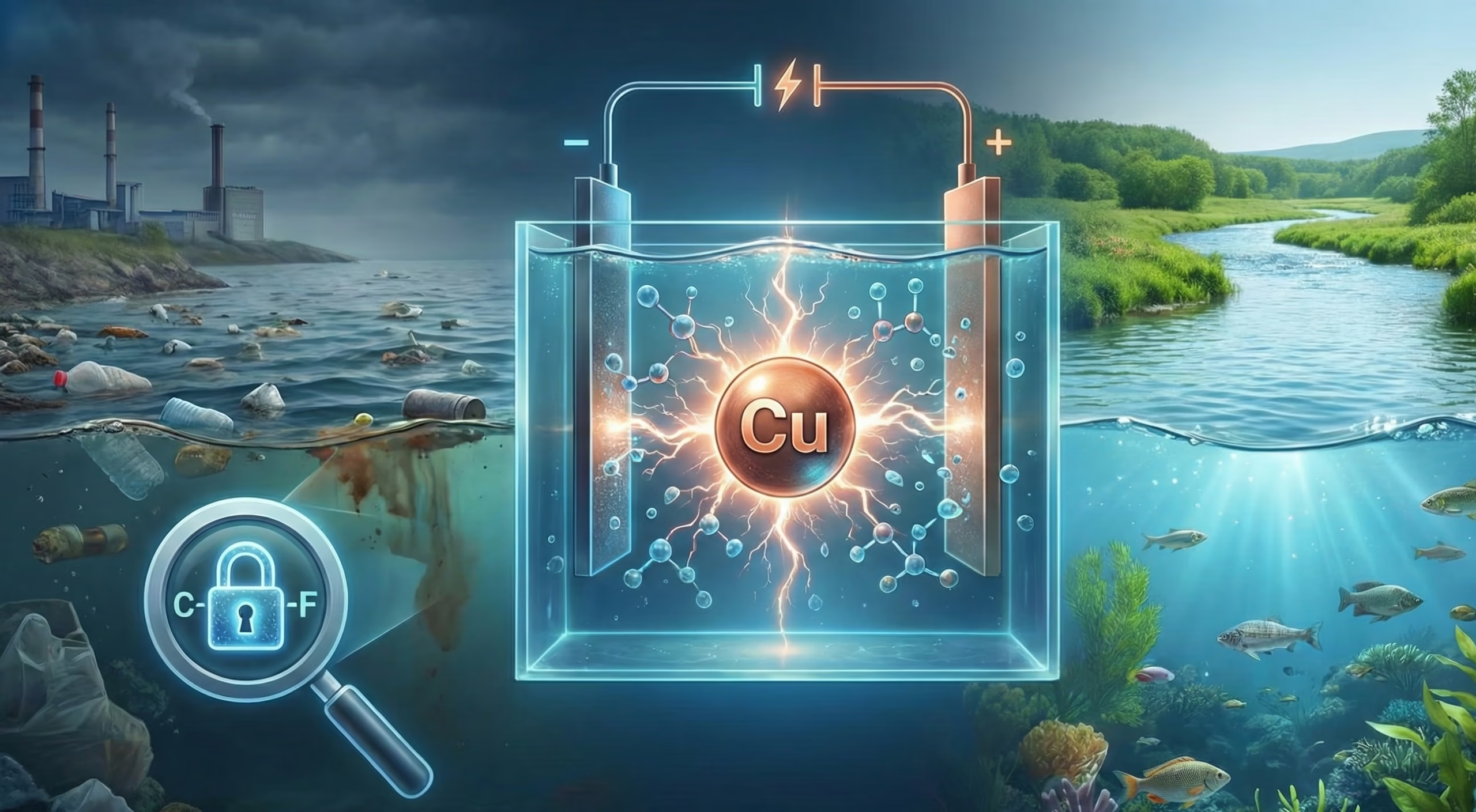
- Rice University researchers developed a single-atom copper catalyst embedded within layered double hydroxides (LDH) that breaks C-F bonds electrochemically at room temperature.
- The defluorination process achieves over 99% destruction efficiency, transforming hazardous fluorocarbons into harmless fluoride ions and readily biodegradable carbon fragments.
In modern industrial history, few chemical innovations have presented as profound an environmental paradox as per- and polyfluoroalkyl substances (PFAS). Engineered in the mid-twentieth century to deliver peerless heat resistance, oil repellency, and hydrophobic waterproofing, these synthetic fluorinated compounds quickly became ubiquitous across consumer manufacturing. From non-stick cookware and grease-resistant fast-food wrappers to stain-proof upholstery, breathable waterproof textiles, and specialized aviation firefighting foams, PFAS molecules revolutionized everyday convenience [1], [2].
Yet that same extraordinary industrial durability harbors a catastrophic ecological consequence: PFAS molecules do not degrade in nature. Earning the moniker “forever chemicals,” they withstand microbial digestion, solar ultraviolet radiation, and typical environmental oxidation for centuries. Today, epidemiological surveys detect trace concentrations of PFAS in rainwater, Arctic polar ice sheets, deep groundwater aquifers, and the blood serum of over 98% of the human population. Facing this planetary contamination crisis, chemical engineers at Rice University have achieved a historic scientific milestone: a single-atom copper electrocatalytic system capable of completely destroying PFAS at ambient room temperature without producing hazardous secondary waste [1], [3].
- 15,000+
- PFAS Variants Synthetic fluorinated chemical formulations manufactured since the 1940s
- 485 kJ/mol
- C-F Bond Energy The strongest single covalent bond in organic chemistry
- 100x
- Destruction Speed Faster electrochemical defluorination compared to conventional methods
- < 4 ppt
- EPA Safety Advisory Maximum lifetime drinking water limit recommended for PFOA and PFOS
The Global Crisis: Ubiquity of Forever Chemicals
The chemical family known as PFAS comprises more than 15,000 distinct fluorinated compounds, the most extensively studied being perfluorooctanoic acid (PFOA) and perfluorooctane sulfonic acid (PFOS). Because industrial manufacturing facilities discharged fluorinated wastewater into municipal waterways for decades, PFAS has steadily leached into soil profiles and municipal drinking water systems across the globe [2], [4].
Unlike traditional organic contaminants like hydrocarbons or chlorinated solvents, which soil microbes gradually break down, PFAS defies biological degradation. Instead, it undergoes bioaccumulation. Aquatic organisms ingest microscopic traces from riverbeds; larger predatory fish consume those organisms, concentrating the chemicals up the food chain until they reach human dinner tables. Once inside the human body, PFAS molecules bind strongly to serum albumin and fatty-acid binding proteins, circulating through the bloodstream for an estimated biological half-life of four to nine years per single exposure [2].
Clinical investigations conducted by the US Environmental Protection Agency (EPA) and international toxicology consortiums confirm severe systemic health outcomes from chronic low-dose exposure. These include immunosuppression—manifesting as diminished antibody response to routine childhood vaccines—endocrine disruption, thyroid dysfunction, gestational hypertension, elevated LDL cholesterol, and increased risks of renal and testicular carcinomas. In response, environmental regulatory bodies have slashed permissible drinking water contamination thresholds to near-zero detection limits (under 4 parts per trillion), confronting municipal water utilities with an unprecedented engineering dilemma [2], [4].
The Carbon-Fluorine Bond: Nature’s Unbreakable Lock
To understand why forever chemicals are so resistant to destruction, one must examine their fundamental molecular architecture. A typical PFAS molecule features a long, aliphatic carbon backbone completely surrounded by fluorine atoms—often described chemically as a “perfluorinated tail” attached to a hydrophilic functional headgroup [1], [3].
The carbon-fluorine (C-F) bond represents the strongest single covalent bond in organic chemistry, possessing an immense bond dissociation energy of approximately 485 kilojoules per mole (kJ/mol). Fluorine is the most electronegative element on the periodic table; when bonded to carbon, it pulls electron density tightly toward its nucleus, shortening the interatomic distance to a mere 1.35 angstroms. This creates a dense, impenetrable electronic shield around the carbon backbone, effectively warding off nucleophilic attacks by enzymes or oxidizing radicals [1].
In nature, chemical degradation occurs when microbes produce specialized enzymes capable of cleaving organic bonds. However, because natural biological evolution never encountered fully fluorinated carbon backbones prior to 1940, no bacterial or fungal enzyme possesses the thermodynamic capability to unpick this molecular lock. Just as intricate biochemical molecular bonds evolved for specific enzymatic reactions over millions of years, synthetic perfluorinated bonds represent an alien structural barrier to the biosphere [1], [3].
The Fatal Flaw of Traditional Filtration Systems
Faced with growing public alarm over contaminated drinking supplies, municipal water utilities have traditionally relied upon physical separation technologies. The three most prevalent approaches include Granular Activated Carbon (GAC), Ion Exchange (IX) resins, and High-Pressure Reverse Osmosis (RO) membranes [4].
While these physical filtration methods successfully remove PFAS molecules from municipal tap water, they suffer from a fatal operational flaw: they do not destroy the chemical. Instead, they merely capture and concentrate the toxin onto solid filter media or into concentrated reject brine. A water treatment facility using activated carbon simply transfers millions of gallons of contaminated water onto hundreds of pounds of solid carbon media [1], [4].
| Feature | Conventional Filtration (GAC / RO) | Complete Destruction StandardSingle-Atom Copper Electrocatalysis |
|---|---|---|
| Core Mechanism | Physical adsorption / membrane separation | Direct electrochemical bond cleavage |
| PFAS Fate | Concentrated onto spent filters or reject brine | Mineralized into non-toxic fluoride and CO2 |
| Secondary Waste Crisis | Generates hazardous solid waste needing landfilling | Zero hazardous chemical residue produced |
| Operational Temperature | Ambient (filtration only) | Ambient room temperature (25°C) |
| Destruction Efficiency | 0% (zero bond cleavage) | Over 99% complete defluorination |
| Lifecycle Cost Burden | High recurring filter replacement & disposal costs | Reusable durable catalyst with low electrical energy input |
Synthesized from Advanced Materials (2025) and EPA Water Technology Reviews
Disposing of spent, PFAS-saturated filtration media presents a secondary ecological nightmare. If buried in municipal landfills, the chemicals inevitably leach back into surrounding groundwater aquifers during rainfall events. If sent to commercial waste incinerators, operating temperatures must exceed 1,100°C to cleave the C-F bonds. If incinerator furnaces fail to maintain sustained peak temperatures, incomplete combustion releases volatile, highly toxic fluorochemical vapors and greenhouse gases into surrounding communities, perpetuating the environmental contamination cycle [1], [4].
Rice University’s Single-Atom Catalysis Breakthrough
To overcome this destructive bottleneck, a research team at Rice University’s George R. Brown School of Engineering, spearheaded by chemical engineer Dr. Haotian Wang, pioneered an innovative electrocatalytic approach. Instead of attempting brute-force thermal incineration or relying on prohibitively expensive precious metals like platinum or palladium, the team leveraged the extraordinary physics of single-atom catalysis [1].
The researchers synthesized a host matrix composed of Layered Double Hydroxides (LDH)—a class of two-dimensional ionic nanomaterials consisting of positively charged metal hydroxide sheets separated by interlayer anions. Into this atomic lattice, they strategically dispersed isolated, individual atoms of copper (Cu). Because each copper atom is physically isolated from its neighbors, 100% of the metal atoms remain chemically exposed and electronically active, yielding an exceptionally high catalytic surface area [1].
This single-atom copper configuration functions as a molecular fishing hook. The surrounding layered double hydroxide matrix possesses a high positive surface charge that electrostatically attracts negatively charged PFAS headgroups, drawing dilute contaminants out of vast volumes of water and aligning them directly across the active copper atomic centers [1], [3].
The Electrochemical Reduction Mechanism: Step-by-Step
Once the PFAS molecule is captured on the catalytic interface, the system initiates an elegant electrochemical reaction known as ambient defluorination. Powered by a modest electric current at standard room temperature, the catalyst systematically dismantles the chemical structure [1]:
Electrochemical PFAS Mineralization Pathway
When voltage is applied across the electrochemical cell, the isolated copper atoms act as electron conduits. By pumping electron density into the anti-bonding orbitals of the carbon-fluorine bonds, the copper catalyst weakens the 485 kJ/mol bond barrier, triggering spontaneous bond cleavage. Fluorine atoms detach one by one, sequestering an electron to become stable, non-toxic fluoride ions (F⁻)—the exact same form added to municipal tap water and commercial toothpaste for dental enamel protection [1], [3].
Remarkably, laboratory trials demonstrated that this single-atom copper electrocatalytic reaction operates over 100 times faster than previously tested electrochemical techniques. Furthermore, it achieves complete mineralization at standard atmospheric pressure and ambient room temperature (20°C to 25°C), completely bypassing the extreme energy expenses associated with thermal breakdown [1].
From Toxic Pollutant to Harmless Minerals: Byproduct Safety
A primary criterion for evaluating any chemical destruction technology is byproduct verification: does the remediation process inadvertently synthesize secondary toxins? In many legacy chemical remediation trials, incomplete breakdown yielded shorter-chain fluorinated compounds (such as perfluorobutanoic acid), which are often more mobile in groundwater and equally hazardous to human biology [2], [3].
High-resolution mass spectrometry and nuclear magnetic resonance (NMR) spectroscopy conducted on the Rice University system confirmed that the single-atom copper catalyst achieves complete defluorination. Because the reaction strips fluorine atoms systematically along the entire aliphatic chain, no toxic fluorinated intermediates persist in the treated effluent [1].
The resulting chemical outputs consist entirely of inorganic fluoride ions, water, and simple, short-chain organic acids (such as formic and acetic acids). These organic fragments are readily consumed by common soil and water bacteria, transforming a once-permanent environmental toxin into natural, biologically compatible nutrients. This breakthrough aligns seamlessly with sustainable principles in urban zero-waste and water management, demonstrating how advanced molecular chemistry can restore degraded ecological cycles [1], [4].
| Remediation Technology | Operating Temperature | Energy Input | PFAS Destruction Rate | Hazardous Secondary Waste |
|---|---|---|---|---|
| Granular Activated Carbon (GAC) | Ambient (20°C) | Low (pumping only) | 0% (Adsorption only) | Spent toxic carbon filters |
| Reverse Osmosis (RO) | Ambient (20°C) | Moderate (pressurization) | 0% (Membrane rejection) | Concentrated toxic reject brine |
| Thermal Incineration | > 1,100°C | Extremely High | 90% to 95% | Toxic fluorochemical flue gases |
| Single-Atom Cu Electrocatalysis | Ambient (20°C – 25°C) | Low (mild voltage) | > 99% Complete Defluorination | Zero (benign fluoride & biodegradable carbon) |
Data compiled from Advanced Materials (2025) and EPA Engineering Evaluations
Industrial Scalability: Municipal Water Treatment Horizons
While laboratory breakthroughs frequently struggle to transition into real-world industrial infrastructure, the engineering architecture of Rice University’s electrocatalytic platform is uniquely positioned for rapid municipal adoption. Copper is thousands of times more abundant and economical than noble metals like platinum, ensuring that large-scale catalytic reactor beds can be manufactured at accessible capital expenditure budgets [1].
Engineering pilot tests demonstrate that the layered double hydroxide catalyst exhibits exceptional chemical stability, maintaining robust catalytic activity over hundreds of continuous operational cycles without metal leaching or surface fouling. Water engineers envision modular, flow-through catalytic cartidges integrated directly into municipal wastewater treatment outfalls, industrial chemical manufacturing discharge lines, and military airfield runoff facilities where aqueous firefighting foams were historically deployed [1], [4].
In conclusion, the development of single-atom copper electrocatalysis marks the dawn of a transformative era in environmental remediation. By deciphering the electrochemical mechanics required to dismantle nature’s strongest organic bond at room temperature, scientists have transformed forever chemicals from an permanent planetary threat into a solvable engineering challenge. As pilot validation moves toward commercial deployment, this breakthrough offers genuine hope for restoring pristine, contaminant-free drinking water for communities worldwide [1], [2].
Frequently Asked Questions
Common reader questions about this study
What makes PFAS chemicals so persistent in nature?
PFAS molecules feature a dense backbone of carbon-fluorine (C-F) bonds. Fluorine's extreme electronegativity creates an exceptionally short, ultra-strong chemical bond that natural environmental enzymes, bacteria, and ultraviolet sunlight cannot cleave.
Why are traditional water filters insufficient for PFAS destruction?
Activated carbon filters and reverse osmosis membranes merely capture and concentrate PFAS molecules into filter media or concentrated brine. They do not degrade the chemical structure, requiring hazardous high-temperature incineration that risks airborne emissions.
How does single-atom copper catalysis destroy forever chemicals?
Single-atom copper sites anchored on layered double hydroxides act as molecular electron pumps, injecting electrons directly into the C-F bonds under mild electric voltage to destabilize and strip fluorine atoms into non-toxic fluoride ions.
What are the primary health risks of chronic PFAS bioaccumulation?
Long-term bioaccumulation of PFAS in human blood serum has been clinically linked to thyroid disruption, elevated liver enzymes, compromised immune antibody response, and reproductive complications even at parts-per-trillion concentrations.
References
- ↩ Wang H, et al. Single-Atom Copper Electrocatalysis for Complete Ambient Defluorination of PFAS. Adv Mater. 2025;37(12):2509842
- ↩ Sunderland EM, et al. A review of the pathways of human exposure to poly- and perfluoroalkyl substances (PFASs) and present understanding of health effects. J Expo Sci Environ Epidemiol. 2019;29(2):131-147
- ↩ Trang B, et al. Low-temperature mineralization of perfluorocarboxylic acids. Science. 2022;377(6608):839-845
- ↩ US Environmental Protection Agency. Per- and Polyfluoroalkyl Substances (PFAS): Drinking Water Health Advisories and Toxicological Reviews. EPA Report. 2024

No comments yet. Be the first to join the conversation.