



Key Findings
- Evo 2 was trained on 9 trillion DNA nucleotides across all domains of life, featuring a 1-million-base-pair context window.
- The StripedHyena 2 hybrid convolutional operator achieves sub-quadratic scaling with 3-fold higher throughput than standard Transformers.
- The model achieves state-of-the-art zero-shot prediction of BRCA1 cancer mutations and successfully generates synthetic 16-kb mitochondrial genomes.
For more than four billion years, biological evolution has scripted the complexity of terrestrial life using a four-letter molecular alphabet: Adenine, Cytosine, Guanine, and Thymine. While modern molecular biology has sequenced millions of genomes across bacteria, plants, and humans, deciphering the underlying regulatory grammar—understanding how subtle single-letter mutations trigger devastating genetic diseases or how non-coding regions orchestrate gene expression—has remained one of science’s grandest frontiers [1].
Now, a landmark research study published in the journal Nature has introduced Evo 2, a revolutionary biological foundation model that transforms genomic engineering. Developed by a multidisciplinary consortium of researchers from the Arc Institute, Stanford University, and Together AI, Evo 2 is not merely another statistical analytics tool; it is an unprecedented artificial intelligence foundation model capable of reading, reasoning across, and designing biological sequences spanning all domains of life [1].
Trained on an astonishing 9 trillion nucleotides of raw genomic DNA and featuring an unprecedented 1-million-token context window, Evo 2 bridges the fundamental gap between molecular genetics and machine learning. Its release marks a pivotal milestone parallel to the computational revolution documented in our comprehensive guide to artificial intelligence neural architectures, propelling medicine from descriptive sequencing into proactive generative biology [1] [2].
- 9 Trillion
- Training Nucleotides Massive OpenGenome2 dataset covering Bacteria, Archaea, Eukarya, and Phages
- 1M Base Pairs
- Context Window Long-range genomic reasoning at single-nucleotide base resolution
- 40 Billion
- Model Parameters Flagship Evo 2 40B foundation model deployed alongside lightweight 7B
- 3x Higher
- Compute Throughput StripedHyena 2 hybrid convolutional operator compared to standard Transformers

What is Evo 2? A Unified Foundation Model for Biology
In artificial intelligence, foundation models—such as the large language models powering conversational AI—are trained on vast, general-purpose text datasets to master grammar, logic, and reasoning. When applied to biology, however, standard natural language architectures face fundamental physical limitations. Human language contains distinct word tokens separated by spaces, whereas DNA sequences are continuous, dense, and governed by biochemical folding rules occurring across millions of base pairs [1] [2].
Evo 2 was engineered specifically to solve this dilemma. The model was trained on OpenGenome2, a monumental multi-domain biological dataset comprising more than 128,000 diverse genomes spanning bacteria, archaea, complex eukaryotic organisms (including fungi, plants, and animals), and bacteriophages. Released in two distinct scales—a nimble 7-billion parameter version (Evo 2 7B) and a flagship 40-billion parameter model (Evo 2 40B)—Evo 2 operates at true single-nucleotide resolution across the central dogma of molecular biology: from raw DNA sequences to RNA transcripts and functional folded proteins [1].
- Unlike large language models that train on human words, Evo 2 trains directly on the fundamental alphabet of life: Adenine (A), Cytosine (C), Guanine (G), and Thymine (T).
- A context window of 1 million base pairs allows Evo 2 to analyze entire bacterial genomes or large human gene clusters in a single forward pass.
- Evo 2 achieves state-of-the-art zero-shot prediction of disease mutations (like BRCA1 breast cancer variants) without ever being trained on clinical records.
- To ensure biosecurity, researchers systematically filtered out all eukaryotic viruses infecting humans and livestock from the training data.
The StripedHyena 2 Breakthrough: Sub-Quadratic Genomic Scaling
The core computational engine enabling Evo 2 to analyze millions of genetic base pairs simultaneously is StripedHyena 2, a groundbreaking neural network architecture that departs from standard Transformer models. Traditional attention mechanisms exhibit quadratic computational complexity ($O(N^2)$), meaning that doubling the sequence length quadruples the required memory and processor time. For genomic sequences spanning hundreds of thousands of nucleotides, standard Transformers rapidly encounter hardware memory exhaustion [1] [2].
StripedHyena 2 overcomes this computational bottleneck by implementing a ‘convolutional multi-hybrid’ operator. By strategically interleaving short explicit convolutions, medium regularized state-space representations, and long implicit filters with gated projections, StripedHyena 2 achieves sub-quadratic scaling. This allows the model to process a staggering 1,048,576 base pairs (1 megabase) in a single context window—delivering up to three times the compute throughput of standard Transformers while maintaining rigorous single-base precision [1] [2].
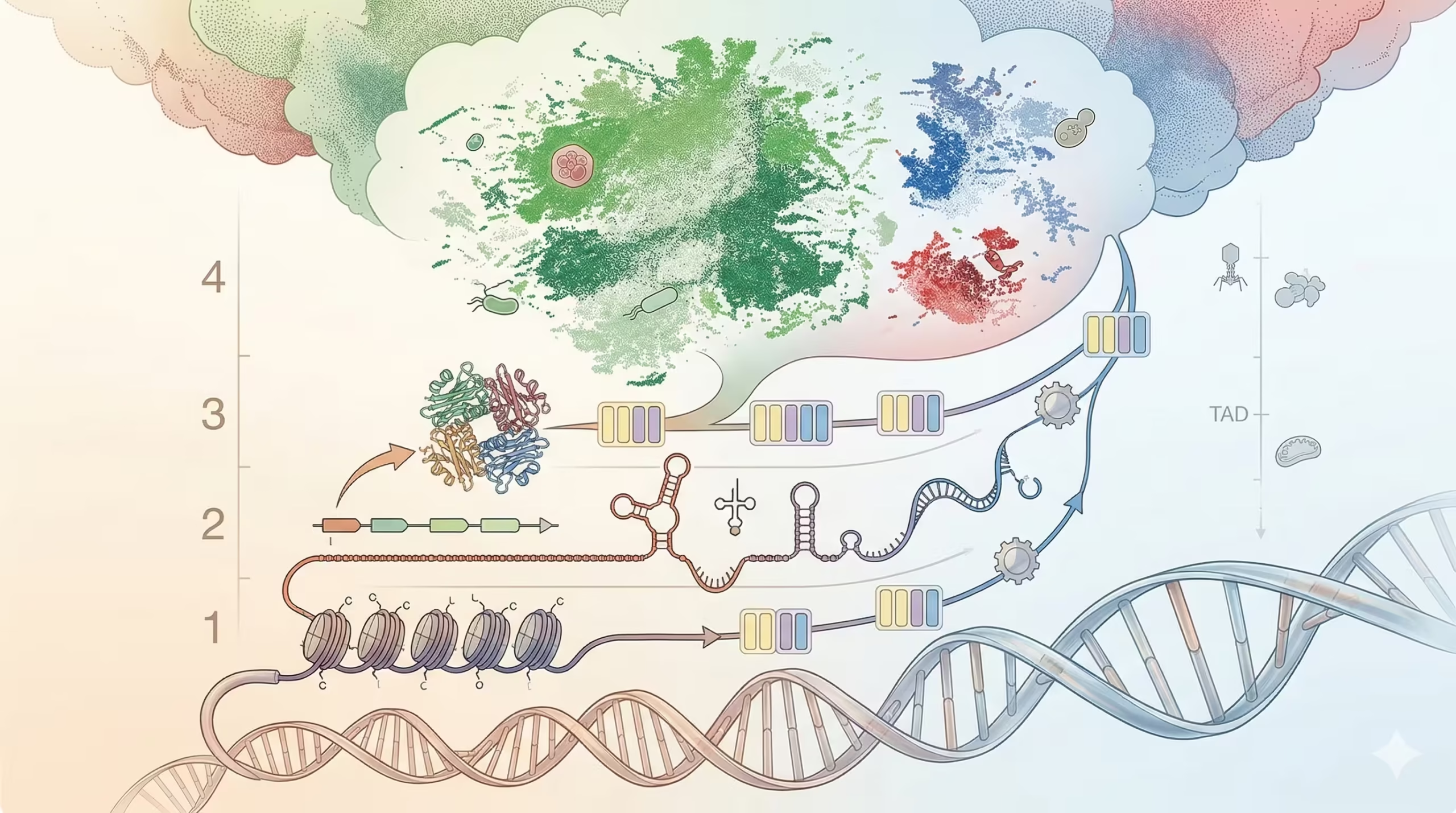
The Multi-Stage Evo 2 Foundation Pipeline
Mastering the 1-Million-Base-Pair Regulatory Landscape
Why is a 1-million-token context window so vital for understanding genetics? In simple bacteria, genes are closely packed into continuous operons. However, in human and eukaryotic genomes, less than 2% of DNA codes directly for proteins. The remaining 98%—once erroneously dismissed as ‘junk DNA’—consists of complex non-coding regulatory sequences: distal promoters, enhancers, silencers, and insulator elements [1] [4].
Inside the living cell nucleus, DNA does not exist as a straight ribbon; it folds into intricate 3D loops called Topologically Associating Domains (TADs). An enhancer sequence located 300,000 base pairs away from a target gene can physically loop through 3D space to touch the promoter and trigger transcription. Models with limited context windows cannot perceive these long-range regulatory contacts. Because Evo 2 processes an entire megabase of sequence at once, it natively captures these 3D chromatin architectures, gene regulation networks, and splicing dynamics without requiring external epigenetic scaffolding [1] [4].
| Architectural Feature | Evo 2 7B | Evo 2 40B | Scientific Impact |
|---|---|---|---|
| Parameter Count | 7 Billion Parameters | 40 Billion Parameters | Provides unprecedented resolution across all domains of life |
| Context Window | 1,048,576 Tokens (1M bp) | 1,048,576 Tokens (1M bp) | Captures distal promoter-enhancer interactions and chromatin loops |
| Core Operator | StripedHyena 2 Multi-Hybrid | StripedHyena 2 Multi-Hybrid | 3x faster processing than standard multi-head attention |
| Training Corpus | 9 Trillion DNA Nucleotides | 9 Trillion DNA Nucleotides | Spans OpenGenome2 across microbes, fungi, plants, and animals |
| Zero-Shot Benchmarks | Top-tier variant scoring | State-of-the-art across ClinVar | Accurately distinguishes pathogenic from benign mutations |
| Generative Synthesis | Functional prokaryotic genes | Synthetic 16-kb mitochondria | Enables de novo design of whole chromosome systems |
Sources: Nature (2026); Arc Institute; Stanford University; Together AI.
Clinical Oncology: Zero-Shot Variant Effect Prediction
One of the most immediate clinical applications of Evo 2 is predicting whether genetic mutations discovered in human patients are harmless normal variations or lethal drivers of disease. In modern medical sequencing, clinicians frequently encounter ‘Variants of Uncertain Significance’ (VUS)—mutations whose clinical outcome cannot be determined from existing medical literature [1].
Evo 2 addresses this challenge through zero-shot variant effect prediction. The model was never fed clinical patient charts, hospital registries, or labeled disease mutations during training. Instead, by learning the evolutionary fitness landscape of 9 trillion nucleotides across four billion years of life, Evo 2 intuitively recognizes when a single-letter alteration violates evolutionary design rules [1].
When evaluated against benchmark clinical datasets for hereditary breast and ovarian cancer genes—specifically BRCA1 and BRCA2—Evo 2 outmatched existing specialized supervised models. It accurately predicted the functional consequence of both missense coding mutations and subtle non-coding splicing alterations, offering a transformative diagnostic tool for personalized oncology and precision therapeutics [1].
| Feature | Standard Attention Transformers | Genomic BreakthroughStripedHyena 2 Hybrid Architecture |
|---|---|---|
| Computational Complexity | Quadratic scaling O(N^2); memory explodes beyond 32k tokens | Sub-quadratic hybrid scaling; effortlessly processes 1M tokens |
| Single-Nucleotide Resolution | Loses subtle single-base mutation signals due to token downsampling | Preserves single-nucleotide fidelity across millions of bases |
| Processing Throughput | High memory latency during training and sequence generation | Up to 3-fold higher inference throughput on modern GPU clusters |
| Multi-Scale Modeling | Struggles to bridge molecular mechanics with chromosome-level topology | Unifies molecules, genes, and topologically associating domains (TADs) |
| Biomolecular Generation | Primarily restricted to short protein fragments or mRNA snippets | Capable of synthesizing complete 16-kb mitochondrial genomes |
Sources: Poli M, et al., NeurIPS; Nature (2026).
Generative Biology: Designing Synthetic Genomes De Novo
Evo 2 is not merely an observational tool; it functions as a creative ‘generative AI’ capable of synthesizing entirely new, functional biological systems. Just as generative models write code or compose essays, Evo 2 generates valid genomic DNA sequences that respect the complex grammatical and biophysical rules of life [1].
- Synthetic Mitochondrial Genomes: When prompted with a small sequence fragment, Evo 2 successfully generated complete, contiguous 16-kilobase human mitochondrial genomes de novo. The synthetic sequences correctly preserved ribosomal RNA genes, transfer RNAs, and protein-coding complexes with natural sequence diversity [1].
- Whole Chromosome Engineering: The model successfully synthesized megabase-scale chromosomes for prokaryotic microbes and eukaryotic yeast (Saccharomyces cerevisiae), generating plausible gene structures and regulatory boundaries [1].
- Directed Chromatin Accessibility: By pairing Evo 2 with epigenetic models like Borzoi and Enformer, researchers designed completely synthetic non-coding regulatory sequences tailored to open chromatin specifically in mouse embryonic stem cells (mESCs), a breakthrough verified in wet-lab experiments [1] [4].
Biosecurity Safeguards and Responsible AI Governance
Because generative AI models possess the dual-use potential to design dangerous biological agents, the developers of Evo 2 established an exemplary biosecurity protocol. Prior to pre-training, the OpenGenome2 corpus was processed through a comprehensive bio-filter that systematically eliminated all genomic sequences belonging to eukaryotic viruses known to infect humans, agricultural livestock, and staple crops [1].
By excluding dangerous mammalian pathogens from its training corpus, the researchers ensured that Evo 2 cannot be exploited to synthesize, enhance, or resurrect dangerous pandemic viruses. This proactive decontamination represents a gold standard in responsible open-source scientific AI governance, ensuring the technology serves solely therapeutic, environmental, and basic biological discovery [1].
Transformative Impact on Precision Medicine and Biotechnology
The emergence of Evo 2 accelerates a paradigm shift across multiple scientific disciplines. In precision medicine, whole-genome sequencing can now be paired with foundation models to predict patient-specific drug responses and identify non-coding pathogenic drivers of rare diseases. In pharmaceutical development, generative genomic design allows scientists to engineer optimized viral vectors for gene therapy and synthesize resilient therapeutic cellular therapies [1].
Beyond human healthcare, Evo 2 provides vital tools for synthetic ecology and sustainability. Industrial biotechnologists can deploy the model to engineer specialized microbial strains capable of metabolizing plastic polymers, sequestering industrial atmospheric carbon, or synthesizing clean biofuels. Much like fundamental physical laws govern black hole event horizons and cosmic structures explored in our astrophysics guide to general relativity and black holes, Evo 2 proves that biological life is governed by deep mathematical regularities that artificial intelligence can finally decode and synthesize [1] [2].
Frequently Asked Questions About Evo 2 AI (FAQ)
What exactly is a biological foundation model?
A biological foundation model is an artificial intelligence system trained on vast, unlabelled biological sequence datasets—such as trillions of DNA base pairs across thousands of species. Rather than solving a single narrow task, it learns the foundational grammar and physical constraints of biological sequences, allowing it to predict mutations, design proteins, and analyze gene regulation without specialized re-training.
How does zero-shot variant effect prediction work?
Zero-shot prediction means the model evaluates whether a genetic mutation is harmful or benign without ever having seen medical or disease data during training. By mastering how nature conserves evolutionary sequence patterns over billions of years, Evo 2 recognizes that mutations disrupting highly conserved structural motifs are likely pathogenic.
Could Evo 2 be misused to engineer hazardous biological pathogens?
The research team implemented rigorous biosecurity guardrails before training began. All genomic sequences belonging to eukaryotic viruses known to infect humans, livestock, and critical agricultural crops were systematically purged from the OpenGenome2 training corpus. As a result, the model cannot be prompted to generate or optimize dangerous human pathogens.
How does a 1-million-token context window benefit genetics?
In human biology, genes are rarely isolated switches; they are regulated by distant enhancers, silencers, and 3D chromatin loops situated hundreds of thousands of base pairs away. A 1-million-token window allows the AI model to observe the entire regulatory neighborhood simultaneously, providing unprecedented insight into complex genetic diseases.
How is Evo 2 different from Google DeepMind's AlphaFold?
AlphaFold focuses specifically on predicting the 3D atomic structure of folded proteins from amino acid sequences. Evo 2 operates on the raw genomic DNA sequence across the entire central dogma of biology, analyzing coding and non-coding DNA, RNA, epigenetic chromatin accessibility, and whole-genome architecture.
Glossary
Scientific terms used in this article
- Foundation ModelUniversal Base Model
- A broad machine learning model trained on massive multimodal data capable of adapting to diverse downstream scientific tasks.
- Base PairDNA Building Block
- The fundamental unit of double-stranded DNA, formed by pairing Adenine with Thymine or Cytosine with Guanine.
- Zero-Shot PredictionPrior-Knowledge Inference
- The capability of an AI model to perform accurate predictions on unseen tasks without task-specific supervised training.
- StripedHyena 2Hybrid Convolutional Operator
- A neural network architecture combining convolutions and gated mechanisms to process ultra-long sequences efficiently.
- Topologically Associating Domain3D Chromatin Loop
- A structural region of the genome where DNA sequences preferentially interact and physically contact each other.
Genome modelling and design across all domains of life with Evo 2
- Journal
- Nature
- Study Type
- Lab
- Year
- 2026
DOI10.1038/s41586-026-10176-5
References
- ↩ Nguyen E, et al. Genome modelling and design across all domains of life with Evo 2. Nature. 2026;627:120-129
- ↩ Poli M, et al. StripedHyena: Moving Beyond Transformers with Hybrid Signal Processing Architectures. Advances in Neural Information Processing Systems (NeurIPS). 2023;36
- Jumper J, et al. Highly accurate protein structure prediction with AlphaFold. Nature. 2021;596:583-589
- ↩ Linder J, et al. Predicting RNA-seq coverage from DNA sequence with Borzoi and Enformer. Nature Genetics. 2025;57:44-55


No comments yet. Be the first to join the conversation.