



Quick Facts
- English Name
- Black Hole
- Also Known As
- Dark Star, Gravitational Singularity
- Field
- Astrophysics, General Relativity
- Discovered (Year)
- 1916
- Discovered By
- Karl Schwarzschild, Albert Einstein, John Wheeler
Key Findings
- A black hole forms when massive stars exceed the Tolman-Oppenheimer-Volkoff limit, collapsing matter beyond the critical Schwarzschild radius.
- Gravitational time dilation near the event horizon causes exterior observers to see falling objects freeze, while the falling object crosses normally.
- Stephen Hawking demonstrated that quantum fluctuations near the horizon produce thermal radiation, causing black holes to slowly evaporate over eons.
What would happen if you gathered every boulder, cliff, and glacier of the entire Himalayan mountain range and compressed them into the microscopic head of a sewing pin? What if the planet Earth itself—with its oceans, continents, and mantle—were squeezed until it fit inside the size of a single marble? While these scenarios sound like fantastical thought experiments, they illustrate the exact mathematical reality behind the universe’s most enigmatic celestial objects: Black Holes [1].
A black hole is not an empty cosmic puncture or a hole in space; rather, it is a region where an immense quantity of mass has been concentrated into an unimaginably compact volume. This extreme concentration warps the surrounding fabric of spacetime so severely that nothing—not even light traveling at 300,000 kilometers per second—can escape its gravitational grasp [2]. Because light cannot break free, telescopes cannot observe a black hole directly. Instead, astrophysicists study these cosmic titans by observing how their immense gravity perturbs nearby companion stars, distorts background starlight, and superheats surrounding gas into blazing, glowing rings of relativistic plasma [1] [2].
From Albert Einstein’s revolutionary equations of General Relativity to the historic first direct imaging by the Event Horizon Telescope (EHT), black holes represent the ultimate frontier of modern astrophysics. They serve as natural laboratories where the two great pillars of contemporary physics—general relativity and quantum mechanics—clash, pointing the way toward an elusive unified theory of quantum gravity [1] [5].
- To transform Earth into a black hole, its entire mass would need to be compressed into a sphere just 9 millimeters wide (the size of a chickpea).
- To turn our Sun into a black hole, it would need to be compressed to a radius of just 3 kilometers.
- A black hole is not a cosmic vacuum cleaner; planets and stars outside its event horizon orbit it normally according to standard Newtonian gravity.
- Astronomers estimate that our Milky Way galaxy alone hosts over 100 million stellar-mass black holes quietly orbiting among the stars.
What is a Black Hole? Warping the Fabric of Spacetime
To understand a black hole, one must first abandon the intuitive Newtonian concept of gravity as a simple pulling force between objects. In 1915, Albert Einstein unveiled his general theory of relativity, revealing that space and time are inextricably linked into a dynamic, four-dimensional fabric called spacetime [6]. Massive objects do not merely exert pull across empty space; they depress and warp the spacetime geometry around them. When a smaller object moves near a massive star, it follows the natural contours of this warped geometry—an effect we perceive and measure as gravitational acceleration.
If an astronomical body concentrates immense mass into a sufficiently small radius, the depression in the spacetime fabric becomes an infinitely steep funnel. In 1916, while stationed on the Russian front during World War I, German astronomer Karl Schwarzschild solved Einstein’s complex field equations and discovered an exact geometric boundary: the Schwarzschild Radius ($R_s = 2GM/c^2$) [6]. If an object’s physical radius shrinks below this critical mathematical threshold, its escape velocity surpasses the speed of light in vacuum, creating an inescapable cosmic boundary known as an event horizon.
Theoretical physics summarizes the simplicity of these objects through the famous ‘No-Hair Theorem’. Regardless of how complex, turbulent, or heterogeneous a collapsing star was—whether it contained oceans, continents, or complex chemical compounds—once it collapses into a black hole, virtually all historical information is erased. From the exterior universe, a classical black hole can be completely described by just three fundamental parameters: its mass, its angular momentum (spin), and its net electric charge [5].
The Gravitational Collapse Cascade: How a Massive Star Becomes a Black Hole
The Life and Death of Stars: How Black Holes Are Born
Not every star in the night sky possesses the physical destiny to become a black hole. Moderate stars like our Sun live peaceful, stable lives spanning billions of years because their existence is defined by an ongoing balance called hydrostatic equilibrium. Deep inside the stellar core, temperatures exceeding millions of degrees drive nuclear fusion, where hydrogen nuclei fuse into helium, releasing enormous outward radiation pressure. Simultaneously, the star’s immense gravitational mass pulls all matter relentlessly inward. As long as outward thermonuclear pressure equals inward gravitational pull, the star shines stably [2].
However, when a supergiant star with a mass 10 to 25 times greater than our Sun exhausts its hydrogen fuel, it begins fusing progressively heavier elements: helium into carbon, carbon into neon, oxygen, and silicon. Eventually, the core is forged into iron. Iron represents the ultimate thermodynamic dead end in nuclear astrophysics. Unlike lighter elements, fusing iron does not release kinetic energy; instead, it absorbs energy, extinguishing the star’s central thermonuclear furnace in a fraction of a second [2] [5].
With outward radiation pressure gone, gravity wins catastrophically. The stellar core collapses inward at nearly a quarter the speed of light. The infalling outer layers rebound off the ultradense core in a cataclysmic supernova explosion, blasting incandescent stellar material across the cosmos. According to calculations established by Indian astrophysicist Subrahmanyan Chandrasekhar (the Chandrasekhar limit of 1.44 solar masses) and expanded by the Tolman-Oppenheimer-Volkoff (TOV) limit (~2.17 solar masses), if the remnant core exceeds approximately 2.2 to 3 solar masses, no known quantum degeneracy force—not even closely packed neutrons—can halt the runaway collapse. The core crushes inward indefinitely, giving birth to a stellar-mass black hole [2] [5].
Centuries of Discovery: The Black Hole Historical Timeline
- 1783
The Dark Star Hypothesis
British natural philosopher John Michell first calculates that a star 500 times larger than the Sun would possess gravity strong enough to trap light. - 1915
General Relativity
Albert Einstein publishes the field equations demonstrating that mass and energy warp the fundamental fabric of spacetime. - 1916
The Schwarzschild Solution
From the World War I Russian front, German physicist Karl Schwarzschild formulates the first exact relativistic solution describing a point-mass singularity. - 1967
Coining the Term 'Black Hole'
American theoretical physicist John Archibald Wheeler popularizes the evocative term ‘black hole’ to replace unwieldy descriptions of collapsed stars. - 1971
First Observational Candidate
Astronomers detect intense X-ray emissions from Cygnus X-1, establishing the first physical observational evidence of a stellar-mass black hole. - 1974
Hawking Radiation Predicted
Stephen Hawking applies quantum field theory to curved spacetime, demonstrating that black holes slowly emit thermal radiation and can evaporate. - 2015
Gravitational Waves Detected
The LIGO observatory makes history by directly measuring spacetime ripples from the collision of two black holes 1.3 billion light-years away. - 2019
First Direct Horizon Image
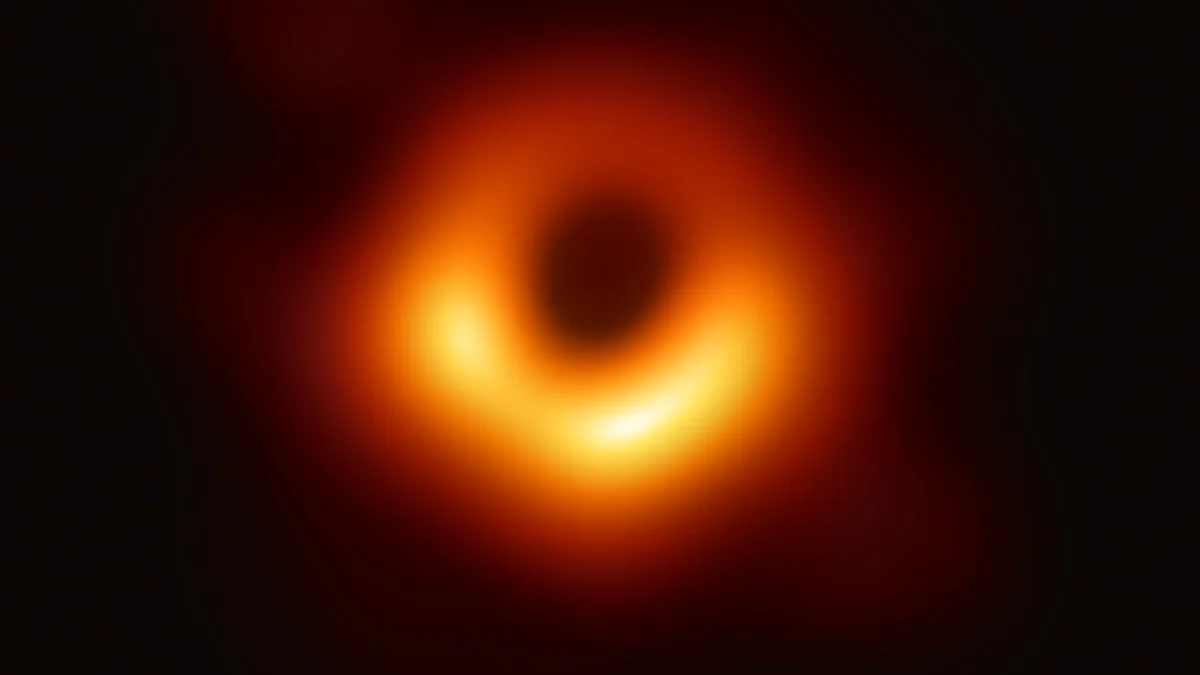
The global Event Horizon Telescope (EHT) collaboration unveils the historic first direct photograph of the supermassive black hole shadow in galaxy M87. - 2022
Milky Way's Heart Revealed
The Event Horizon Telescope releases the groundbreaking direct image of Sagittarius A*, the 4-million-solar-mass black hole anchoring our own galaxy.
Anatomy of a Black Hole: Event Horizon, Singularity, and Ergosphere
Astrophysicists conceptually divide a black hole into several distinct anatomical zones, each governed by extreme and unique physical principles [1] [4]:
- 1. The Event Horizon (Point of No Return): The spherical boundary surrounding the black hole where the local escape velocity exactly equals the speed of light. Anything crossing this threshold is causally disconnected from the rest of the universe. For a black hole with the mass of our Sun, the event horizon radius is approximately 3 kilometers; for the supermassive monster in M87*, it spans billions of kilometers [1] [6].
- 2. The Gravitational Singularity: Located at the dead center of the horizon, the singularity is the theoretical point where the entire mass of the collapsed star is crushed into zero volume. Here, density and spacetime curvature reach infinity, and the classical equations of general relativity fail. Resolving what truly happens at this point requires a yet-undiscovered theory of quantum gravity [5].
- 3. The Accretion Disk and Photon Sphere: Surrounding the black hole is an orbital swirl of super-heated gas and dust. Relativistic friction heats this accretion disk to millions of degrees, causing it to glow brilliantly in X-rays and radio waves. Just outside the horizon lies the photon sphere ($1.5 R_s$), where gravity is so strong that photons of light are forced to orbit the black hole in unstable circles [1].
- 4. The Ergosphere and Frame-Dragging: Real astronomical black holes spin rapidly. In 1963, mathematician Roy Kerr solved the field equations for rotating black holes, predicting an outer region called the ergosphere. Here, spacetime itself is dragged along with the black hole’s rotation (an effect known as frame-dragging). Through the theoretical Penrose Process, future advanced civilizations could potentially extract up to 29% of a black hole’s rotational energy by hurling mass into the ergosphere [5].
| Anatomical Region | Physical Definition | Scientific Significance | Observational Detection Method |
|---|---|---|---|
| Event Horizon | The boundary of no return ($R_s = 2GM/c^2$) | Threshold where escape velocity equals the speed of light; no information escapes | Appears as the inner dark silhouette (shadow) in EHT images |
| Singularity | Infinite density point at the center | Point where all mass is crushed into zero volume; general relativity breaks down | Pure theoretical mathematical deduction |
| Accretion Disk | Relativistic swirling gas and plasma | Viscous friction heats gas to tens of millions of degrees, radiating intense X-rays | Imaged by radio interferometry and space-based X-ray telescopes |
| Photon Sphere | Unstable circular orbit of light ($1.5 R_s$) | Region where photons are gravitationally bent into complete circular orbital loops | Forms the bright, razor-thin inner ring bordering the shadow |
| Ergosphere | Ellipsoidal region outside rotating horizon | Spacetime itself is dragged along with the black hole’s spin (frame-dragging) | Penrose process allows rotational energy extraction up to 29% |
| Relativistic Jets | Collimated beams of magnetic plasma | Super-heated matter accelerated near light speed away from the poles | Imaged across thousands of light-years by radio and gamma-ray arrays |
Sources: Event Horizon Telescope (EHT) Collaboration; NASA Astrophysics Data System; Physical Review Letters.
Gravitational Time Dilation: Freezing the Tick of the Cosmic Clock
One of the most mind-bending consequences of Einstein’s relativity is gravitational time dilation: time ticks slower in stronger gravitational fields—a physical phenomenon with deep implications for chronobiology and time perception, as explored in our neuroscience study on biological rhythms and cognitive focus. Even on Earth, atomic clocks placed at sea level tick fractionally slower than identical clocks resting on the summit of Mount Everest. Global Positioning System (GPS) satellites orbiting 20,000 kilometers above Earth must adjust their onboard atomic clocks by 45 microseconds every day to compensate for weaker gravity; without these relativistic corrections, satellite navigation would drift by over 10 kilometers daily.
Near a black hole’s event horizon, this temporal dilation reaches an infinite disparity. Imagine two astronauts: Arun remains in a safe spacecraft far from the black hole, while Vijay gently drifts toward the event horizon. From Arun’s perspective, as Vijay gets closer to the boundary, Vijay’s movements appear slower and slower. The light waves emitted from Vijay’s suit are stretched to longer, redder wavelengths (gravitational redshift). As Vijay touches the event horizon, Arun sees him freeze in time, dimming to complete invisibility. Arun would have to wait an infinite amount of time to watch Vijay actually cross the threshold [1] [6].
Yet from Vijay’s personal perspective, time flows completely normally! His wristwatch ticks at its regular pace. In a matter of mere moments of his own proper time, Vijay crosses the event horizon without any sensation of freezing, embarking on a one-way trajectory toward the central singularity [5].
| Feature | Stellar-Mass Black Holes | Supermassive Black Holes (SMBHs) |
|---|---|---|
| Mass Scale | 3 to approximately 100 times the mass of our Sun | Hundreds of thousands to tens of billions of solar masses |
| Physical Origin | Catastrophic gravitational collapse of massive stars during supernova explosions | Primordial collapse of giant gas clouds or runaway mergers at galactic centers |
| Horizon Radius | Compact: typically 10 to 300 kilometers wide (size of a small city) | Colossal: millions to tens of billions of kilometers wide (size of our solar system) |
| Tidal Forces at Horizon | Extreme and lethal: destructive tidal gradients tear matter apart far outside horizon | Gentle: mild tidal gradient allows an observer to cross the horizon intact before singularity |
| Spatial Distribution | Scattered by the millions throughout galactic spiral arms and star-forming regions | Anchored exclusively at the dense gravitational centers of nearly all large galaxies |
| Prime Observational Examples | Cygnus X-1, V404 Cygni, GW150914 (LIGO merger event) | Sagittarius A* (Milky Way), M87* (Virgo A cluster) |
Sources: Astrophysical Journal; Monthly Notices of the Royal Astronomical Society (MNRAS).
Spaghettification: Extreme Gravitational Tidal Forces
If an astronaut were to fall feet-first into a stellar-mass black hole, they would experience an extraordinary physical phenomenon astrophysicists call Spaghettification (or the noodle effect). Gravity decreases sharply with distance according to an inverse-cube relationship ($1/r^3$) for tidal gradients. Because the astronaut’s feet are approximately six feet closer to the singularity than their head, the gravitational pull on their feet is orders of magnitude stronger than the pull on their head [5].
Simultaneously, the lines of gravitational force converge toward the center, violently compressing the astronaut inward from the sides. The combined effect stretches the human body vertically like pulled dough while squeezing it horizontally, eventually ripping organic tissue, molecules, and atoms into a thin, continuous string of subatomic particles before they reach the singularity. Interestingly, this tidal tearing occurs far outside the horizon for small stellar black holes, but for supermassive giants like Sagittarius A*, the horizon is so immense that an astronaut could pass through the event horizon without feeling severe tidal discomfort [1] [4].
Hawking Radiation: Can Black Holes Evaporate and Die?
For decades, physicists assumed that black holes were cosmic dead ends from which nothing could ever escape. In 1974, British theoretical physicist Stephen Hawking united quantum field theory with general relativity and made a stunning discovery: black holes emit steady thermal radiation, now known as Hawking Radiation [3].
According to quantum mechanics, the vacuum of space is not empty but teems with virtual particle-antiparticle pairs that spontaneously pop into existence and annihilate each other in fractions of a second. Hawking demonstrated that right at the event horizon, one partner of the virtual pair can fall into the black hole before annihilation, while the other escapes into space as real radiation [3].
Because the escaping particle carries away positive energy, the black hole must lose an equivalent amount of mass according to Einstein’s mass-energy equivalence ($E = mc^2$). Over incomprehensibly long cosmic epochs—roughly $10^{67}$ years for a stellar black hole—the black hole slowly loses mass, shrinks, and eventually detonates in a final burst of high-energy gamma rays. Hawking radiation sparked the profound Black Hole Information Paradox, questioning whether quantum information is permanently destroyed when a black hole evaporates [3] [5].
How Astronomers ‘See’ the Unseeable: Modern Observational Breakthroughs
How do astronomers verify the existence of objects that swallow light? Over the past fifty years, astronomers have developed four ingenious observational methodologies [1] [2] [4]:
- 1. Stellar Kinematics: By tracking the high-speed orbital paths of stars around an invisible center of mass. Over two decades of observations by Nobel laureates Reinhard Genzel and Andrea Ghez revealed stars orbiting an invisible object at the center of the Milky Way at speeds up to 5,000 km/s, proving the existence of Sagittarius A*, a supermassive black hole containing 4 million solar masses [4].
- 2. High-Energy X-Ray Emission: When a black hole strips gas from a nearby companion star, the spiraling accretion disk heats up to tens of millions of degrees, radiating luminous X-rays detected by orbiting observatories like NASA’s Chandra X-ray Observatory [1].
- 3. Gravitational Wave Astronomy: On September 14, 2015, the Laser Interferometer Gravitational-Wave Observatory (LIGO) made history by detecting physical ripples in spacetime produced by the merger of two black holes 1.3 billion light-years away, opening an entirely new window onto the universe [2].
- 4. Very Long Baseline Interferometry (VLBI): In 2019, the Event Horizon Telescope combined synchronized radio observatories across Earth into a planet-sized virtual dish, creating the iconic first direct image of the black hole shadow in galaxy Messier 87 (M87*), followed in 2022 by the image of Sagittarius A* [1] [4]. Modern processing of these petabytes of astronomical data relies heavily on advanced computational neural networks and signal processing algorithms, reminiscent of advances in our guide to machine learning and neural architectures.
Frequently Asked Questions About Black Holes (FAQ)
If black holes suck in everything, will our Sun or the Milky Way eventually be swallowed?
No. Black holes do not act as cosmic vacuum cleaners that pull objects from across space. Gravity outside the event horizon obeys the standard laws of physics. If the Sun were instantaneously replaced by an identical 1-solar-mass black hole, Earth would continue orbiting exactly as it does today, unaffected by extra gravitational pull, though it would freeze without sunlight.
Can an astronaut physically survive crossing the event horizon of a supermassive black hole?
In a supermassive black hole (like M87*), the event horizon is vast, and the gravitational gradient between the astronaut’s head and feet is remarkably gentle. The astronaut could smoothly cross the event horizon without feeling tearing tidal forces. However, once inside, all future spacetime paths inexorably lead toward the central singularity, where destruction is unavoidable.
What actually happens to time as an object approaches a black hole?
Due to gravitational time dilation predicted by Einstein, clocks run significantly slower in deep gravitational fields. An observer watching from a safe distance would see the falling object slow down, dim, and appear frozen at the event horizon forever. Conversely, the falling object experiences time normally and crosses the boundary in a few moments of proper time.
Do black holes live forever, or can they die?
Black holes do not live forever. As Stephen Hawking proved in 1974, quantum vacuum fluctuations at the event horizon produce thermal radiation known as Hawking radiation. Over unimaginably long cosmic timescales (up to 10^67 years for stellar black holes and 10^100 years for supermassive ones), black holes slowly lose mass and ultimately evaporate in a burst of gamma rays.
How do astronomers take a picture of something that emits no light?
Astronomers do not photograph the interior of the black hole itself; rather, they photograph its silhouette or ‘shadow.’ The glowing accretion disk of super-heated gas orbiting just outside the photon sphere provides an intense illuminated background, against which the dark, light-trapping silhouette of the event horizon is crisply outlined.
Glossary
Scientific terms used in this article
- Event HorizonPoint of No Return
- The boundary marking the threshold where the escape velocity of a black hole exceeds the universal speed of light.
- Gravitational SingularityInfinite Density Center
- The central mathematical point of infinite curvature and zero volume where the laws of classical physics break down.
- Schwarzschild RadiusCritical Horizon Radius
- The exact radius to which an object of given mass must be compressed to create a gravitational event horizon.
- SpaghettificationTidal Stretching
- The vertical elongation and horizontal compression of an object subjected to extreme gravitational tidal gradients.
- Hawking RadiationQuantum Thermal Emission
- The theoretical particle-antiparticle radiation emitted by black holes due to quantum vacuum effects near the event horizon.
First M87 Event Horizon Telescope Results. I. The Shadow of the Supermassive Black Hole
- Journal
- The Astrophysical Journal Letters
- Study Type
- Report
- Year
- 2019
DOI10.3847/2041-8213/ab0ec7
References
- ↩ Event Horizon Telescope Collaboration. First M87 Event Horizon Telescope Results. I. The Shadow of the Supermassive Black Hole. The Astrophysical Journal Letters. 2019;875(1):L1
- ↩ Abbott BP, et al. (LIGO Scientific Collaboration and Virgo Collaboration). Observation of Gravitational Waves from a Binary Black Hole Merger. Physical Review Letters. 2016;116(6):061102
- ↩ Hawking SW. Black hole explosions? Nature. 1974;248(5443):30-31
- ↩ Event Horizon Telescope Collaboration. First Sagittarius A* Results. I. The Shadow of the Supermassive Black Hole in the Centre of the Milky Way. The Astrophysical Journal Letters. 2022;930(2):L12
- ↩ Penrose R. Gravitational Collapse and Space-Time Singularities. Physical Review Letters. 1965;14(3):57-59
- ↩ Schwarzschild K. Über das Gravitationsfeld eines Massenpunktes nach der Einsteinschen Theorie. Sitzungsberichte der Königlich Preussischen Akademie der Wissenschaften. 1916:189-196



No comments yet. Be the first to join the conversation.