



Key Findings
- Sodium bicarbonate reacts with batter acids to instantly generate millions of carbon dioxide micro-bubbles that seed cake leavening.
- Thermal expansion following Charles's Law and steam vaporization inflate trapped bubbles until gluten and starch gelatinize at 80°C.
- Excess baking soda leaves unreacted alkaline sodium carbonate, producing an acrid soapy taste and causing over-expanded cakes to collapse.
Few sensory experiences in the culinary world rival the delight of slicing into a freshly baked cake, warm, feather-light, and yielding a tender, delicate crumb that melts across the palate. Yet for home bakers and pastry chefs alike, observing a dense, liquid amalgam of flour, sugar, eggs, and butter expand into a voluminous golden sponge inside an oven can seem almost miraculous, balancing glycemic density where simple habits like walking after meals manage blood sugar. Behind this familiar kitchen transformation lies no sorcery, but a masterclass in organic chemistry, thermodynamics, and polymer physics governed by a humble white mineral powder: baking soda [1, 2].
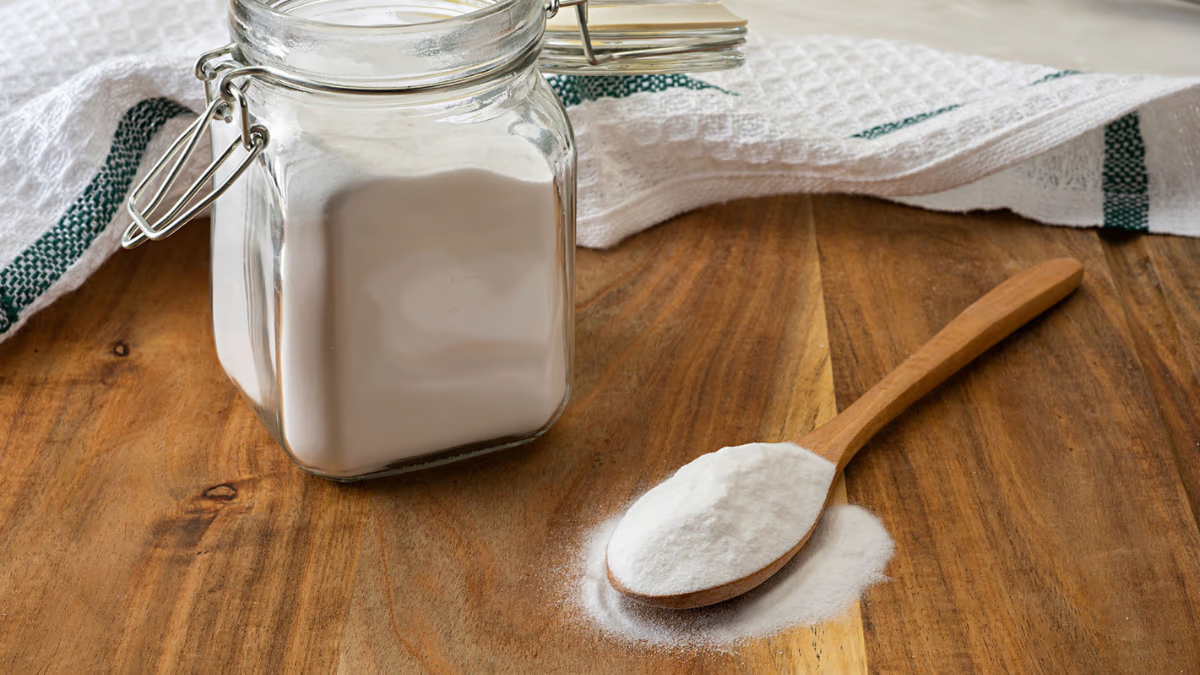
Known systematically in inorganic chemistry as sodium bicarbonate (NaHCO3), baking soda functions as a chemical leavening agent. When blended into batter alongside acidic liquids and subjected to oven thermal currents, it initiates an energetic cascade of acid-base neutralization, gas nucleation, and structural setting. Understanding the exact molecular choreography of baking soda elevates baking from blind recipe-following into an art of predictable culinary engineering [1, 3].
The Alchemy of the Oven: Transforming Heavy Batter into Light Crumb
Before examining chemical reactions, one must appreciate the physical dilemma of cake batter. Raw batter is essentially a thick, high-density fluid emulsion. Fat globules, starch granules, dissolved sucrose, and hydrated proteins form a heavy slurry with a specific gravity far too dense to bake into anything edible on its own. If baked without a leavening mechanism, the mixture coagulates into a rubbery, leaden slab resembling dense fudge or wet clay [1, 2].
To produce an aerated, porous sponge, the batter requires billions of microscopic gaseous cavities distributed evenly throughout its volume. These gas cells serve two structural roles: they decrease overall bulk density and provide room for thermal expansion. While physical creaming (whipping butter and sugar together) incorporates an initial baseline of air pockets, mechanical creaming alone lacks the propulsive power required to overcome the viscous resistance of flour proteins. This is where chemical leaveners provide the decisive evolutionary leap in baking science [2, 3].
The Fundamental Chemical Equation: Sodium Bicarbonate Neutralization
Baking soda is a slightly alkaline chemical salt composed of sodium cations (Na+) and bicarbonate anions (HCO3-). In dry crystalline form, sodium bicarbonate is entirely stable at room temperature. However, the moment it dissolves in water alongside an acidic proton donor (H+), an instantaneous, stoichiometric acid-base neutralization occurs [1, 4]:
NaHCO3 + H+ → Na+ + H2CO3 → Na+ + H2O + CO2 ↑
The bicarbonate ion reacts with the free hydronium ion to form unstable carbonic acid (H2CO3), which rapidly decomposes into liquid water and gaseous carbon dioxide (CO2). In a typical cake batter, common culinary acids supply the requisite protons: lactic acid from buttermilk or yogurt, citric acid from lemon juice, acetic acid from vinegar, tartaric acid from molasses, or natural phenolic acids present in unprocessed natural cocoa powder [1, 2].
This reaction activates immediately upon wetting at room temperature. Millions of carbon dioxide molecules nucleate around pre-existing microscopic air bubbles whipped into the batter during mixing. Because carbon dioxide is produced in enormous molecular volume, internal pressure builds within each micro-bubble, causing them to swell gently while the batter rests in the pan [1, 3].
The 3 Stages of Cake Leavening and Structure Formation
Acid-Base Gas Burst
Sodium bicarbonate dissolves and neutralizes batter acids, rapidly releasing millions of CO2 gas molecules that seed tiny air pockets.
Charles’s Law Lift
Oven heat excites trapped CO2 and vaporizes batter water into steam, dramatically multiplying bubble volume and inflating the batter upward.
Permanent Crumb Set
At 80°C to 85°C, egg ovalbumin coagulates and wheat starches gelatinize, locking inflated gas chambers into an airy, permanent crumb scaffold.
The Thermal Expansion Phase: Charles’s Law and Steam Dynamics
Once the cake pan enters a preheated oven (typically 175°C to 180°C), a secondary physical leavening mechanism takes over. According to Charles’s Law of Ideal Gases, the volume of a confined gas is directly proportional to its absolute temperature. As heat penetrates the wet batter, the kinetic energy of trapped carbon dioxide molecules escalates rapidly, exerting outward hydrostatic pressure against surrounding fluid walls [1, 2].
Furthermore, as interior batter temperature approaches 100°C, moisture in the batter begins to vaporize into water vapor (steam). Steam expands to roughly 1,600 times the volume of liquid water. This vapor does not create new bubbles from scratch; instead, it migrates into pre-existing carbon dioxide cavities seeded by baking soda. The synergistic partnership between thermal CO2 expansion and water vapor pressure causes the cake to rise dramatically in the oven [1, 3].
In addition, sodium bicarbonate possesses a secondary thermal property: even in the absence of an acid, pure NaHCO3 undergoes thermal decomposition once temperatures exceed 80°C (176°F):
2 NaHCO3 (heat > 80°C) → Na2CO3 + H2O + CO2 ↑
This thermal decomposition provides a late-stage burst of leavening gas deep in the center of the baking cake, maintaining lift until structural proteins set [1, 4].
The Gluten-Starch Scaffold: How Micro-Bubbles Form Permanent Air Cells
Generating expanding gas is only half the battle; the batter must possess sufficient viscoelastic strength to trap that gas without rupturing. This structural integrity is provided by wheat flour proteins (gliadin and glutenin) and egg proteins (primarily ovalbumin) [2].
As gas bubbles swell, surrounding gluten strands stretch into thin, elastic membranes resembling elastic balloons. If the batter contains too little protein or too much sugar and fat, the bubble membranes stretch too thin, burst prematurely, and allow carbon dioxide to vent out into the oven air, causing the cake to collapse in the center [1, 3].
Between 75°C and 85°C, two decisive chemical transformations finalize cake architecture: wheat starch granules absorb free water and swell (gelatinization), while egg and gluten proteins undergo thermal denaturation, linking into rigid, insoluble three-dimensional matrices. Once this protein-starch scaffold solidifies, the flexible balloon walls freeze permanently into rigid cellular air pockets. When the cake cools and internal steam condenses back to water, the open-celled crumb maintains its tall, spongy height [2, 4].
Chemical Leavener Comparison: Baking Soda vs Baking Powder
| Parameter | Baking Soda (Pure NaHCO3) | Single-Acting Baking Powder | Double-Acting Baking Powder |
|---|---|---|---|
| Active Composition | 100% Sodium Bicarbonate | Soda + Tartaric acid + Cornstarch | Soda + MCP (fast) + SAPP/SAS (heat-activated) |
| Acid Requirement | Requires external batter acid | Self-contained acid salts | Self-contained dual-acid system |
| Reaction Timing | Immediate upon mixing (fast) | Immediate upon hydration (fast) | 1st burst during mixing, 2nd burst in oven heat |
| Leavening Strength | 3x to 4x stronger per gram | Standard baseline strength | Standard baseline strength |
Baking Soda vs Baking Powder: The Single vs Double-Acting Distinction
One of the most frequent sources of kitchen confusion is the distinction between baking soda and baking powder. While both chemicals release carbon dioxide gas, their chemical formulations and reaction kinetics differ profoundly [1, 3]:
Baking Soda: Consists solely of pure, unadulterated sodium bicarbonate. It possesses approximately three to four times the leavening strength of commercial baking powder per gram. However, it is utterly inert unless the baker supplies an external acidic liquid. Because it reacts instantly upon contact with moisture, batters leavened solely with baking soda must be baked immediately before liberated gas escapes [1, 2].
Baking Powder: A complete, pre-balanced leavening system containing sodium bicarbonate, one or more dry acid salts, and an inert buffer (usually cornstarch) to prevent premature reaction in the container. Modern commercial baking powders are almost universally double-acting. They combine a fast-acting acid like monocalcium phosphate (MCP), which reacts at room temperature to seed bubbles, with a slow-acting, heat-activated acid like sodium aluminum sulfate (SAS) or sodium acid pyrophosphate (SAPP). The second acid only dissolves and reacts once batter temperatures cross 55°C in the oven, providing an indispensable insurance policy against flat cakes [1, 4].
The Maillard Reaction and pH: Flavor, Browning, and Crust Chemistry
Beyond leavening, baking soda exerts a profound influence on cake flavor, color, and texture through pH regulation, much like adding salt to sweets enhances flavor chemistry. When baking soda neutralizes excess acids in batter, it raises the overall pH toward a slightly alkaline level (pH 7.2 to 7.8) [2, 3].
This elevated pH serves as a powerful catalyst for the Maillard reaction, the complex non-enzymatic browning reaction between amino acids and reducing sugars. In alkaline environments, amino groups remain unprotonated and far more nucleophilic, reacting with reducing sugars at significantly lower temperatures. Consequently, cakes containing balanced baking soda develop deep golden-brown crusts, rich toffee and nutty aromas, and a delicate, melting crumb texture [1, 3].
Culinary Pitfalls: The Chemistry of Sinking Cakes and Soapy Off-Flavors
Precision is mandatory when measuring chemical leaveners. Adding too much baking soda in an attempt to make a cake extra fluffy inevitably triggers disastrous culinary consequences [1, 2]:
1. The Sunken Crater Effect: Excessive baking soda generates an overwhelming flood of carbon dioxide. The gas bubbles expand beyond the tensile strength of the delicate gluten-egg matrix, coalescing into giant pockets that rupture and collapse before starch gelatinization can set the structure. The cake collapses into a sunken crater with a gummy, dense center [2].
2. Alkaline Off-Flavors: If the batter lacks sufficient acid to neutralize all the sodium bicarbonate, residual unreacted NaHCO3 decomposes thermally into sodium carbonate (Na2CO3). Sodium carbonate is a strong alkaline salt that imparts an unmistakable, acrid, bitter, and soapy chemical taste, while turning the cake crumb an unappealing yellowish-green hue [1, 3].
Practical Kitchen Science: Testing Freshness and Balancing Ratios
To guarantee flawless baking outcomes, professional culinary scientists adhere to standard stoichiometric rules of thumb [1, 2]:
The Golden Ratio: In standard scratch baking, the ideal proportion is 1/4 teaspoon (roughly 1.25 grams) of baking soda per 1 cup (120–140 grams) of all-purpose flour. This volume delivers optimal carbon dioxide production while being easily neutralized by 1/2 cup of buttermilk, yogurt, or sour cream [1].
The Freshness Fizz Test: Sodium bicarbonate can absorb ambient humidity and slowly degrade over months in a kitchen cupboard. To verify its potency before baking, drop 1/2 teaspoon of baking soda into 2 tablespoons of white vinegar or fresh lemon juice. If it fizzes furiously with immediate foaming eruptions, the leavener is active; if it produces sluggish, weak bubbling, discard the container immediately [1, 3].
Frequently Asked Questions (FAQ)
Can I substitute baking powder for baking soda?
Yes, but because baking powder contains acid salts and starch, it is only about one-third as strong. You need roughly 3 teaspoons of baking powder to replace 1 teaspoon of baking soda. Additionally, eliminate any added acids from the recipe to avoid an overly sour batter.
Why does my cake have a bitter or soapy taste?
A soapy flavor indicates an excess of unreacted sodium bicarbonate. When batter lacks enough acid to fully neutralize the baking soda, residual soda converts into sodium carbonate, which tastes sharply alkaline and bitter.
How does yeast differ from baking soda in baking?
Yeast is a living single-celled fungus that ferments sugars over hours to produce carbon dioxide and ethanol, creating complex bread flavors. Baking soda is a pure chemical compound that produces carbon dioxide instantaneously upon contact with acid.
Why did my cake rise high and then sink in the middle?
A sunken cake typically results from using too much baking soda, opening the oven door too early, or insufficient baking time. Excess gas causes bubbles to over-expand and burst before the gluten-egg scaffold solidifies.
The Chemistry of Leavening Agents: Sodium Bicarbonate in Culinary Applications
- Journal
- Journal of Chemical Education
- Study Type
- journal
- Year
- 1985
DOI10.1021/ed062p742
Emulsion and leavening interactions in baking
- Journal
- Food Chemistry
- Study Type
- journal
- Year
- 2019
DOI10.1016/j.foodchem.2019.125219
Acid-base leavening reaction and fluffy cake texture
- Journal
- Journal of Emerging Investigators
- Study Type
- journal
- Year
- 2022
DOI10.59720/22-020
On Food and Cooking: The Science and Lore of the Kitchen
- Journal
- Scribner
- Study Type
- book
- Year
- 2004
References
- ↩ Journal of Chemical Education (1985). The Chemistry of Leavening Agents: Sodium Bicarbonate in Culinary Applications. Journal of Chemical Education, 62(9), 742.
- ↩ Food Science Research Group (2019). Emulsion and leavening interactions in baking. Food Chemistry, 298, 125219.
- ↩ Journal of Emerging Investigators (2022). Acid-base leavening reaction and fluffy cake texture. Journal of Emerging Investigators, 5, 22-020.
- ↩ McGee, H. (2004). On Food and Cooking: The Science and Lore of the Kitchen. Scribner.

No comments yet. Be the first to join the conversation.