


Key Findings
- Household source segregation into organic wet waste and recyclable dry waste eliminates over 80% of domestic landfill contributions.
- Domestic Reverse Osmosis (RO) purifiers discard 3 liters of water for every 1 liter purified, producing reusable greywater ideal for mopping and flushing.
- Aerated balcony composting maintains a 2:1 carbon-to-nitrogen ratio, preventing anaerobic putrefaction and eliminating foul odors completely.
- Harvesting pure AC condensate provides mineral-free distilled water ideal for steam irons, vehicle coolant top-ups, and sensitive indoor plants.
Every morning across our sprawling cities, a familiar routine plays out. Front doors open, and plastic garbage bags bulging with unsegregated domestic refuse—yesterday’s onion skins, plastic courier wrappers, food leftovers, and milk pouches—are handed over to municipal sanitary workers or discarded into communal street bins. By mid-morning, thousands of diesel dump trucks haul this collective burden toward gargantuan suburban dumping grounds [1] [2].
There, compressed under millions of tons of older trash without oxygen, this organic matter decays anaerobically, leaching toxic black leachate into groundwater aquifers and outgassing potent methane plumes that trigger spontaneous subsurface fires. Simultaneously, inside our modern kitchens and apartments, domestic reverse osmosis (RO) water purifiers silently discard up to 60 liters of clean, mineral-rich wastewater directly into the drainage line every single day [3].
We face a striking urban paradox: cities spend crores transporting domestic water across hundreds of kilometers while tankers charge premium prices during summer droughts, yet urban households discard thousands of liters of usable water and discard nutrient-rich compostables as worthless refuse. Grounded in directives from the Central Pollution Control Board (CPCB) and municipal solid waste guidelines, this guide provides a practical, science-backed framework to convert any city home or apartment into an eco-conscious zero-waste sanctuary [1] [3].
- 5,400+ Tons
- Daily Urban Waste Average municipal solid waste generated daily across major metropolitan cities
- 3 : 1
- RO Reject Ratio Three liters of mineral-rich water discarded for every single liter purified
- 80%+
- Landfill Diversion Potential reduction in household garbage achievable through two-bin segregation and composting
- 15 Liters
- Daily AC Condensate Free mineral-free distilled water harvested per operating split AC unit daily
Daily Urban Realities: The Escalating Waste and Water Crisis on Our Doorstep
Rapid urban migration has outpaced traditional municipal waste infrastructure. A standard urban family of four generates approximately 2 to 2.5 kilograms of solid waste daily. Compositional analyses published by municipal corporations reveal that between 55% and 65% of this volume comprises biodegradable organic wet waste—vegetable trimmings, tea grounds, fruit peels, and cooked remnants [2].
When wet organic matter is intermixed with dry plastics, paper, and sanitary waste, the entire batch becomes hopelessly contaminated. Recyclable plastics cannot be salvaged by sanitation workers, paper fibers turn to pulp, and the entire mass is condemned to the dump yard. Conversely, when waste is segregated cleanly at the exact point of origin—the household kitchen—the dynamics reverse completely: wet waste transforms into organic soil fertilizer, dry recyclables enter circular manufacturing streams, and residual landfill contributions plunge by over 80% [1] [2].

The Art of Source Segregation: Organizing Wet, Dry, and Sanitary Waste
Achieving effective waste segregation does not require complex automated sorting machines or frontier Artificial Intelligence algorithms; it simply requires establishing an intuitive three-stream sorting station in your kitchen area [1]:
- Green Bin (Biodegradable Organic Wet Waste): Fruit and vegetable trimmings, coffee grounds, eggshells, tea dregs, wilted flowers, and raw garden leaves. This stream feeds your home compost bin.
- Blue Bin (Clean Dry Recyclables): Cardboard cartons, clean milk pouches (washed and dried), glass bottles, metal tins, PET beverage bottles, and unsoiled paper. Keep this stream dry to prevent mold growth.
- Red Bin / Pouch (Sanitary and Domestic Hazardous Waste): Used diapers, sanitary napkins, adhesive bandages, expired pharmaceuticals, razor blades, and aerosol cans. Wrap securely in newspaper before disposal.

Odorless Home Composting: Converting Kitchen Scraps into Nutrient-Rich Humus
The single greatest psychological barrier preventing urban apartment dwellers from composting is the fear of foul odors, maggots, and insect infestations. Yet biological science reveals that foul odors are not an inevitable consequence of decomposition; they are symptoms of anaerobic suffocation caused by excess moisture and lack of oxygen [1] [2].
Aerobic composting relies on oxygen-breathing bacteria (actinomycetes) that break down organic carbohydrates into rich humus without generating foul-smelling hydrogen sulfide or ammonia. To maintain this aerobic balance on an apartment balcony or terrace, follow the fundamental Carbon-to-Nitrogen Ratio (C:N):
- Greens (Nitrogen-Rich): Vegetable rinds, fruit peels, and fresh plant cuttings. These provide moisture and metabolic fuel for bacterial colonies.
- Browns (Carbon-Rich): Dry crushed leaves, coco peat, fine sawdust, or shredded corrugated cardboard. These absorb excess liquid and create physical air pockets.
The Golden Rule: For every handful of wet green kitchen scraps added to your aerated composter, top it immediately with two handfuls of dry brown coco peat or dry leaves. Turn the pile once weekly with a small garden fork to reintroduce fresh oxygen. Within 45 to 60 days, active microbial activity yields “black gold”—dark, crumbly, sweet-smelling organic compost that supercharges balcony container gardens [1].

Reclaiming RO Reject Water: Simple Plumbing Solutions for Domestic Conservation
Domestic Reverse Osmosis (RO) water purification has become ubiquitous across urban Indian apartments. However, standard household RO membranes operate with a recovery efficiency of only 25% to 30%. This means that to generate 1 liter of purified drinking water, the unit expels roughly 3 liters of “reject water” directly down the kitchen sink drain [3].
For an average household purifying 20 liters of water daily, 60 liters of high-utility water is squandered—accumulating to over 1,800 liters every month. Contrary to popular misconception, RO reject water is not sewage; it is simply potable feed water with a higher concentration of natural dissolved mineral salts (typically 800 to 1,500 ppm Total Dissolved Solids) [3].

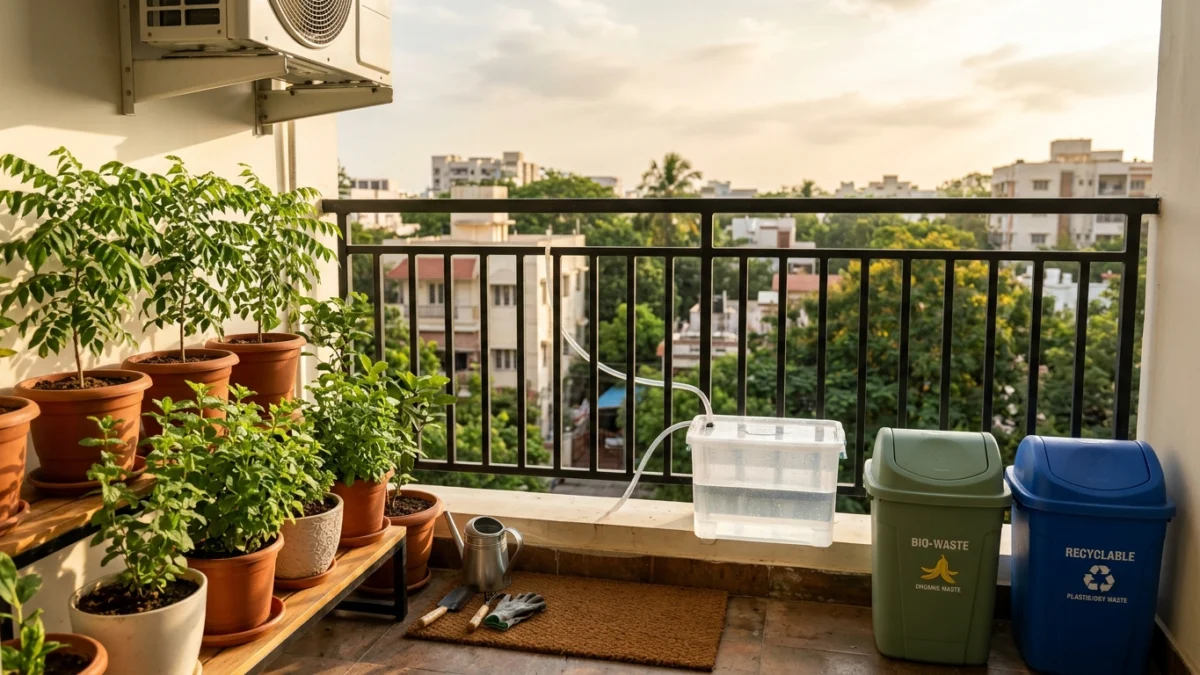
Reclaiming this stream is remarkably straightforward. Route the flexible white reject tube into a dedicated 50-liter plastic drum or bucket placed adjacent to your kitchen sink or utility balcony. This water is perfectly suited for daily floor mopping, pre-washing greasy plates, flushing toilet cisterns, washing balconies, and cleaning car tyres [3].
| Water Source | Chemical Character & Mineral Profile | Recommended Reusable Applications | Unsafe / Prohibited Uses |
|---|---|---|---|
| RO Reject Water | Moderate to high salinity (TDS 800–1,500 ppm); concentrated dissolved minerals | Floor mopping, toilet flushing, pre-rinsing greasy utensils, hardy ornamental plants | Drinking, cooking, infant laundry, salt-sensitive potted greens |
| AC Condensate | Pure atmospheric condensate; virtually zero TDS (mineral-free distilled water) | Steam irons, lead-acid inverter batteries, vehicle radiator top-up, misting delicate houseplants | Direct human consumption without mineral remineralization |
| Rice & Pulse Rinse Water | Starch-rich, mild carbohydrate & nitrogen suspension; non-toxic | High-nutrient fertilizer water for kitchen garden herbs, flowering potted plants, and microgreens | Long-term closed tank storage (ferments and sours if left over 24 hours) |
| Washing Machine Final Rinse | Dilute detergent residue; low chemical oxygen demand | Outdoor porch scrubbing, car tyre washing, toilet bowl pre-soaking | Edible vegetable gardening, direct discharge into storm drains |
Sources: Central Pollution Control Board (CPCB) Urban Greywater Directives; Environmental Engineering Literature.
Harvesting Pure AC Condensate: Free Distilled Water for Household Utilities
During warm and humid summer seasons, split air conditioning units operate continuously across millions of urban residences. As warm indoor room air circulates across chilled evaporator coils, atmospheric humidity condenses into liquid water and drains out through an external drain line. A single 1.5-ton split AC running for 8 hours in coastal or humid regions produces between 10 and 15 liters of pure condensate daily [3].
Because this water is condensed atmospheric vapor, its Total Dissolved Solids (TDS) measure almost zero—making it identical to laboratory distilled water. Instead of allowing this liquid to drip down balcony railings, position a clean plastic canister below the drain outlet. This mineral-free water is exceptional for filling steam clothes irons (preventing internal calcium scale), topping up automotive inverter batteries, and misting delicate indoor ornamental foliage [3].

Kitchen Nutrient Waters: Natural Bio-Fertilizers for Terrace Gardens
In traditional South Indian households, culinary greywater was never discarded into open drains. The cloudy water obtained after rinsing raw rice, lentils, pulses, and boiled vegetable broths contains suspended starches, soluble proteins, trace minerals, and micro-nutrients. When poured onto balcony potted plants, these natural starches feed beneficial soil microbes, enhancing root mycorrhizal networks and accelerating flowering without requiring synthetic chemical fertilizers [1] [2].

| Feature | Conventional Household | RecommendedEco-Conscious Zero-Waste Home |
|---|---|---|
| Daily Garbage Output | 2 to 3 kg unsegregated mixed trash sent directly to landfills | Under 200g clean dry recyclables (80%+ landfill diversion) |
| Water Purifier Wastage | 60+ liters of RO reject water flushed directly into the sewer | 100% captured and repurposed for daily mopping and toilet cisterns |
| AC Condensate | Drips wastefully down balcony drainage pipes | 10–15 liters collected daily for steam irons, car care, and indoor plants |
| Kitchen Organic Scraps | Rots anaerobically in municipal dump yards, generating methane | Transformed in 45 days into odorless, dark, nutrient-rich organic compost |
| Household Economics | Recurring expenses on bottled water, synthetic fertilizers, and drain cleaners | Saves ₹500–₹1,000 monthly on water tankers, plant care, and household utilities |
Sources: Greater Chennai Corporation (GCC) Solid Waste Reports; Central Pollution Control Board (CPCB).
Eliminating Single-Use Plastics: The Power of Circular Daily Habits
While managing domestic waste after generation is vital, refusing unnecessary packaging at the source is the foundational tenet of circular zero-waste living. The ubiquitous yellow cloth shopping bag—traditionally known as the Manjappai in Tamil culture—represents centuries of practical zero-waste wisdom [4].
By keeping two washable cloth bags in your commuter vehicle or office bag, refusing flimsy single-use plastic carry bags at grocery stores, purchasing pantry staples in bulk glass canisters, and carrying a refillable stainless-steel water bottle, an individual prevents over 300 disposable plastic items from entering landfills every single year [4].

The 7-Day Action Plan: Transforming Your Urban Home Step by Step
Transitioning toward a zero-waste household does not happen overnight. Sustainable lifestyle shifts succeed when implemented as incremental, repeatable daily habits [1] [2]:
- Day 1 (Audit & Organize): Set up two distinct bins in your kitchen: Green for wet compostables and Blue for dry recyclables.
- Day 2 (RO Water Diversion): Connect an extended 1/4-inch food-grade tube to your RO reject outlet and guide it into a 50-liter utility collection bucket.
- Day 3 (AC Water Harvesting): Place a clean collection canister beneath your split AC drain pipe to capture distilled condensate.
- Day 4 (Compost Bin Setup): Set up an aerated balcony terracotta or plastic composter; layer the base with 3 inches of coco peat or dry leaves.
- Day 5 (Kitchen Scraps Layering): Begin adding daily wet vegetable scraps, strictly topping each addition with double the volume of dry brown carbon matter.
- Day 6 (Dry Recyclables Audit): Wash, dry, and flatten all milk pouches, delivery cartons, and cardboard boxes before storing them for local scrap dealers.
- Day 7 (Family Alignment): Involve children and household members in the routine. Celebrate your household’s 80% reduction in landfill waste, reinforcing positive habits across the entire household just as we explore in our comprehensive pediatric guide to healthy family routines.

Frequently Asked Questions (FAQ)
Will composting in a small apartment balcony attract mosquitoes, maggots, or foul odors?
No, provided you maintain the crucial 2:1 carbon-to-nitrogen balance. Foul odors occur only when compost becomes anaerobic and waterlogged. By adding two handfuls of dry brown matter (sawdust, coco peat, or shredded cardboard) for every handful of wet kitchen scraps, aerobic microbes thrive without any foul smell or flies.
Is RO reject water safe for watering balcony plants?
Yes, for established ornamental plants, hibiscus, bougainvillea, and hardy flowering shrubs. However, avoid using it repeatedly on salt-sensitive greens (like spinach or coriander) or seedlings, as concentrated total dissolved solids (TDS) can cause soil salinization over time.
Can AC condensate water be consumed as drinking water?
No. While AC condensate is distilled atmospheric moisture with virtually zero mineral content, it runs across interior evaporator coils and drainage trays that may harbor airborne dust, mold spores, and bacterial biofilms. It is perfect for cleaning, ironing, and batteries, but should never be ingested.
What kitchen scraps should never be placed in a home compost bin?
Avoid cooked foods heavily laden with oil, dairy products (milk, cheese), cooked gravies, and animal meat/bones. These items attract pests, turn rancid, and disrupt the aerobic bacterial colony. Stick strictly to raw vegetable peels, fruit skins, coffee grounds, and tea leaves.
How much water does a typical household save each month by reclaiming greywater?
A four-member urban family utilizing a domestic RO unit and two split ACs can easily reclaim 2,000 to 2,500 liters of high-utility water every month—enough to meet 100% of their daily floor mopping, car washing, and toilet flushing needs.
Glossary
Scientific terms used in this article
- Waste SegregationSource Separation
- Separating wet biodegradable scraps, dry recyclables, and hazardous waste at the exact point of generation.
- RO Reject WaterConcentrated Brine
- The mineral-rich wastewater stream expelled by reverse osmosis purification membranes.
- AC CondensateAtmospheric Moisture
- Pure distilled water condensed from indoor ambient humidity across cooling evaporator coils.
- Aerobic CompostingOxygenated Decomposition
- Biological breakdown of organic matter by oxygen-breathing bacteria, producing odor-free humus.
- Circular LivingClosed-Loop Resource Recovery
- A lifestyle framework where household resources are reused, repaired, and recycled, eliminating landfill waste.
References
- ↩ Central Pollution Control Board (CPCB) – Solid Waste Management Rules Guidelines
- ↩ Greater Chennai Corporation (GCC) – Municipal Solid Waste Management Directives & Waste Characterization
- ↩ Ministry of Jal Shakti & CPCB – Urban Greywater Management and Wastewater Recycling Directives
- ↩ Tamil Nadu Pollution Control Board (TNPCB) – Plastic and Solid Waste Environmental Regulations

No comments yet. Be the first to join the conversation.