

Key Findings
- Microbial breakdown of uric acid in penguin guano releases high concentrations of atmospheric ammonia across coastal Antarctica.
- Ammonia stabilizes oceanic sulfuric acid vapor to trigger new particle formation and seed dense Cloud Condensation Nuclei (CCN).
- Enhanced cloud albedo deflects incoming solar radiation, creating a crucial biological cooling shield that protects polar ice sheets.
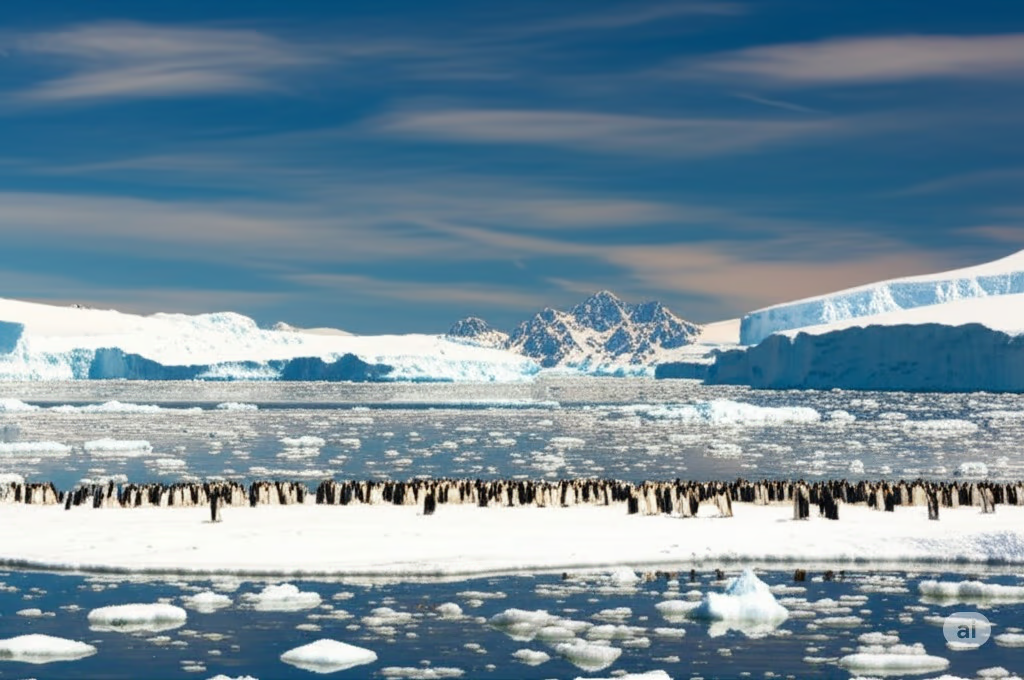
When thinking of Antarctica, the mind immediately conjures images of endless white glaciers, colossal floating ice shelves, and biting polar blizzards. Yet across the rocky headlands and coastal permafrost of this frozen wilderness, millions of penguins assemble in deafening, bustling breeding colonies. For generations, explorers and naturalists regarded the pungent, reddish-brown excrement blanketing these colonies, known scientifically as guano, as little more than an offensive byproduct of avian digestion. However, groundbreaking atmospheric research has unraveled an extraordinary biological feedback mechanism: penguin guano plays a direct and vital role in regulating the polar atmospheric chemistry and cooling our planet [1] [2].
Far from being an inert waste deposit, penguin guano operates as a massive biochemical vapor pump. As vast colonies consume metric tons of marine biomass daily, their nitrogen-rich droppings undergo rapid microbial decomposition, releasing enormous plumes of gaseous ammonia into the pristine Antarctic troposphere. When this biological vapor mingles with sulfur emissions generated by oceanic phytoplankton, it sparks a chain reaction of new particle formation, producing billions of microscopic atmospheric seeds that condense into bright, sun-deflecting clouds [3]. Exploring this wondrous phenomenon demonstrates how marine ecology and atmospheric physics intertwine to shield our planet against accelerated warming.
The Frozen Continent’s Surprising Bio-Atmospheric Engine
The Southern Ocean surrounding Antarctica is one of the most chemically pristine marine environments on Earth, virtually untouched by anthropogenic industrial pollution. Under normal conditions, the unpolluted air over the polar ice caps contains exceptionally low background concentrations of aerosol precursor gases. Consequently, atmospheric nucleation, the birth of new microscopic solid or liquid particles suspended in the atmosphere, is severely limited by chemical scarcity. Without adequate aerosol seeds, moisture in the freezing polar air struggles to aggregate into dense, highly reflective cloud layers [2].
Herein lies the ecological wonder of Antarctica’s coastal seabird populations. Penguin colonies, often numbering tens of thousands to hundreds of thousands of breeding pairs on islands such as Seymour Island and King George Island, concentrate biological activity into dense terrestrial hotspots. Rather than dispersing their organic residues uniformly across vast oceanic expanses, penguins deposit mountains of concentrated excrement directly onto sun-exposed coastal rocks and ornithogenic soils [1]. In doing so, they create powerful regional atmospheric point sources that rival industrial plumes in chemical potency, fundamentally altering the aerosol landscape of the polar skies.
From Krill Diets to Atmospheric Ammonia: The Biochemical Pathway
To grasp how guano transforms into atmospheric cooling agents, one must examine the dietary biochemistry of polar penguins. Species like Adelie penguins, gentoo penguins, and chinstrap penguins subsist almost exclusively on Antarctic krill (Euphausia superba) and small pelagic silverfish. Krill are small, shrimp-like crustaceans that graze upon marine phytoplankton, accumulating dense quantities of dietary proteins and structural chitin. When penguins digest this protein-dense sustenance, their metabolic pathways process excess nitrogen into uric acid, which is excreted as thick, semi-solid guano [1].
Once deposited upon rocky nesting grounds during the polar summer thaw, colonies become biological reactors. Psychrotolerant bacteria living within the ornithogenic soil utilize powerful urease enzymes to rapidly cleave uric acid molecules into ammonia (NH3) gas and carbon dioxide. Because summer temperatures temporarily rise above freezing and colony rocks absorb incoming solar heat, evaporation drives volatile ammonia straight into the lower boundary layer of the atmosphere. Field measurements reveal that peak summer ammonia concentrations downwind of major penguin rookeries can spike more than a thousand times higher than normal background maritime polar levels [1] [3].
The 3-Step Guano-to-Cloud Climate Cooling Engine
Ammonia Release
Bacterial enzymes break down nitrogenous uric acid in warm coastal guano soils, pumping high concentrations of ammonia vapor into the polar boundary layer.
Aerosol Generation
Ammonia gas bonds rapidly with oceanic sulfuric acid and water vapor, triggering explosive new-particle formation of ammonium bisulfate clusters.
Solar Radiation Shield
Clusters grow into Cloud Condensation Nuclei (CCN), seeding ultra-reflective low stratocumulus clouds that deflect incoming solar thermal energy into space.
The Marine Chemistry Collision: Ammonia Meets Oceanic Sulfur
Ammonia gas alone cannot generate clouds; it requires a chemical partner. Concurrently in the chilly waters of the Southern Ocean, prolific summer blooms of marine microalgae and phytoplankton synthesize dimethylsulfoniopropionate (DMSP) to regulate osmotic cell pressure. When these algae are grazed upon by krill or undergo natural cell lysis, DMSP converts into volatile dimethyl sulfide (DMS). This sulfuric compound vents freely from the sea surface into the atmosphere [3].
Once airborne, solar ultraviolet radiation oxidizes DMS into sulfur dioxide (SO2) and subsequently into gaseous sulfuric acid (H2SO4). Under normal unseeded circumstances, sulfuric acid and water vapor molecules collide too infrequently in cold polar air to condense into stable aerosol particles. However, when gaseous ammonia from penguin colonies encounters sulfuric acid vapor, basic chemistry produces an explosive acceleration in ternary nucleation. Ammonia serves as a potent chemical stabilizer, binding neutralizing acidic hydrogen bonds and dropping the nucleation energy barrier by orders of magnitude. The resulting ammonium sulfate and ammonium bisulfate molecular clusters coalesce into stable nanoscale aerosols within seconds [1] [3].
How Cloud Condensation Nuclei Form Polar Sunshields
Aerosol particles freshly generated by molecular nucleation are exceedingly tiny, typically measuring mere nanometers in diameter. For these infant aerosols to exert a measurable influence on planetary climate, they must undergo atmospheric growth until they reach an aerodynamic diameter of roughly 50 to 100 nanometers. At this threshold size, physics classifies them as Cloud Condensation Nuclei (CCN) [2] [4].
As ascending thermal air currents loft ammonium clusters higher into the marine boundary layer, secondary vapors such as oxidized organics, methanesulfonic acid (MSA), and excess water condense onto their surfaces. Within a matter of hours to days, these growing particles achieve CCN status. In the hyper-clean air of Antarctica where dust and soot are nonexistent, these biologically generated ammonium particles become the primary nuclei upon which water droplets condense, creating expansive blankets of low-altitude maritime stratocumulus clouds across hundreds of square kilometers [3].
Atmospheric Comparison: Penguin Colony Plume vs Clean Polar Air
| Atmospheric Parameter | Baseline Marine Air | Penguin Colony Plume Zone | Climate Impact Mechanism |
|---|---|---|---|
| Gaseous Ammonia (NH3) | < 0.05 ppb | 10 to 120 ppb | Provides critical neutralizing base for acid nucleation |
| New Particle Formation Rate | Extremely Low (< 0.1 cm⁻³ s⁻¹) | High (10 to 100 cm⁻³ s⁻¹) | Triggers exponential burst of nanoscale aerosol seeds |
| Cloud Condensation Nuclei (CCN) | Sparse, scattered droplets | Dense concentration (> 500 cm⁻³) | Produces clouds with higher optical thickness |
| Cloud Albedo (Reflectivity) | Moderate reflectivity | Significantly enhanced whiteness | Deflects incoming shortwave solar radiation back to space |
The Albedo Effect: How Whitened Clouds Reflect Solar Radiation
The climatic significance of this aerosol boost stems directly from a fundamental meteorological principle known as the Twomey Effect or the first aerosol indirect effect. In any given cloud possessing a fixed volume of liquid water content, the total optical reflectivity (albedo) depends entirely on how that moisture is partitioned among available condensation nuclei [2].
When few CCN particles are present, condensed water aggregates into a smaller number of large droplets, resulting in a cloud that appears relatively translucent and permits substantial solar radiation to penetrate down to the Earth’s surface. Conversely, when guano-derived ammonia seeds the atmosphere with hundreds of tiny CCN per cubic centimeter, the identical volume of water distributes across billions of micro-droplets. This dramatic multiplication of droplet surface area transforms the cloud into an extraordinarily brilliant, optically thick white mirror [3] [4].
During the Antarctic summer solstice, when the sun illuminates the southern hemisphere for up to 24 consecutive hours each day, this heightened cloud albedo is critically consequential. By bouncing shortwave solar energy directly back into outer space before it can reach dark open ocean waters or exposed coastal terrain, guano-seeded clouds produce a localized radiative cooling effect that depresses summer temperatures by several tenths of a degree Celsius across expansive sub-polar sectors [1] [3].
The Lingering Protection of Ornithogenic Soils
One might intuitively assume that this cooling mechanism ceases the moment adult penguins finish their seasonal nesting cycle and swim north into open seas for the winter. Yet field research conducted across the Antarctic Peninsula reveals an even deeper layer of ecological resilience: ornithogenic soils maintain their chemical output long after their feathered architects depart [1].
Over decades and centuries of continuous seasonal habitation, layers of guano integrate deeply into coastal permafrost and rock fissures, creating organic soils rich in insoluble nitrogen compounds. Even when penguin colonies migrate offshore into pack ice, moisture from summer melting continues to feed cold-adapted bacterial colonies embedded in the soil. These subterranean microbial consortia sustain ammonia degassing for weeks and months, maintaining elevated atmospheric CCN levels well into the late autumn months [1] [2].
The Ecological Domino Effect: Melting Ice and Fragile Penguin Colonies
Recognizing the cooling efficacy of penguin guano brings a sobering corollary to light: the precarious feedback loops threatened by modern anthropogenic climate destabilization. The Antarctic Peninsula has witnessed some of the fastest rates of atmospheric and oceanic warming recorded anywhere on Earth over the past half-century [3].
Rising sea temperatures and disintegrating winter pack ice have precipitated catastrophic breeding failures among ice-dependent penguin populations, particularly emperor and Adelie penguins. Furthermore, shifts in Southern Ocean currents have triggered localized declines in krill stocks, starving breeding rookeries and driving dramatic colony contractions. When penguin populations crash, their atmospheric ammonia footprint shrinks proportionally [1] [4].
This collapse initiates a treacherous positive feedback loop. Fewer penguins yield diminished ammonia emissions; diminished ammonia curtails aerosol nucleation and thins low cloud cover; thinner cloud cover permits increased solar radiation to strike polar waters; and warmer surface waters accelerate the melting of remaining ice sheets. Thus, what was once a self-reinforcing biological refrigerator risks mutating into an amplified thermal accelerator [3].
Global Implications: Protecting Polar Seabirds to Stabilize Planetary Climate
The discovery that penguin guano acts as a regional geo-engineering agent revolutionizes our broader understanding of global biosphere-atmosphere interactions. Similar biological aerosol pumping mechanisms have been documented in the high Arctic, where colossal colonies of migratory auks, guillemots, and fulmars enrich northern polar clouds during critical summer melting seasons [4].
These revelations dismantle the outdated view of wildlife conservation as an isolated moral or aesthetic duty. Preserving seabird biodiversity, regulating industrial krill super-trawling in the Southern Ocean, and establishing robust Marine Protected Areas (MPAs) are essential strategies for planetary climate stabilization. Every breeding pair of penguins nesting on an Antarctic cliff is not merely an iconic polar curiosity, but an active participant in maintaining the delicate thermal equilibrium that shields our living world from catastrophic overheating [1] [3].
Frequently Asked Questions (FAQ)
Does penguin guano genuinely create clouds?
Yes. Penguin guano releases high concentrations of gaseous ammonia into the air. This ammonia bonds with marine sulfuric acid vapor to trigger new particle formation, creating Cloud Condensation Nuclei that serve as the seeds for reflective stratocumulus clouds.
Can penguin colonies be detected from space using guano?
Yes. Satellite imagery from NASA and international space agencies routinely detects the reddish-brown staining of penguin guano against white snow, allowing scientists to monitor and census remote colonies from orbit.
Does this cooling effect extend beyond Antarctica?
While the immediate cloud-brightening effect occurs over Antarctica and the Southern Ocean, cooling these waters helps stabilize major global ocean conveyor belts and protects polar ice sheets that regulate planetary sea levels.
What happens to this cloud cover if penguin populations decline?
If penguin populations decrease, ammonia emissions drop, resulting in thinner, less reflective clouds. This allows greater solar radiation to penetrate the surface, accelerating polar ice melting.
Potential ammonia emissions from penguin guano, ornithogenic soils and marine animal colonies in Antarctica
- Journal
- Antarctic Science
- Study Type
- journal
- Year
- 2010
DOI10.1017/s0954102010000623
Variations in cloud condensation nuclei at Palmer Station Antarctica
- Journal
- Atmospheric Research
- Study Type
- journal
- Year
- 1996
DOI10.1016/0169-8095(96)00012-9
Penguin guano is an important source of climate-relevant aerosol particles in Antarctica
- Journal
- Communications Earth & Environment
- Study Type
- journal
- Year
- 2025
DOI10.1038/s43247-025-02312-2
Contribution of Arctic seabird-colony ammonia to atmospheric aerosol nucleation
- Journal
- Nature Communications
- Study Type
- journal
- Year
- 2016
DOI10.1038/ncomms13444
References
- ↩ Zhu, R., et al. (2010). Potential ammonia emissions from penguin guano, ornithogenic soils and marine animal colonies in Antarctica. Antarctic Science, 23(1), 78-88.
- ↩ Saxena, V. K. (1996). Variations in cloud condensation nuclei at Palmer Station Antarctica. Atmospheric Research, 41(3-4), 249-265.
- ↩ Communications Earth & Environment (2025). Penguin guano is an important source of climate-relevant aerosol particles in Antarctica.
- ↩ Croft, B., et al. (2016). Contribution of Arctic seabird-colony ammonia to atmospheric aerosol nucleation. Nature Communications, 7, 13444.

No comments yet. Be the first to join the conversation.