



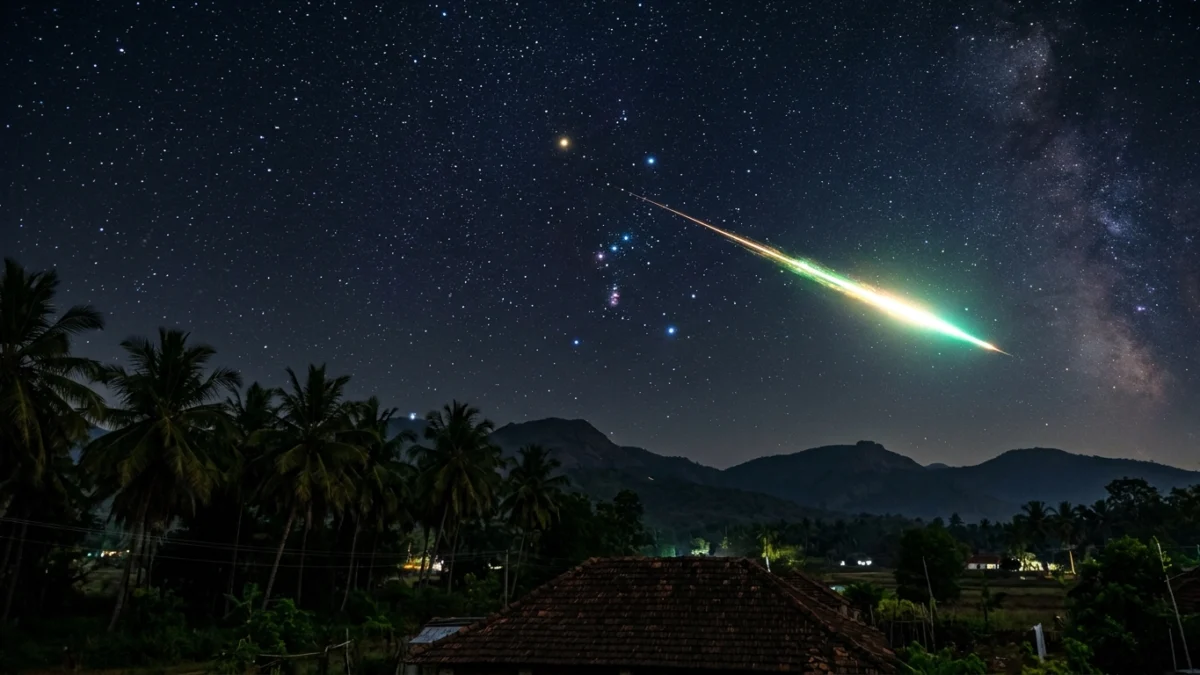
Key Findings
- Orionid meteors enter Earth's atmosphere at a blistering 66 kilometers per second, making them among the fastest meteors in astronomy.
- Incoming particles are ancient remnants shed by Comet 1P/Halley that vaporize in the mesosphere between 80 and 100 kilometers altitude.
- Telescopes are counterproductive for meteor watching; dark-adapted naked-eye vision offers the ideal 130-degree panoramic field of view.
Few nocturnal spectacles rival the quiet, heart-stopping majesty of a meteor shower. Standing beneath an inky autumn sky far from artificial glare, the stillness of the cosmos is suddenly broken by a swift, incandescent needle of green light streaking across the stars. For millennia, cultures around the world romanticized these luminous flashes as “falling stars” or celestial omens. In truth, modern astrophysics reveals a far more fascinating reality: you are witnessing ancient debris shed by history’s most famous comet colliding with Earth’s atmosphere at sixty-six kilometers per second [1].
Each October, our planet sweeps through the dense orbital dust stream left behind by Comet 1P/Halley, producing the annual Orionid meteor shower [1] [2]. These meteors are renowned among stargazers for their blistering speed, bright persistent trains, and brilliant emerald-green hues. Observing this celestial display requires no costly telescopes, no complex tracking equipment, and no deep astronomical training, only warm clothing, dark skies, and a curious pair of eyes [1] [6].
- 66 km/s
- Entry Velocity Atmospheric collision speed of Orionid grains (approx. 237,600 km/h)
- 15–20
- Zenithal Hourly Rate Expected meteors visible per hour under pristine dark rural skies
- 80–100 km
- Ablation Altitude Mesospheric atmospheric height where incoming particles completely vaporize
- 76 Years
- Comet Halley Orbital Period Cosmic periodicity of the parent comet that deposited the meteoroid stream
Halley’s Comet Debris Science: How Meteor Showers Are Born
To understand the Orionids, one must look to their parent body: Comet 1P/Halley. Halley is a “dirty snowball” composed of frozen volatile ices, water, carbon monoxide, methane, and ammonia, intermixed with primordial silicate grains and metallic minerals [1] [3]. Travelling on an elongated 76-year retrograde elliptical orbit around the Sun, Halley plunges into the warm inner solar system from beyond the orbit of Neptune [3].
Whenever Halley approaches perihelion (its closest orbital point to the Sun), solar radiation heats its fragile icy nucleus. The surface ices sublimate violently, bursting outward in volcanic geysers that drag billions of tons of mineral dust and rocky debris into interplanetary space [1] [4]. Over centuries, gravitational nudges from Jupiter and Saturn distribute these ejected particles into an immense, ribbon-like toroidal debris stream that mirrors Halley’s orbital trajectory [3]. Earth intersects this ancient river of dust twice every year: once in early May (producing the Eta Aquariid shower) and again in late October, giving birth to the Orionids [1] [2].
As Comet 1P/Halley nears perihelion, sublimating water ice expels millions of silicate and metallic meteoroids into a toroidal debris trail orbiting the Sun.
Earth intersects the dust trail at 66 km/s. The particle compresses mesospheric air molecules, generating an intense shockwave exceeding 1,600°C.
The grain vaporizes between 80 and 100 kilometers altitude, leaving a glowing column of ionized gas and metallic atoms visible across vast ground distances.
Atmospheric Friction and Ram Pressure: The Physics of Incandescence
Popular accounts frequently state that meteors catch fire due to mechanical friction with the atmosphere. However, atmospheric physicists note that the dominant heating mechanism is actually severe ram pressure [1] [5]. Because Halley’s Comet orbits the Sun in a retrograde direction (opposite to the orbital motion of the planets), Earth and the cometary dust stream collide almost head-on [1].
An Orionid meteoroid enters the upper atmosphere at approximately 66 kilometers per second, equivalent to roughly 237,600 kilometers per hour [1] [5]. At this staggering velocity, the air molecules in front of the incoming grain cannot clear out of the path quickly enough. The mesospheric gas is brutally compressed, forming an intense shockwave. According to thermodynamic gas laws, rapid adiabatic compression creates scorching temperatures exceeding 1,600°C (3,000°F) in front of the grain [5]. This localized thermal inferno rapidly vaporizes the particle in a process known as ablation, creating a blinding sheath of ionized plasma that expands across several meters [1] [5]. This extreme kinetic physics parallels high-energy cosmology, much like the intense gravitational fields encountered in the astrophysics of black holes and spacetime.
Spectral Colors of Meteors: Chemical Fingerprints Across the Sky
Attentive skywatchers will notice that Orionid meteors frequently flash in vivid hues of emerald green, amber yellow, or brilliant white. These colors are not optical illusions; they represent chemical emission spectra generated as distinct elements vaporize within the plasma column [1] [5]:
When high-energy collisions knock electrons out of metallic atoms, the electrons release photons of characteristic wavelengths as they drop back into lower energy states [5]. Vaporizing magnesium atoms emit a signature green glow at 517 nanometers, sodium produces a bright amber yellow at 589 nanometers, and iron radiates a golden white hue [1]. Simultaneously, atmospheric nitrogen and oxygen molecules excited by the shockwave glow in soft red and violet shades around the periphery [5]. By analyzing meteor photographs with diffraction gratings, astronomers can deduce the mineral composition of a comet that is currently billions of kilometers away [1]. Understanding such rigorous classification reflects the broader principles explored in our standardized scientific terminology guide.
| Chemical Element | Primary Mineral Source | Dominant Emission Wavelength | Characteristic Visible Streak Color |
|---|---|---|---|
| Magnesium (Mg) | Olivine and Pyroxene silicates | 517 nm (Triplet green emission) | Vivid teal to emerald green |
| Sodium (Na) | Plagioclase feldspar grains | 589 nm (D-line doublet) | Bright amber to deep golden yellow |
| Iron (Fe) | Metallic meteoritic inclusions | Multiple wavelengths in mid-spectrum | Soft yellowish-white glow |
| Calcium (Ca) | Calcium-aluminum inclusions (CAIs) | 393 nm / 397 nm (H and K lines) | Deep violet to faint ultraviolet |
| Atmospheric Nitrogen (N) | Earth’s upper atmospheric gas | 650–870 nm (Ionized air plasma) | Crimson red to faint pink fringe |
Spectroscopic data compiled from International Meteor Organization (IMO) and NASA meteor physics reports.
The Orion Constellation Radiant: How Perspective Creates the Shower
If you trace the trajectories of all Orionid meteors backward, they appear to emanate from a single focal point in the sky, located just north of the bright red supergiant star Betelgeuse in the constellation Orion the Hunter [1] [2]. This apparent origin point is called the shower’s radiant [2].
This phenomenon is an effect of optical perspective, identical to driving a car through a snowstorm at night: snowflakes appear to diverge outward from a single point directly ahead on the windshield [1]. In reality, all the cometary grains are traveling on parallel trajectories through space. It is Earth’s forward velocity into the cloud that makes them seem to radiate outward [2]. Importantly, while the radiant identifies the shower, meteors can appear in any part of the sky; in fact, meteors that flash 45 to 90 degrees away from Orion often produce the longest, most dramatic luminous streaks [1] [6].
- Orionids are not falling stars; they are microscopic remnants shed by Halley’s Comet (1P/Halley) over thousands of years of solar passages.
- A particle the size of a mustard seed produces an incandescent streak bright enough to be seen across a hundred-kilometer radius.
- Orionids are among the fastest meteors in astronomy, entering retrograde relative to Earth’s orbital trajectory.
- Roughly half of all observed Orionids leave persistent glowing ionization trains that linger in the upper atmosphere for several seconds.
Best Viewing Window and Geometry: Timing Your Stargazing Session
Timing is everything in meteor observing. Beginners often make the mistake of heading out at 9:00 PM or 10:00 PM, only to return disappointed [6]. Because the constellation Orion rises late in the autumn evening, the radiant remains close to or below the eastern horizon before midnight [2] [6].
The optimal observing window opens around 2:30 AM and peaks between 3:30 AM and 5:15 AM local time, just before the first glimmer of dawn [6]. Why? Because the Earth rotates on its axis as it orbits the Sun. Before midnight, your location is positioned on the trailing side of Earth, meaning incoming meteors must catch up to us from behind [1]. After 2:00 AM, your geographic location turns directly into the planet’s forward orbital path. Earth’s leading hemisphere plows straight into the Halley debris stream, dramatically multiplying both meteor frequency and relative entry velocity [1] [6].
Naked-Eye Stargazing Techniques: Maximizing Meteor Counts
Observing a meteor shower requires a counterintuitive approach for amateur stargazers: leave your telescopes, spotting scopes, and binoculars at home [6]. Optical instruments restrict your field of view to a tiny patch of sky, making it almost impossible to catch fleeting, unexpected streaks [1].
| Feature | Telescopes & High-Power Binoculars | Astronomical StandardDark-Adapted Naked-Eye Observation |
|---|---|---|
| Field of View | Extremely narrow (1° to 5°); misses 99% of transient sky events | Panoramic wide-angle field of view (approx. 130°) |
| Detection Probability | Extremely low; meteors dart past before optics can be slewed | High; peripheral vision naturally detects rapid transient movement |
| Adaptation Comfort | Induces severe neck strain and fatigue during prolonged viewing | Relaxed reclining position on a camp chair or ground mat |
| Spatial Context | Zero constellation or radiant contextual orientation | Full visualization of Orion radiant and surrounding sky constellations |
| Equipment Cost | Expensive optical glass and tracking tripods required | Zero equipment required; completely free and accessible to all |
Professional meteor astronomers universally recommend naked-eye observation for visual meteor rate counting.
To maximize your meteor count, implement these field-tested astronomical protocols [6]:
1. Escape Urban Light Pollution: Artificial streetlights wash out faint meteors. Driving just 20 to 30 kilometers outside municipal limits to an open rural clearing, beach, or rooftop can triple the number of visible meteors [6].
2. Allow 20–30 Minutes for Dark Adaptation: The human eye produces rhodopsin (visual purple) in dark conditions, dramatically increasing rod sensitivity. Looking at a bright smartphone screen for even two seconds resets this chemical adaptation, blinding you to faint meteors for another twenty minutes. Use dim red flashlights if illumination is needed [6].
3. Recline Horizontally: Straining your neck while standing quickly causes fatigue. Use a reclining lawn chair, sleeping mat, or camp cot so you can gaze comfortably across the broadest swath of sky without physical discomfort [6].
Fireballs, Persistent Trains, and Electrophonic Sounds
Among the most thrilling features of the Orionid shower is the frequent appearance of fireballs (meteors brighter than the planet Venus, magnitude -4) [1] [5]. Roughly forty to fifty percent of bright Orionids leave behind “persistent trains”, phosphorescent ribbons of ionized mesospheric gas that twist and drift in high-altitude jet streams for several seconds, or even minutes, after the meteor has vanished [1] [5].
Even more extraordinary is the controversial phenomenon of electrophonic sounds. Observers in exceptionally quiet wilderness settings occasionally report hearing faint hissing, crackling, or popping noises simultaneously with the appearance of a massive fireball [1]. Because acoustic sound takes over four minutes to travel eighty kilometers from the upper mesosphere, a direct sonic boom cannot explain instant perception. Biophysicists believe that intense very-low-frequency (VLF) radio waves emitted by the churning meteor plasma travel at light speed to ground level, inducing sympathetic electro-acoustic vibrations in nearby conductors, foliage, or even an observer’s eyeglasses [1].
Where Does Cosmic Dust Go? Micro-Meteorites and Halley’s Return in 2061
What happens after a meteoroid vaporizes in our sky? The vaporized atoms re-condense in the cold mesosphere into microscopic smoke particles known as meteoric dust [1]. These microscopic grains drift down through the stratosphere and troposphere over weeks and months, eventually settling onto rooftops, tree canopies, and oceans [1]. Scientists estimate that over forty tons of extraterrestrial dust settle onto Earth’s surface every single day, meaning that raindrops falling on your jacket often contain atoms that once drifted across the outer solar system inside Halley’s icy mantle [1].
Meanwhile, parent Comet 1P/Halley is currently outbound near its aphelion beyond Neptune’s orbit. It will round its celestial turn and begin its long gravitational plunge back toward the Sun, reaching perihelion again in mid-2061 [3]. Until that historic return, every October’s Orionid meteor shower offers humanity an accessible, intimate connection to Halley’s cosmic legacy, a reminder of the clockwork precision governing our solar system [1] [3].
Frequently Asked Questions About Meteor Observing
Do I need an expensive telescope or binoculars to watch the shower?
No, optical instruments are actually counterproductive for meteor watching because their field of view is extremely narrow. Meteors can flash across any quadrant of the sky without warning. Your naked eyes, once adapted to the dark, offer a 130-degree panoramic field of view, making them the ultimate astronomical tool for this phenomenon.
What is the absolute best time window to watch the Orionids?
The optimal observing window is during the pre-dawn hours between 3:30 AM and 5:15 AM local time. At this hour, the constellation Orion has climbed high above the eastern horizon, and the Earth’s leading hemisphere is plowing directly into the debris stream.
Could an Orionid meteor survive atmospheric entry and hit the ground?
No. Orionid meteoroids are low-density, fragile aggregate grains ranging from the size of dust motes to small chickpeas. Due to their extreme entry velocity of 66 kilometers per second, they undergo total thermal ablation in the upper mesosphere, fully vaporizing between 80 and 100 kilometers above sea level.
Can people living in brightly lit urban cities see the meteors?
In heavily light-polluted metropolitan centers like Chennai, Mumbai, or Coimbatore, only the brightest fireballs (roughly 2 to 4 per hour) will be visible through the ambient glare. Moving to suburban fringes, open farmland, or dark rural coastal areas increases visible rates to 15–20 meteors per hour.
What causes some meteors to glow vivid green or amber?
Meteor colors reveal elemental composition. Vaporizing magnesium emits bright green light (517 nm), sodium creates a brilliant golden-yellow hue, and iron glows yellowish-white. In addition, ionized atmospheric nitrogen and oxygen can tint the outer wake in crimson.
Astronomical Terminology (Glossary)
Scientific terms used in this article
- Meteoroid
- A small rocky or metallic particle traveling through interplanetary space, ranging from microscopic dust motes to meter-wide boulders.
- Meteor
- The incandescent luminous streak produced when a meteoroid enters Earth’s atmosphere at high speed and undergoes thermal ablation.
- Radiant
- The celestial coordinate from which the paths of meteors in a specific shower appear to originate due to perspective projection.
- Ram Pressure
- The immense mechanical pressure exerted on a body moving at extreme velocity through a fluid medium, generating intense shockwave compression and frictional heating.
- Zenithal Hourly Rate (ZHR)
- The theoretical number of meteors a single observer would see under completely dark, cloudless skies with the radiant located directly overhead at the zenith.
Meteor Showers and their Parent Comets
- Journal
- Cambridge University Press / International Astronomical Union
- Study Type
- Book/Review
- Year
- 2006
DOI10.1017/CBO9781139014564
References
- ↩ Meteor Showers and their Parent Comets. Cambridge University Press
- ↩ The Orionid meteor shower: activity and radiant characteristics. MNRAS. 2008;384(2):775-783
- ↩ The Halleyid meteoroid streams: Dynamics and structure. Icarus. 2020;338:113605
- ↩ Near-Earth objects among the Halley-family dust stream. Astronomy & Astrophysics. 2013;558:A12
- ↩ Atmospheric trajectories and light curves of Orionid fireballs. Planetary and Space Science. 2020;182:104712
- ↩ International Meteor Organization (IMO). 2026 Meteor Shower Calendar and Ephemeris



No comments yet. Be the first to join the conversation.