


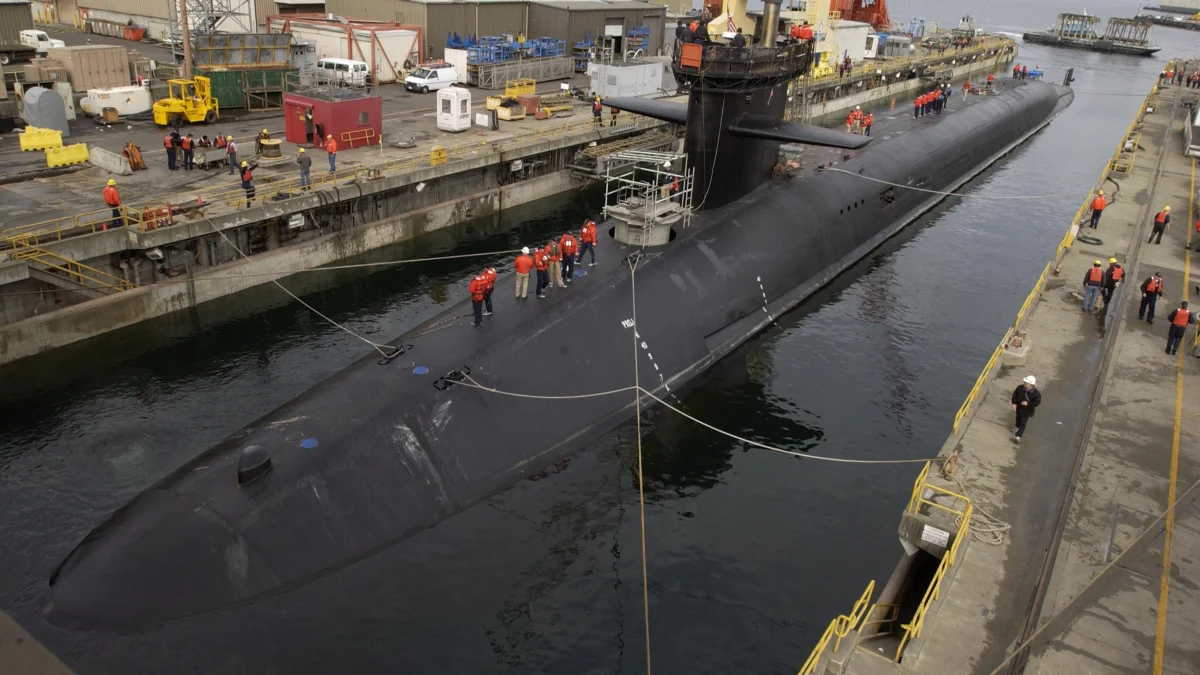
Gliding through the pitch-black abyssal depths hundreds of meters beneath the turbulent ocean surface, a modern submarine represents humanity’s pinnacle of naval architecture, fluid dynamics, and nuclear engineering. Constructed from thousands of tons of high-yield alloy steel and titanium, these titanic vessels navigate an environment more hostile and unforgiving than the vacuum of outer space [1, 2]. Every cubic meter of displacement must be precisely calculated, balanced, and maintained to ensure absolute structural survival in an alien realm where sunlight never penetrates and ambient water temperatures hover just above freezing.
While spacecraft operate under an external vacuum of zero atmospheres, a submerged submarine must resist crushing hydrostatic water pressures exceeding 30 to 50 atmospheres–equivalent to supporting the weight of a commercial locomotive on every square meter of its hull. Yet, despite having no access to atmospheric air or celestial satellite signals for months at a time, a nuclear-powered submarine can circumnavigate the globe submerged, generating its own breathable oxygen, distilling fresh drinking water, and navigating with pin-point inertial precision [1, 3]. The margin between operational stealth and cataclysmic hull implosion is governed entirely by the rigorous application of fundamental physical laws.
Marine engineers and naval hydrodynamicists design these submersibles around the timeless physics of Archimedes’ Principle, Boyle’s Law, and advanced underwater acoustics [1, 2]. Landmark research published in the Journal of Marine Science and Engineering and Ocean Engineering illustrates how high-pressure pneumatic air expulsion, variable buoyancy trimming, and anechoic acoustic tile shielding enable massive vessels to hover motionlessly and silently within ocean thermoclines [1, 3]. Here is the definitive scientific and engineering guide to how modern submarines operate beneath the world’s oceans.
- 50+ bar
- Peak Hull Pressure
- 300 – 400 m
- Standard Test Depth
- 0 Decibels
- Ambient Acoustic Masking
- 90+ Days
- Submerged Endurance
The Abyssal Enigma: Mastering Hydrostatic Equilibrium
To understand how a vessel weighing 10,000 to 18,000 tons can float like a leaf upon ocean swells, sink into the abyss on command, and hover at a predetermined depth with zero vertical drift, one must examine the physics of hydrostatic equilibrium [1]. In naval architecture, equilibrium is never static; it is a dynamic interplay between gravitational pull downwards and upward fluid displacement that changes continuously with ocean depth, water salinity, and temperature gradients.
According to Archimedes’ Principle, any object partially or completely submerged in a fluid experiences an upward buoyant force equal to the gravitational weight of the fluid displaced by that object [1]:
- Positive Buoyancy (Floating): When the total weight of the submarine is less than the weight of the displaced seawater, the net vertical force is upward, causing the vessel to float on the surface [1].
- Negative Buoyancy (Sinking): When the total weight of the submarine exceeds the weight of the displaced seawater, the net vertical force is downward, causing the vessel to sink into the ocean [1].
- Neutral Buoyancy (Hovering): When the total weight of the submarine exactly matches the weight of the displaced seawater, the vessel achieves perfect hydrostatic equilibrium, hovering suspended at a fixed depth without sinking or ascending [1, 3].
Surface ships possess fixed positive buoyancy: their steel hulls enclose vast hollow volumes of air, ensuring their average density remains far lower than seawater. A submarine, however, possesses the unique engineering ability to dynamically alter its overall mass and average density at will [1]. Understanding the delicate physical balance between gravitational forces and fluid equilibrium, as explored in our astrophysics analysis of what is a black hole and general relativity guide, demonstrates how nature balances opposing compressive and expansive pressures across macroscopic physical systems.
Archimedes Principle and Ballast Tank Fluidics (Diving, Hovering, Surfacing)
The mechanical instruments that allow a submarine to transition between positive, neutral, and negative buoyancy are its Main Ballast Tanks (MBTs) and Trim Tanks [1, 3]. These fluidic reservoirs are integrated into the vessel’s hull geometry to provide instantaneous response to dive orders, ballast adjustments, and surfacing maneuvers.
A submarine features a specialized double-hull or saddle-tank configuration:
- Structure of the Main Ballast Tanks: Located between the inner pressure hull and the outer hydrodynamic fairing, MBTs feature large openings called flood ports at the bottom, and remotely operated vent valves at the top [1].
- The Diving Sequence: While cruising on the surface, the top vent valves remain tightly sealed, trapping vast volumes of buoyant air inside the MBTs. To initiate a dive, the officer of the deck orders ‘Open Vents.’ The hydraulic top valves snap open, allowing trapped air to escape rapidly under atmospheric venting. Seawater rushes through the open bottom flood ports under hydrostatic pressure, completely flooding the tanks. As water displaces air, the submarine’s average density exceeds that of seawater, creating negative buoyancy that pulls the vessel beneath the surface [1, 3].
- Fine-Tuning with Variable Trim Tanks: Seawater density is not constant: cold polar water is denser than warm tropical water, and high-salinity currents exert greater buoyant force than brackish estuaries. To maintain precise neutral buoyancy, naval technicians utilize internal Depth Control and Trim Tanks. High-pressure trim pumps transfer small volumes of water forward, aft, or overboard, balancing the vessel’s longitudinal pitch and buoyancy down to individual kilograms [1].
- Surfacing via High-Pressure Air Blow: To return to the surface, the top vent valves are closed, and high-pressure compressed air (stored at 200 to 300 bar in forged alloy air flasks) is blasted into the tops of the MBTs. The expanding compressed air forces seawater out through the bottom flood ports, restoring positive buoyancy and lifting the submarine back to the surface [1, 3].
In emergency combat or damage-control situations, an ‘Emergency Blow’ releases the entire volume of high-pressure air into all ballast tanks simultaneously within seconds, rocketing a 10,000-ton vessel to the surface in a spectacular parabolic breach [1]. This fail-safe mechanism ensures that even during total electrical or primary propulsion loss, a flooded vessel can overcome negative trim and reach atmospheric safety.
Structural Mechanics: The High-Yield Pressure Hull Against Hydrostatic Crush
The ocean depths exert terrifying physical forces: for every 10 meters a submarine descends, ambient water pressure increases by approximately 1 atmosphere (1 bar or 100 kilopascals) [3]. This linear pressure gradient means that at extreme diving depths, the total compressive force acting on the entire surface area of the hull reaches millions of tons.
At an operational depth of 400 meters, every square centimeter of the submarine’s hull is subjected to 40 kilograms of continuous compressive force. If the hull were to suffer structural deformation, the immense pressure would implode the vessel in milliseconds [3]:
- The Two-Hull Architecture: A modern submarine consists of two separate structures: an Outer Hydrodynamic Hull made of lightweight steel or fiberglass designed to slice smoothly through water with minimal turbulence, and an Inner Pressure Hull engineered to withstand crushing hydrostatic loads [1, 3].
- High-Yield Metallurgical Alloys: Pressure hulls are constructed from specialized high-strength quenched and tempered alloy steels, such as HY-80 (80,000 psi yield strength), HY-100, or Russian titanium alloys. Titanium offers an exceptional strength-to-weight ratio and non-magnetic stealth, allowing titanium-hulled submarines (such as the Alfa class) to dive beyond 700 meters [3].
- Perfect Cylindrical Geometry: The pressure hull is fabricated as an array of precision-machined cylindrical and conical sections joined by hemispherical end bulkheads. Internal T-shaped circumferential stiffener rings are welded every few feet along the hull to resist elastic buckling and hoop stress [3].
Any deviation from perfect circular symmetry–even a mere fraction of an inch–creates localized stress concentrations where catastrophic buckling can initiate. Consequently, every hull weld undergoes exhaustive ultrasonic and radiographic non-destructive examination [3]. Furthermore, complex structural penetrations such as propeller drive shafts, cooling water intakes, and periscope masts require specialized triple-redundant mechanical seals and packings that prevent ingress while maintaining watertight integrity under cycling depths.
Underwater Propulsion Architecture: Diesel-Electric, AIP, and Nuclear Reactors
Propelling a submerged warship without emitting telltale exhaust plumes or consuming limited oxygen requires revolutionary thermodynamic power plants [1, 2]. The historical challenge of underwater mobility has always been energy density: how to store or generate thousands of shaft horsepower in a closed environment without asphyxiating the crew.
Modern naval doctrines deploy three distinct propulsion paradigms:
- Conventional Diesel-Electric: Diesel engines require vast quantities of atmospheric oxygen for combustion. Diesel-electric submarines run their diesel generators only while operating near the surface using a retractable Snorkel mast to suck in fresh air and discharge exhaust. The diesel engines charge massive banks of lead-acid or lithium-ion batteries. Once submerged, the diesels shut down, and the vessel runs silently on battery-powered electric traction motors. However, conventional subs must snorkel every 24 to 72 hours, leaving them vulnerable to radar detection [1, 2].
- Air-Independent Propulsion (AIP): To extend underwater endurance, non-nuclear submarines incorporate AIP systems:
- Fuel Cells: Polymer Electrolyte Membrane (PEM) fuel cells combine liquid oxygen with stored hydrogen, generating electricity and pure drinking water with zero mechanical vibration and zero exhaust [1].
- Stirling Engines: Closed-cycle external combustion engines burning diesel fuel and liquid oxygen under high pressure to drive electrical alternators. AIP systems allow modern conventional subs to remain submerged continuously for two to three weeks [1, 2].
- Nuclear Propulsion: The ultimate underwater power plant. A compact pressurized water nuclear reactor (PWR) utilizes enriched uranium fuel to produce fission heat. High-pressure primary water transfers heat to steam generators, driving high-speed steam turbines that rotate the propeller shaft and generate megawatts of electrical power [1, 2].
Because nuclear fission consumes zero oxygen and a single core contains enough energy to operate for 25 to 30 years without refueling, a nuclear submarine’s underwater endurance is constrained solely by the crew’s food rations [1, 2]. Modern computational control architectures, analogous to mathematical optimization models reviewed in our study on cryptographic mathematical reasoning and computational algorithms, govern the nuclear reactor control rod drives and automated steam bypass loops to eliminate operational fluctuations.
Acoustic Stealth and Subsea Sensory Physics (Active vs Passive Sonar)
In the lightless depths of the ocean, electromagnetic radar and visual optical cameras are completely useless: light penetrates less than 100 to 200 meters into clear water, and radio waves are rapidly attenuated by seawater’s electrical conductivity [2]. In this opaque wilderness, acoustic vibrations provide the only window through which subsea operators can perceive their environment.
Consequently, underwater warfare and subsea navigation rely entirely on acoustics–the science of sound propagation through water [2]:
- Passive Sonar (The Silent Ear): Submarines operate predominantly in passive sonar mode. Arrays of highly sensitive hydrophones (piezoelectric underwater microphones) mounted across the bow sphere, hull flanks, and towed behind the ship on multi-kilometer cables listen continuously to ambient ocean noises. Advanced digital signal processors filter out ocean biologics (whale clicks, snapping shrimp) and classify target vessel signatures by identifying the exact acoustic frequency of their propulsion turbines and propeller blade rotation [2].
- Active Sonar (The Acoustic Flare): An active sonar transmitter sends out high-energy acoustic pulses (‘pings’) that bounce off foreign objects and return as echoes, providing precise range and bearing. However, transmitting an active ping is suicidal in submarine combat: it instantly reveals the submarine’s exact location to every listening passive sonar array within hundreds of nautical miles [2].
- Anechoic Rubber Tiles: To absorb incoming enemy active sonar pings, modern submarine hulls are covered in thousands of synthetic rubber anechoic tiles containing microscopic air voids. These tiles dampen sound reflections, reducing the submarine’s sonar return signature by over ninety percent [1, 2].
Exploring low-frequency acoustic transmission in the animal kingdom, as documented in our scientific study on elephant acoustic communication and infrasound science, illustrates how deep low-frequency sound waves travel hundreds of kilometers through dense physical media with minimal scattering. Submarines exploit oceanographic acoustic ducts, such as the SOFAR (Sound Fixing and Ranging) channel, to project passive listening baselines across entire ocean basins.
Closed-Loop Life Support: Electrolytic Oxygen Generation and CO2 Scrubbing
Sustaining a crew of over one hundred sailors inside a sealed metal cylinder hundreds of meters underwater for three months requires sophisticated closed-loop chemical engineering [1]. The onboard atmosphere must be purified, monitored, and balanced in real time without the luxury of venting stale gases directly to the atmosphere.
A submarine’s life support systems continuously regulate three critical atmospheric parameters:
- Oxygen Generation via Electrolysis: Modern nuclear and AIP submarines do not carry heavy compressed oxygen tanks. Instead, they extract oxygen directly from seawater using Low-Pressure Electrolysis (LPE). Desalinated freshwater is subjected to direct electrical current across catalytic electrodes, splitting H2O molecules into breathable oxygen (O2) and hydrogen gas (H2). The oxygen is pumped into the ventilation ducts, while the flammable hydrogen is safely pumped overboard into the sea [1].
- Carbon Dioxide Scrubbing: As the crew inhales oxygen and exhales carbon dioxide, CO2 levels in the sealed cabin rise rapidly, threatening cognitive impairment and acidosis. Liquid amine scrubbers (utilizing monoethanolamine) circulate cabin air through chemical absorbers that chemically bind CO2. The amine solution is then heated, boiling off the captured CO2 to be compressed and discharged into the ocean, while the regenerated amine returns to scrub more air [1, 2].
- Catalytic Carbon Monoxide and Hydrocarbon Burners: Minute contaminants–such as carbon monoxide from cooking, hydrogen from battery banks, and volatile organic solvents–are drawn through catalytic oxidizers containing platinum-palladium pellets heated to 300°C, converting hazardous gases into harmless trace elements [1].
Atmospheric monitoring on nuclear submarines is conducted via automated mass spectrometers and nondispersive infrared analyzers that verify oxygen concentrations between 19.5% and 21%, maintain carbon dioxide below 0.5%, and trace toxic particulates down to parts-per-billion thresholds. Fresh water is generated continuously through reverse osmosis and multistage flash distillation units powered by reactor waste heat, producing over 30,000 liters of pure potable water daily for drinking, hygiene, and electrolytic feedstock [1, 2]. Sustainable closed-loop water purification protocols reflect principles also detailed in our environmental analysis of urban home waste management and water reuse guide.
Inertial Navigation and Submerged Geodesic Positioning
Because Global Positioning System (GPS) satellite radio signals cannot penetrate more than a few inches into conductive seawater, a submerged submarine cannot look up its location via GPS without surfacing a vulnerable mast [1, 2]. Long-range submerged navigation demands autonomous systems completely independent of external satellites.
To navigate across oceans with surgical precision, submarines utilize an Electrostatic Gyro Navigation System (ESGN) or Ring Laser Gyro Inertial Navigation System (INS):
- Dead Reckoning via Inertial Sensing: The INS utilizes ultra-stable laser gyroscopes and quartz accelerometers mounted on vibration-isolated gimbals. By measuring every minute rotational motion and acceleration along three orthogonal axes from a known starting point, onboard navigation computers calculate the submarine’s position, velocity, and heading continuously via double-integration of acceleration [1, 2].
- Bathymetric Gravimetric Navigation: Modern submarines complement inertial dead-reckoning by comparing real-time multibeam sonar bottom depth measurements against classified bathymetric sea-floor maps and gravitational anomaly charts, confirming their subterranean position without transmitting a single detectable signal [2].
Periodic cross-referencing with local magnetic variations and sea-floor terrain contours prevents the subtle mechanical drift inherent to inertial measurement units, ensuring the submarine maintains positioning accuracy within meters after thousands of miles of submerged transit [1, 2].
Submarine Powertrain and Hydrodynamic Specifications Grid
Comparing conventional diesel-electric, AIP, and nuclear submarines highlights the dramatic technological divergence across modern naval fleets [1, 2]. Naval architects select specific propulsion configurations based on tactical mission profiles, geographic patrol constraints, and endurance requirements.
| Submarine Class / Type | Primary Power Source | Submerged Endurance | Maximum Speed (Submerged) | Tactical Operational Advantage |
|---|---|---|---|---|
| Conventional Diesel-Electric (SSK) | Diesel generators + Lead-Acid / Li-Ion batteries | 48 – 96 hours on battery; requires regular snorkeling | 18 – 22 knots (in short bursts) | Extremely quiet on battery power; compact for coastal defense |
| Air-Independent Propulsion (AIP) | Fuel Cells (H2/O2) or Stirling cycle + Batteries | 14 – 21 days continuous submerged crawling | 6 – 12 knots (low-speed silent patrol) | Zero cavitation or bubble emission; formidable choke-point ambush |
| Nuclear Attack Submarine (SSN) | Pressurized Water Nuclear Fission Reactor (PWR) | Unlimited (90+ days limited solely by crew food) | 30 – 35+ knots (indefinite sustained high-speed) | Global expeditionary reach; rapid repositioning across oceans |
| Nuclear Ballistic Missile Sub (SSBN) | Naval Nuclear Reactor (Life-of-Ship Core) | Unlimited (continuous stealth deterrence patrol) | 20 – 25 knots | Ultimate strategic second-strike nuclear deterrence |
A submarine is fundamentally more than a warship; it is a self-contained artificial biosphere and an extraordinary monument to human mastery over fluid mechanics and thermodynamics. By harnessing the physical laws of Archimedes, high-pressure hydraulics, and molecular gas chemistry, modern engineering has conquered the deepest, darkest realms of our planet [1, 2]. As oceanic exploration advances toward autonomous unmanned submersibles and ultra-deep scientific bathyscaphes, the foundational hydrodynamics forged in submarine design continue to expand humanity’s understanding of our planetary hydrosphere.
Frequently Asked Questions (FAQ)
How do submarines generate oxygen underwater without fresh air?
Nuclear and modern AIP submarines use water electrolysis: an electric current passes through desalinated seawater, splitting water molecules into breathable oxygen gas and hydrogen. The hydrogen is vented safely into the sea.
Why doesn't the water pressure crush a submerged submarine?
The submarine’s interior is protected by an inner pressure hull made of high-strength alloy steel or titanium, reinforced with internal structural rings. The hull’s circular cross-section distributes compressive hydrostatic forces evenly around its circumference.
How do submarines communicate when deep underwater?
Standard radio signals cannot penetrate seawater. Submarines use Very Low Frequency (VLF) and Extremely Low Frequency (ELF) radio waves with enormous land-based antennas, or deploy floating wire antennas near the surface.
What happens if the main ballast tanks fail to blow underwater?
Submarines feature multiple redundant recovery systems: secondary high-pressure blow systems, electrical trim pumps to pump water out, and moveable hydroplane dive planes that can fly the submarine toward the surface dynamically if forward propulsion is available.
Sources and Research References
Coupled Simulation Study on the High-Pressure Air Expulsion and Ballast Tank Dynamics in Submarines
- Journal
- Journal of Marine Science and Engineering
- Study Type
- Research
- Year
- 2025
DOI10.3390/jmse13091769
Passive Sonar Target Detection Using Statistical Classifier for Submarines
- Journal
- Applied Sciences
- Study Type
- Research
- Year
- 2018
DOI10.3390/app8010061
Structural design and hydrostatic collapse analysis of deep-submergence pressure hulls
- Journal
- Ocean Engineering
- Study Type
- Research
- Year
- 2021
DOI10.1016/j.oceaneng.2021.109842
Glossary
Scientific terms used in this article
- Main Ballast Tanks (MBTs)
- Large tanks located between the inner pressure hull and outer hull that flood with seawater to submerge or blow with compressed air to surface.
- Pressure Hull
- The immensely strong inner structural hull that resists hydrostatic water pressure and protects the crew and equipment.
- Hydrostatic Pressure
- The pressure exerted by a fluid at equilibrium at a given point due to the gravitational weight of the fluid column above it.
- Passive Sonar
- An acoustic listening system that detects underwater sounds emitted by target vessels using hydrophones without transmitting any signals.
- Air-Independent Propulsion (AIP)
- Marine propulsion technology that allows non-nuclear submarines to operate without access to atmospheric oxygen for weeks at a time.
References
- ↩ Zhang, J., & Wang, Y. (2025). Coupled Simulation Study on the High-Pressure Air Expulsion and Ballast Tank Dynamics in Submarines. Journal of Marine Science and Engineering, 13(9), 1769.
- ↩ Park, J., & Choi, J. W. (2018). Passive Sonar Target Detection Using Statistical Classifier for Submarines. Applied Sciences, 8(1), 61.
- ↩ Liang, Y., Chen, W., & Zhang, H. (2021). Structural design and hydrostatic collapse analysis of deep-submergence pressure hulls. Ocean Engineering, 235, 109842.


No comments yet. Be the first to join the conversation.