

Key Findings
- Avimaia schweitzerae (~110 to 115 Ma) is the first fossil bird found preserving an unlaid egg inside its body cavity [1].
- Abnormal double-layered eggshell strata reveal the ancient enantiornithine likely died from fatal egg-binding (dystocia) [1].
- Spongy endosteal femoral tissue matches ovulation-linked medullary bone earlier identified in Tyrannosaurus rex [1, 2].
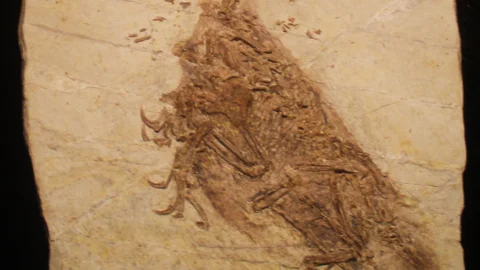
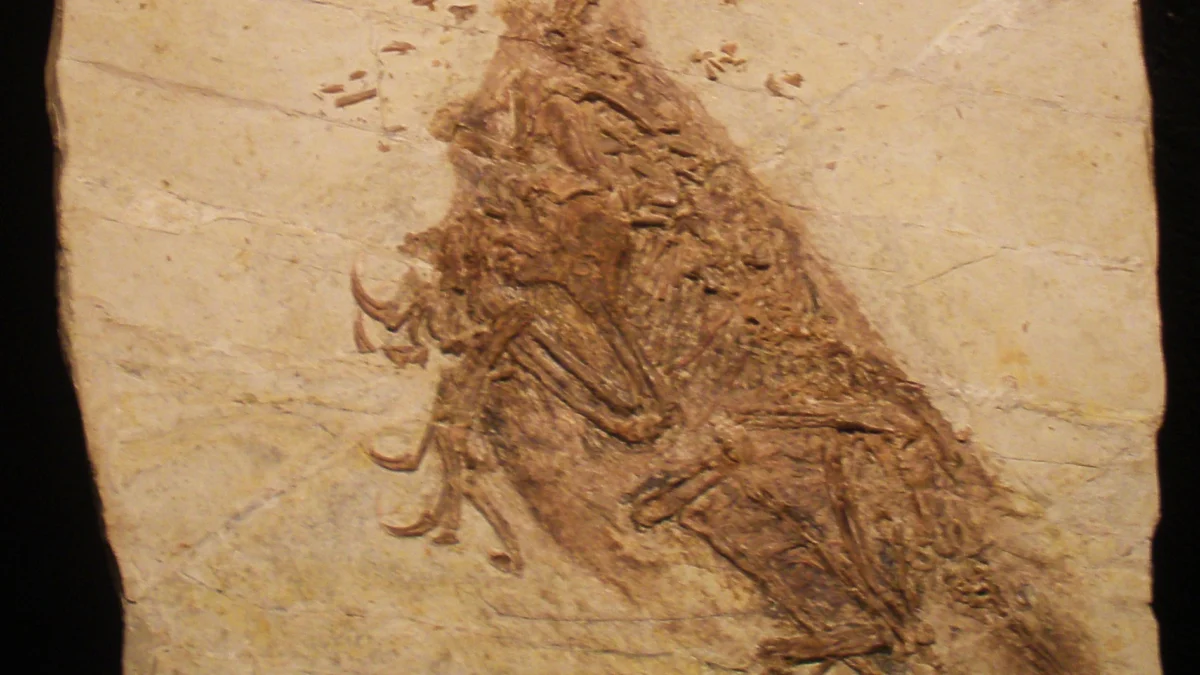
Around 110 to 115 million years ago in northwestern China, a sparrow-sized bird carrying an egg died inside a shallow lake basin [1]. Fine mud buried her skeleton rapidly, preserving crushed shell fragments trapped inside her body cavity [1].
In 2019, paleontologist Alida Bailleul and colleagues named this specimen Avimaia schweitzerae, the first fossil bird ever found with an unlaid egg still preserved inside [1]. Even more remarkably, microscope sections of the trapped shell and femur revealed abnormal double-layered eggshell and probable medullary bone [1].
Together with Mary Schweitzer’s bone histology discoveries in Tyrannosaurus rex, this tiny Early Cretaceous bird links modern avian reproduction directly back to Mesozoic dinosaurs [1, 2, 3]. High-resolution microscopy methods like those used to uncover ancient artifacts in our report on ancient Keeladi ceramics under electron microscopy let researchers read physiological clues locked inside stone.
Why This Matters: Reading Physiology Inside Ancient Stone
For generations, vertebrate paleontology worked almost exclusively from dry skeletal shapes. Anatomists compared wing bones, teeth, and vertebrae, yet rarely knew an extinct animal’s biological sex or immediate cause of death [1, 2].
Microscopic paleohistology changed that limitation completely [1, 2]. By slicing millimeter-thin rock-mineralized bone and eggshell wafers, scientists detect reproductive tissue remodeling frozen minutes before burial [1, 2].
Studying rapid evolutionary transitions also clarifies how early fliers thrived across ancient ecosystems. You can explore related vertebrate adaptation mechanics in our analysis of streamlined body dynamics in fluid environments and cellular mineral metabolism.
Early Cretaceous rocks from northeastern and northwestern China have revolutionized avian paleontology over the last three decades [1]. Fine volcanic ash and lake sediments preserved feathers, stomach contents, skin impressions, and delicate soft tissues rarely seen in coarse river sandstones [1]. Discovering an unlaid egg locked inside Avimaia adds rare physiological life-history detail alongside external wing anatomy [1].
How the Study Was Done: Thin-Section Histology and Microscopy
Bailleul, Jingmai O’Connor, and colleagues examined the Avimaia slab recovered from the Xiagou Formation in Gansu Province, China [1]. Dated to the Early Cretaceous roughly 110 to 115 million years ago, those layered siltstones formed inside tranquil freshwater lake basins [1]. Low bottom oxygen and rapid fine-silt burial protected fragile hollow bones and mineralized membranes from scavengers [1].
The fossil belonged to Enantiornithes, an extinct group of toothed “opposite birds” that dominated Cretaceous skies alongside early ancestors of living birds [1]. Unlike modern birds with toothless beaks and short fused tail bones, enantiornithines kept small jaw teeth and clawed wing digits while flying swiftly between lakeside forests [1].
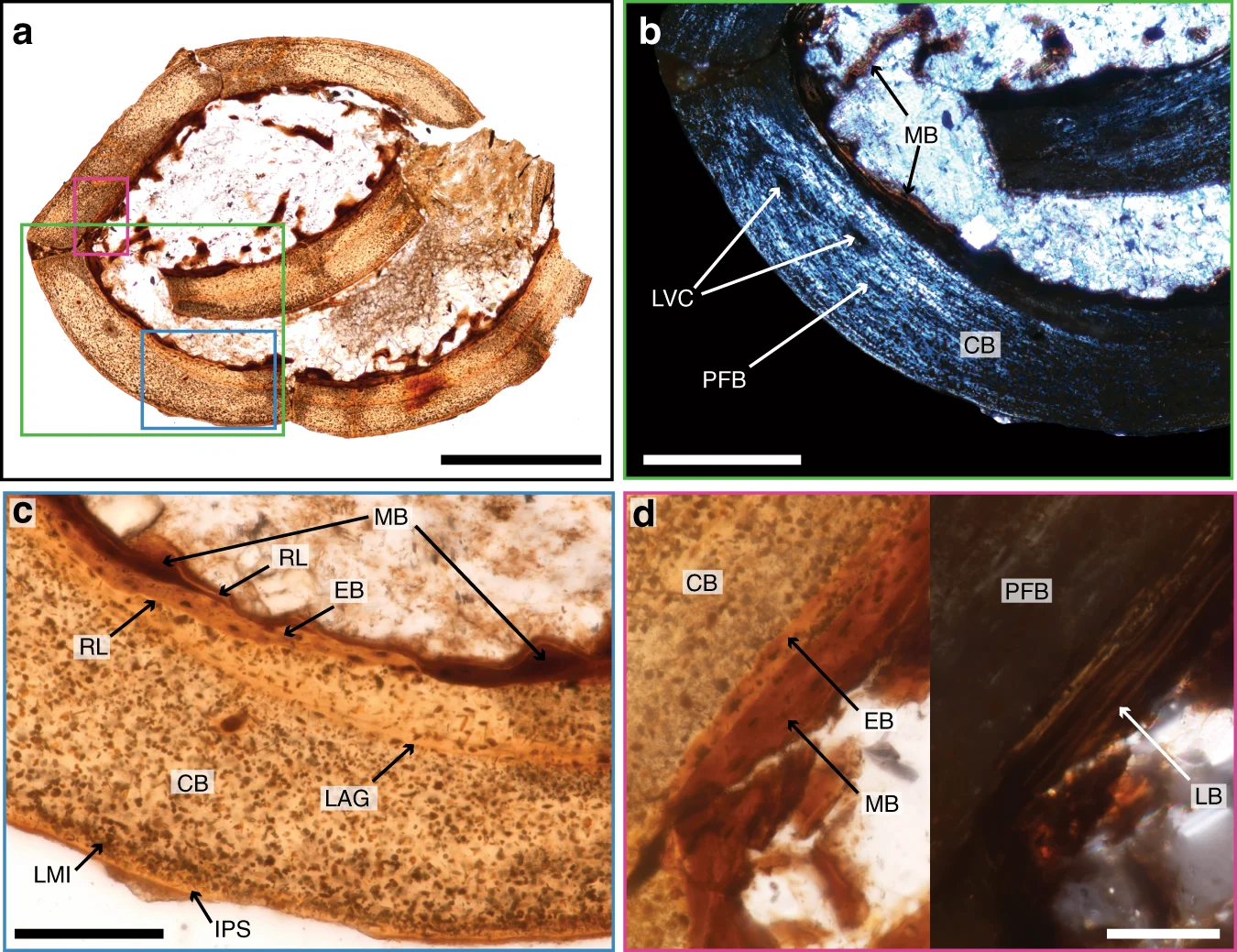
Instead of leaving the crushed abdominal mass untouched, researchers extracted microscopic samples for transmitted-light microscopy, scanning electron microscopy (SEM), and energy-dispersive X-ray spectroscopy [1]. They also prepared thin sections from a broken femur shaft to inspect interior marrow cavities [1]. Chemical mapping ruled out accidental limestone crusts, verifying genuine biological phosphate and carbonate minerals matching vertebrate shell chemistry [1].
Comparing those ancient microstructures directly against laying chickens, ratites, and Schweitzer’s T. rex specimen MOR 1125 enabled side-by-side biological validation [1, 2]. Together, thin-section slides turned an isolated flattened slab into an anatomical autopsy across 110 million years [1, 2].
Fatal Egg-Binding: Why Double Eggshells Formed Inside Avimaia
Healthy bird eggs pass smoothly through the shell gland once, picking up a single crisp calcified layer before laying [1]. When Bailleul and colleagues zoomed into Avimaia‘s squashed abdominal mass, they expected typical thin single-layer eggshell [1]. Instead, electron micrographs revealed abnormal double-layered and multi-layered shell strata separated by organic membranes [1].
Modern poultry veterinarians recognize that layered pattern immediately [1]. When a female bird faces severe physiological stress or pelvic blockage, an egg stays trapped inside the shell gland [1]. Biologists call this dangerous retention egg-binding or dystocia [1]. As days pass, uterine glands deposit extra calcite layers atop the stalled shell, harming embryo gas exchange and risking maternal death [1].
Normal eggshells also show microscopic breathing pores and vertical crystal columns built in organized stages inside the uterus [1]. By contrast, Avimaia‘s retained shell showed chaotic extra mineral bands stacked directly atop an existing outer cuticle membrane [1]. That distinct pathological layering happens only when a fully formed egg remains stuck inside the reproductive tract while hormone cycles attempt to build a second coat [1].
How Fatal Egg-Binding Preserved Clues Inside Avimaia
- Stage 2
Oviduct Retention (Dystocia)
Physiological stress or developmental failure stalls the descending egg inside the shell gland [1]. - Stage 3
Multiple Shell Deposition
Retained uterine secretions coat the trapped egg with two or more abnormal mineralized shell layers [1]. - Stage 4
Rapid Lacustrine Burial
Following maternal death, fine Early Cretaceous Xiagou lake mud seals crushed shell fragments and bone histology [1].
Researchers concluded Avimaia schweitzerae likely died directly from reproductive complications caused by this retained egg [1]. What looked like a crushed stain on stone turned out to be the oldest known physiological record of egg-binding in fossil birds [1].
Medullary Bone: Bridging Chickens, Enantiornithines, and T. rex
Inside Avimaia‘s femur cavity, thin-section slides preserved a delicate lace-like mineral network growing inward from the cortex [1]. Modern female birds build this temporary tissue, called medullary bone, shortly before ovulation [1, 2].
Building calcified shells demands enormous calcium in just 24 hours. Rather than eroding dense outer leg bones until limbs fracture, female birds draw fast-dissolving calcium directly from spongy medullary bone lining marrow cavities [1, 2].
Back in June 2005, Mary Schweitzer and colleagues published a landmark Science study proving Tyrannosaurus rex specimen MOR 1125 held identical medullary bone beside ostrich and emu controls [2]. Before that paper, paleontologists could rarely prove whether a giant theropod skeleton belonged to a male or female [2]. Finding calcium-rich medullary tissue inside the predator’s hindlimb confirmed she was an ovulating female at death [2].
Earlier in March 2005, Schweitzer’s team had also documented preserved soft-tissue blood vessel networks inside demineralized dinosaur bone [3]. Naming the 2019 Early Cretaceous bird Avimaia schweitzerae directly honored Schweitzer’s pioneer paleohistology breakthroughs [1]. Together, those fossils demonstrate that avian reproductive bone chemistry predates modern flying birds by tens of millions of years [1, 2, 3].
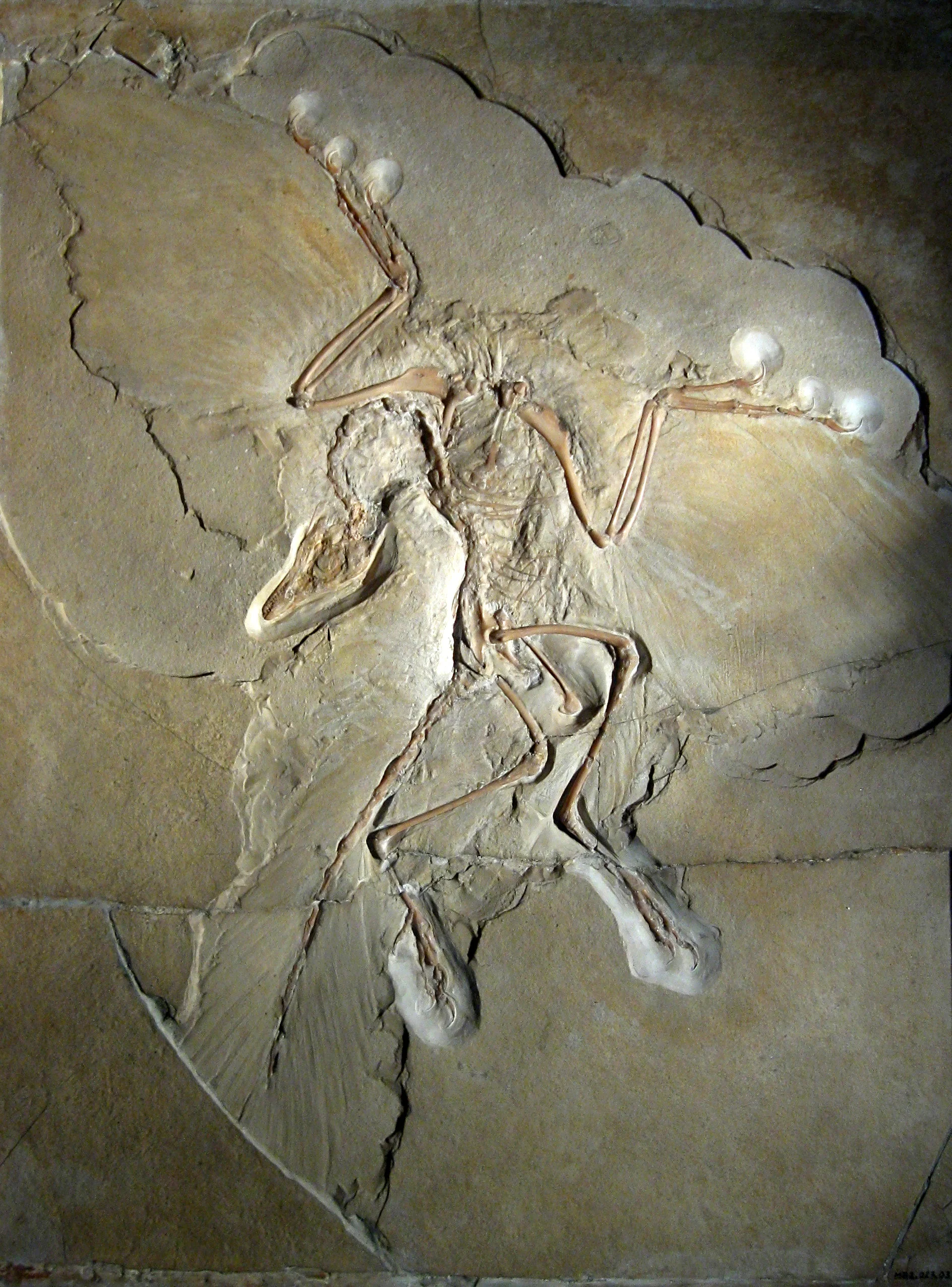
Table 1 summarizes key reproductive and histological fossil comparisons linking non-avian theropods, Mesozoic enantiornithines, and modern birds [1, 2, 3].
| Lineage Group | Geological Era | Medullary Bone | Eggshell & Reproductive Traits |
|---|---|---|---|
| Non-Avian Theropods (T. rex) [2, 3] | Late Cretaceous (~68 Ma) | Confirmed in MOR 1125 femur | Two functional oviducts; slow clutch laying |
| Enantiornithines (Avimaia) [1] | Early Cretaceous (~110 to 115 Ma) | Probable endosteal tissue | Single-egg abdominal retention; pathological double-layering |
| Modern Neornithine Birds [1, 2] | Cenozoic to Present | Standard pre-laying calcium bank | Rapid daily calcified shell deposition; rare fatal dystocia |
Compiled from Bailleul et al. (2019) and Schweitzer et al. (2005).
How Avimaia Reshapes Avian Evolution Models
Enantiornithines (“opposite birds”) retained clawed fingers, toothed jaws, and unfused hand bones long after diverging from the ancestors of modern birds [1]. Many paleontologists once wondered whether their reproductive cycles behaved more like reptiles or modern songbirds [1]. Early avian hatchlings in this clade also emerged unusually precocial with flight feathers already sprouting, showing a fascinating mix of ancestral and modern traits [1].
Finding both probable medullary bone and multi-layered shell pathology inside one skeleton proves Avimaia ran high-turnover avian shell glands and rapid calcium mobilization [1]. Even traits considered distinctively modern, including stress-induced egg retention inside a single functional oviduct, evolved over 110 million years ago [1].
Surprisingly, modern birds inherited nearly their entire reproductive toolkit from Cretaceous predecessors before the asteroid extinction wiped out non-avian dinosaurs and enantiornithines 66 million years ago [1, 2]. Modern birds carry only a single functional left ovary and oviduct, trimming flight weight rather than carrying two heavy eggs at once like early reptiles [1]. Observing one large retained egg inside Avimaia aligns smoothly with early single-oviduct streamlining among agile Cretaceous fliers [1].
Fossils preserving direct reproductive snapshots remain extraordinarily scarce compared with isolated teeth or limb bones [1]. Every egg-bearing specimen from China, Mongolia, or North America sharpens evolutionary timelines showing how cold-blooded reptilian nesting gradually gave way to high-metabolism avian incubation [1, 2].
What the study cannot tell us: Taphonomy and Unresolved Limits
Even extraordinary fossils carry analytical limits [1]. Crushing inside ancient lake mud flattened Avimaia‘s egg completely, preventing scientists from measuring intact egg volume or embryonic skeletons [1].
Researchers also remain cautious about calling the femoral tissue definitive medullary bone because fossil recrystallization can mimic trabecular spicules [1]. Future synchrotron X-ray tomography on undisturbed Jehol bird slabs may distinguish estrogen-driven medullary bone from stress fractures without cutting specimens apart [1].
Because only a single reproductive specimen of Avimaia schweitzerae exists today, paleontologists cannot yet quantify how often egg-binding struck Cretaceous bird populations [1]. Every newly excavated fossil bird from Gansu and Liaoning shale beds brings fresh data to test these evolutionary hypotheses [1].
Determining biological sex in extinct vertebrates still requires rare preservation luck [1, 2]. Medullary bone disappears quickly after egg laying finishes in modern birds, meaning only females preserved right near ovulation keep that temporary calcium signature [1, 2]. When fossil preservation captures that fleeting window cleanly, paleontologists gain an unmistakable snapshot of prehistoric reproduction and mortality [1, 2].
Frequently Asked Questions About Avimaia and Fossil Eggs
Frequently Asked Questions
How did scientists know the fossilized egg inside Avimaia was never laid?
The crushed eggshell lay trapped inside the bird’s pelvic abdominal cavity rather than scattered beside the skeleton, and microscopy uncovered abnormal multi-layered shell bands formed when an egg stalls inside the shell gland.
What is medullary bone and why does it matter in dinosaurs?
Medullary bone is a temporary spongy calcium deposit female birds grow inside leg marrow cavities just before laying eggs. Finding it in Tyrannosaurus rex and Avimaia confirms biological sex and shared calcium chemistry between dinosaurs and modern birds.
Why are enantiornithines called opposite birds?
Their ankle and shoulder joint sockets articulate in an opposite ball-and-socket orientation compared with modern living birds, even though they closely resembled small songbirds externally.
Did Avimaia survive after developing double eggshells?
Likely no. Just as in modern pet and poultry medicine, severe egg-binding blocks reproductive transit and commonly proves fatal, which preserved the egg directly inside her fossilized abdomen.
Technical Terms and Definitions
Scientific terms used in this article
- Medullary BoneOvulation Calcium Tissue
- Temporary spongy bone built inside female bird marrow cavities to supply calcium rapidly during eggshell formation.
- EnantiornithinesExtinct Toothed Cretaceous Birds
- The most diverse Cretaceous bird lineage, possessing teeth and wing claws, extinct after the 66-million-year impact.
- Dystocia (Egg-Binding)Stalled Egg Pathology
- A dangerous condition in female birds and reptiles where an egg gets lodged inside the oviduct or shell gland.
- PaleohistologyFossil Tissue Microscopy
- The study of microscopic cellular and mineral patterns preserved inside thin slices of fossil bone and shell.
Scientific References and Primary Literature
An Early Cretaceous enantiornithine (Aves) preserving an unlaid egg and probable medullary bone
- Journal
- Nature Communications
- Study Type
- Report
- Year
- 2019
DOI10.1038/s41467-019-09259-x
Timeline
- 2005
Dinosaur Medullary Bone Proven
Schweitzer et al. identified female ovulation-linked bone inside Tyrannosaurus rex MOR 1125.
- 2019
Avimaia Unlaid Egg Described
Bailleul et al. reported the first fossil bird retaining a double-layered egg in situ.
References
- ↩ Bailleul, A. M., O'Connor, J., Zhang, S., Li, Z., Wang, Q., Lamanna, M. C., Zhu, X., & Zhou, Z. (2019). An Early Cretaceous enantiornithine (Aves) preserving an unlaid egg and probable medullary bone. Nature Communications 10, Article 1275.
- ↩ Schweitzer, M. H., Wittmeyer, J. L., & Horner, J. R. (2005). Gender-specific reproductive tissue in ratites and Tyrannosaurus rex. Science 308(5727), 1456-1460.
- ↩ Schweitzer, M. H., Wittmeyer, J. L., Horner, J. R., & Toporski, J. K. (2005). Soft-tissue vessels and cellular preservation in Tyrannosaurus rex. Science 307(5717), 1952-1955.
No comments yet. Be the first to join the conversation.