
Key Findings
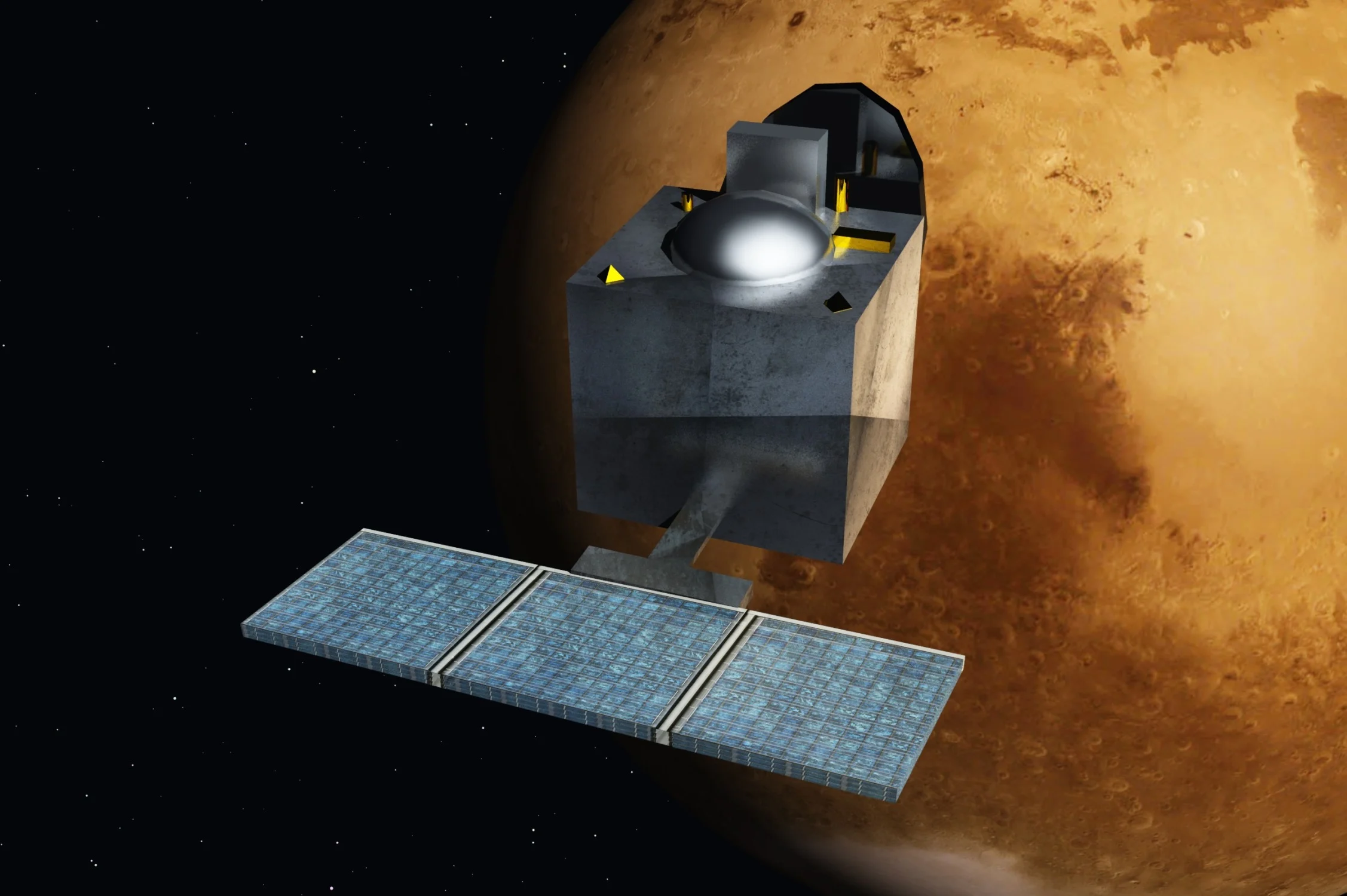
- Mangalyaan launched on November 5, 2013 aboard PSLV-C25 and reached Martian orbit on its first attempt on September 24, 2014 [1, 4].
- Designed for six months near 450 crore rupees, MOM operated for eight years carrying five compact payloads totaling ~15 kg [1, 4].
- MENCA mass spectra documented transitions from CO2 to atomic oxygen in Mars' upper exosphere alongside global MCC dust imaging [2, 3].
On November 5, 2013, a compact Polar Satellite Launch Vehicle (PSLV-C25) lifted off from Sriharikota carrying a 1,350-kilogram orbiter [1, 4]. Ten months later, on September 24, 2014, Mangalyaan entered Mars orbit cleanly on India’s very first attempt [1, 4].
ISRO built the entire Mars Orbiter Mission on roughly 450 crore rupees [4]. Engineers designed it primarily for six months of orbital demonstration, yet it kept functioning around Mars until 2022 [1, 4].
Mission engineering papers and payload reports explain how orbital slingshots and five tiny sensors delivered lasting planetary data [1, 2, 3, 4]. Exploring deep-space gravity physics and optical spectral scattering clarifies why lightweight remote sensing succeeded so well.
- Sept 24, 2014
- First-Try Mars Orbit ISRO became the first agency globally to reach Mars orbit on debut [4]
Why This Matters: Slingshot Orbits and Frugal Planetary Engineering
Most Mars missions fly aboard massive heavy-lift rockets that blast spacecraft straight onto an interplanetary path within hours of launch [1]. India did not yet have an operational heavy-lift rocket ready in 2013, forcing mission planners to solve a demanding orbital puzzle with PSLV-C25 [1, 4].
Rather than overpowering Earth’s gravity in one giant burn, engineers placed Mangalyaan into an elliptical parking orbit and fired its 440-Newton Liquid Apogee Motor repeatedly at perigee [1]. Each burn climbed higher until one final trans-Mars injection push sent the probe cruising toward Mars along a fuel-saving Hohmann transfer ellipse [1].
Mastering deep-space autonomy, thermal survival, and optical communication across millions of kilometers gave Indian aerospace engineers operational heritage used later for Moon and solar observatories [1, 4]. Fast turnaround from cabinet sanction in August 2012 to liftoff in November 2013 demonstrated streamlined mission design built around flight-proven satellite buses [1, 4]. Precision radio tracking also ties planetary navigation to Earth avionics principles explored in our guide on high-efficiency solid-state optoelectronics.
How the Study Was Done: Mission Design and Payload Papers
In September 2015, ISRO mission engineers and instrument scientists published a peer-reviewed special section in Current Science [1, 2, 3]. Those articles documented every major spacecraft subsystem and early Mars science dataset openly [1, 2, 3].
Project Director S. Arunan and spacecraft engineers detailed orbital insertion, fault-recovery software, thermal insulation, and propulsion restart reliability [1]. The Liquid Apogee Motor had to survive nearly 300 days of cold deep-space cruise before reigniting reliably near Mars [1].
Meanwhile, A. S. Arya and optical payload scientists documented pre-flight calibration and early orbital imaging from the Mars Colour Camera (MCC) [2]. Alongside them, Anil Bhardwaj and atmospheric physicists published first exospheric neutral mass spectra captured by MENCA during low-altitude periapsis passes [3]. Together, these papers record both technological risk management and empirical planetary measurements [1, 2, 3].
How Mangalyaan Reached Mars With a Medium Rocket
Interplanetary travel relies on precise synchronization between moving orbits around the Sun. Earth and Mars align favorably for a minimum-energy Hohmann transfer only once roughly every 26 months [1]. Missing that launch window forces spacecraft engineers to wait over two years until planetary geometry lines up efficiently again [1].
Launching into a low parking orbit first offered smart orbital flexibility for Sriharikota range operations [1]. Raising apogee cleanly across multiple perigee firings minimized gravity losses when using a smaller rocket stage [1]. Engineers timed the final trans-Mars injection burn accurately so solar arrival matched Mars’ moving orbital position ten months later [1].
Radio signals travel across space at the speed of light, yet vast distances create severe communication delays [1]. Depending on planetary alignment, messages take between 4 and 24 minutes to cross from Earth to Mars [1]. Ground teams therefore cannot steer thrusters live during Mars Orbit Insertion [1]. Instead, onboard computers woke the engine autonomously while behind Mars’ radio shadow and braked cleanly into orbit [1].
How Mangalyaan Climbed From Sriharikota Into Mars Orbit
ISRO placed Mangalyaan into a highly elliptical orbit rather than a low circular mapping track [1, 2]. Closest approach dipped near 422 kilometers while farthest apoapsis swung past 76,000 kilometers [1, 2]. That sweeping path let the camera capture full-disk portraits alongside close atmospheric sampling [2, 3].
Thermal control and solar power management posed constant engineering puzzles along that stretched ellipse [1]. As Mangalyaan swung far from the Sun, sunlight intensity dropped below half of Earth-level solar warmth [1]. Multi-layer insulation blankets, electrical heaters, and hydrazine fuel-line warmers kept propulsion valves from freezing solid in deep space [1].
The Five Science Instruments Aboard Mangalyaan
Every kilogram matters when launching across solar orbits. Mangalyaan carried about 15 kilograms of scientific sensors divided across five compact payloads [1, 4].
First, the Mars Colour Camera (MCC) carried an RGB Bayer sensor array capturing Martian dust clouds, canyon walls, and moons Phobos and Deimos [2, 4]. Second, the Thermal Infrared Imaging Spectrometer (TIS) measured surface thermal emission between 7 and 13 micrometers to map mineral brightness and surface temperature [4].
Third, the Mars Exospheric Neutral Composition Analyser (MENCA) used a quadrupole mass spectrometer covering 1 to 300 atomic mass units to sniff thin gases high above Mars [3, 4]. Fourth, the Lyman Alpha Photometer (LAP) tracked deuterium-to-hydrogen ratios in upper ultraviolet emissions to estimate how fast ancient Mars lost liquid water [4]. Fifth, the Methane Sensor for Mars (MSM) monitored reflected solar infrared bands sensitive to atmospheric CH4 gas columns [4].
Designing those five payloads around low power budgets forced remarkable miniaturization across optical assemblies and electronics [1, 2, 3]. Rather than building heavy gimbaled scan platforms, engineers mounted sensors onto a shared bus frame and pivoted the whole spacecraft via reaction wheels during targeted observations [1, 2]. Data collected during close passes stored onto onboard solid-state recorders before beaming back slowly across high-gain dish antennas toward Indian Deep Space Network tracking stations near Bengaluru [1, 2].
Table 1 summarizes Mangalyaan’s five scientific instruments, measurement technologies, and planetary research goals [2, 3, 4].
| Payload Instrument | Sensor Architecture | Spectral / Mass Range | Planetary Science Target |
|---|---|---|---|
| Mars Colour Camera (MCC) [2, 4] | Tri-color RGB Bayer optical array | Visible wavelengths | Global disk views, dust storms, Phobos, and Deimos |
| Thermal Infrared Spectrometer (TIS) [4] | Uncooled micro-bolometer | 7 to 13 micrometers | Martian surface temperature and silica/mineral mapping |
| MENCA Mass Spectrometer [3, 4] | Quadrupole mass analyzer | 1 to 300 atomic mass units | CO2, N2, argon, and oxygen atoms in exosphere |
| Lyman Alpha Photometer (LAP) [4] | Hydrogen/deuterium absorption cell | 121.6 nm Lyman-alpha UV | D/H ratio tracking ancient H2O escape to space |
| Methane Sensor for Mars (MSM) [4] | Fabry-Perot differential radiometer | 1.65 micrometer SWIR | Column atmospheric CH4 and solar reflectance |
Compiled from ISRO Payload Specifications and Current Science Vol. 109(6) (2015) [2, 3, 4].
Key Scientific Results: Exosphere, Dust, and Phobos Views
During low periapsis plunges only a few hundred kilometers above Martian terrain, MENCA sampled upper atmospheric gas composition directly [3]. Spectra revealed distinct transition zones where heavy CO2 dominated lower exospheric altitudes while lighter atomic oxygen became increasingly abundant higher up [3]. Mapping neutral gas scale heights as seasons changed helped atmospheric physicists constrain how solar heating inflates and strips outer Martian air into space [3].
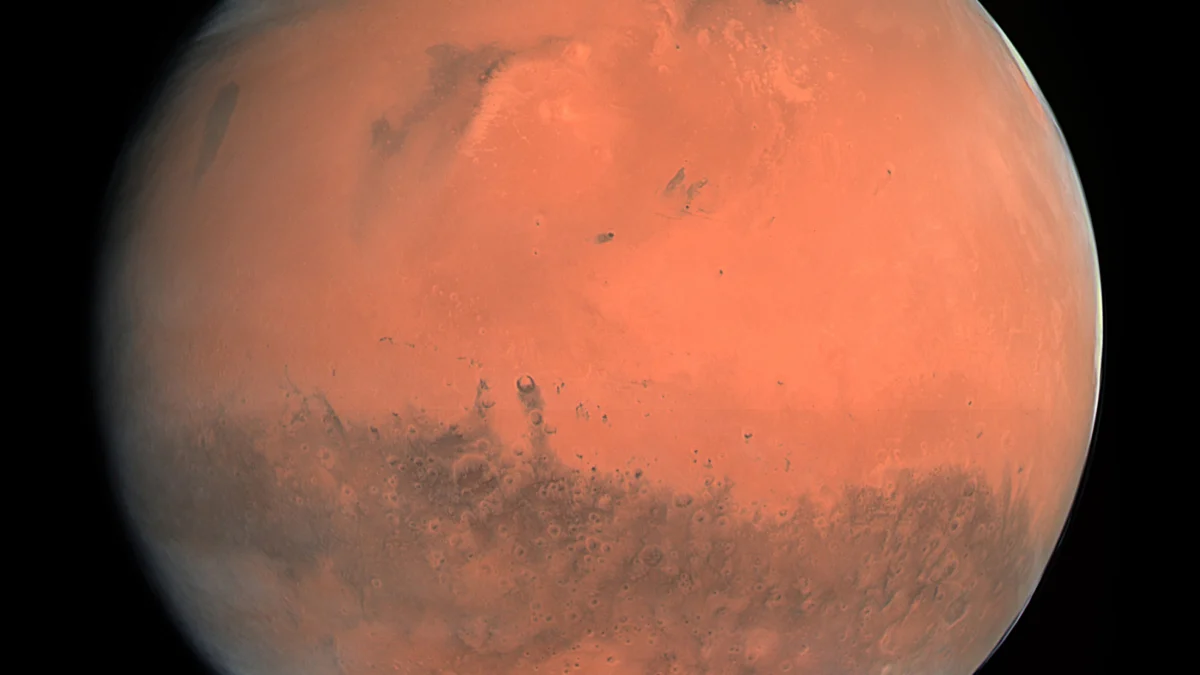
Meanwhile, MCC transmitted hundreds of crisp color frames showing towering regional dust storms drifting across cratered highlands and canyons [2]. Because its elongated orbit pulled far back above Mars every few days, MCC captured planetary-scale weather evolution rarely visible from tighter low-altitude NASA orbiters [2]. High-altitude snapshots captured full illuminated crescents, hazy limb airglow, and shifting polar carbon-dioxide ice caps across successive Martian seasons [2].
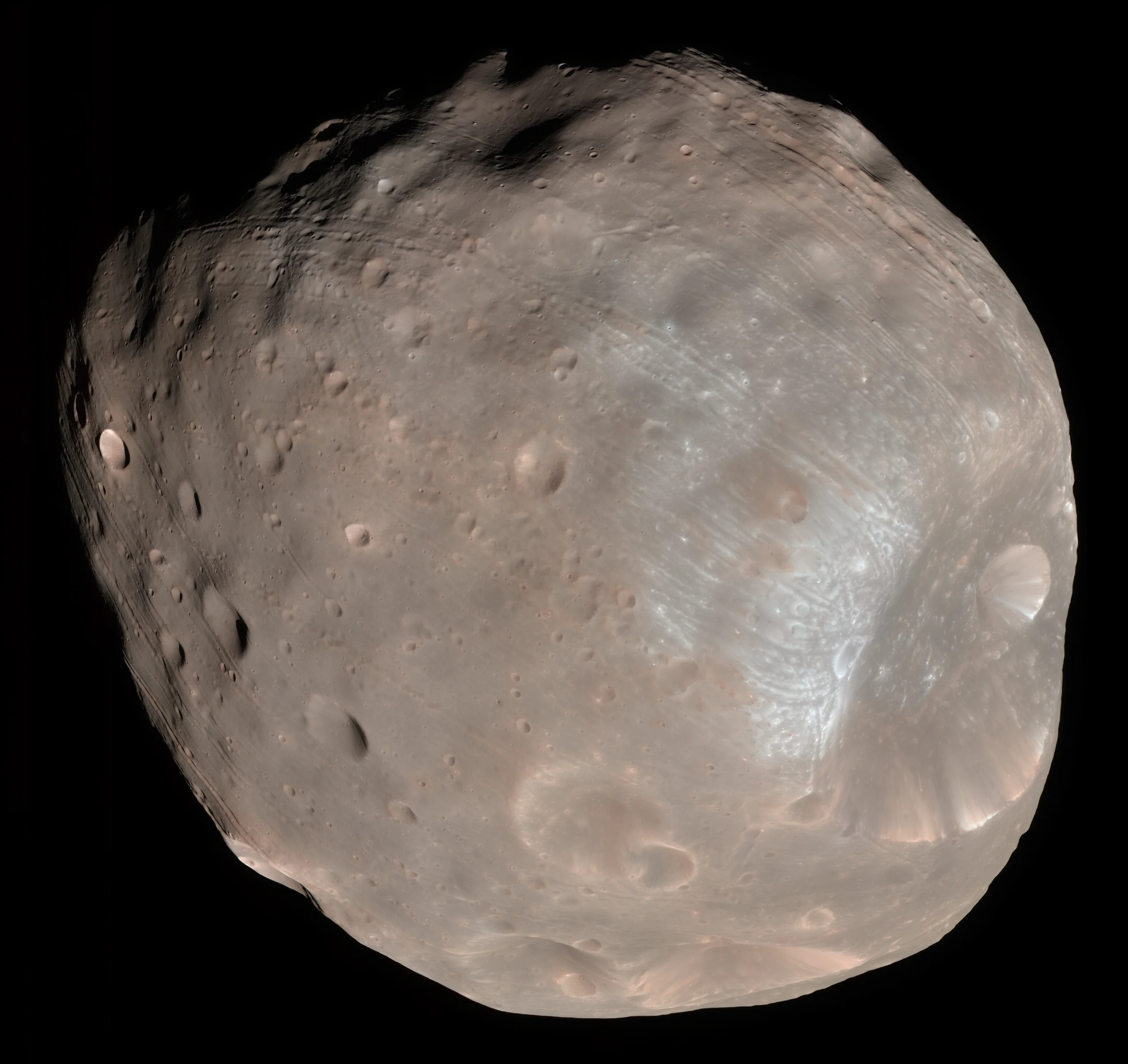
Orbital imaging also snapped rare close views of Mars’ tiny inner moon Phobos silhouetted directly against the orange Martian disk [2]. Tracking global atmospheric water loss alongside atmospheric CO2 dynamics helps planetary scientists understand how Mars shifted from an ancient wet world into a frozen desert [3, 4]. Analyzing regional dust storms from pole to pole also improved dust-lifting forecasts critical for planning future robotic landers and solar-powered rovers [2, 4].
What the study cannot tell us: Instrument and Fuel Limits
Honest engineering analysis highlights clear limits alongside Mangalyaan’s historic debut success [1, 4]. Launching on PSLV restricted scientific payload capacity to about 15 kilograms, far smaller than dedicated heavy NASA or ESA Mars orbiters [1].
Later spacecraft calibration checks showed the Methane Sensor for Mars acted largely as a bright-albedo reflected sunlight mapper rather than detecting unambiguous localized trace CH4 plumes. Its elongated ellipse also spent most of every 72-hour orbit thousands of kilometers from the surface, trading high-resolution closeup surface pixels for wide global disk views [2].
In 2022, after eight years far surpassing its six-month design life, Mangalyaan finally stopped responding to Deep Space Network commands [4]. Long orbital eclipses draining aging batteries alongside exhausted station-keeping propellant ended one of spaceflight’s most cost-effective planetary demonstrations [1, 4].
Future Indian planetary missions will build directly atop those eight years of flight telemetry [1, 4]. Heavier launch vehicles enable dedicated radar, landers, and larger spectrometers on future flights. Even so, Mangalyaan proved a lean engineering team can solve interplanetary navigation first and scale scientific mass afterward [1, 4].
Frequently Asked Questions About Mangalyaan
Frequently Asked Questions
Why did Mangalyaan orbit Earth several times instead of flying straight to Mars?
Because the PSLV-C25 rocket had limited heavy-lift thrust, ISRO engineers fired the spacecraft’s onboard liquid engine during six successive Earth orbits to stretch altitude gradually before launching onto a Mars transfer orbit.
How long was Mangalyaan designed to work compared to its actual lifespan?
ISRO engineers built MOM primarily as a six-month technology demonstrator, yet clever fuel conservation allowed it to keep orbiting Mars for eight years until contact ended in 2022.
Did Mangalyaan confirm active Martian methane vents?
No. While MOM carried a differential radiometer to look for methane bands, independent verification never established confirmed Martian methane plumes from its data, and later analyses noted solar reflectance calibration challenges.
What makes ISRO's first Mars mission historically unique?
India became the first nation to succeed in placing a spacecraft around Mars on its very first mission attempt, accomplishing the launch and orbital capture on a budget near 450 crore rupees.
Technical Terms and Definitions
Scientific terms used in this article
- Hohmann Transfer OrbitMinimum-Energy Planetary Path
- An elliptical solar orbit connecting two planetary orbits using two brief engine burns with minimal propellant.
- Periapsis and ApoapsisClosest and Farthest Orbit Points
- The nearest and farthest points along an elliptical spacecraft path around a planet like Mars.
- ExosphereOutermost Planetary Atmosphere
- The tenuous upper boundary of a planet’s atmosphere where sparse gas molecules can escape into space.
- Orbital InsertionPlanet Capture Engine Burn
- A backward-facing rocket firing that slows an arriving spacecraft enough for planetary gravity to capture it.
Scientific References and Primary Literature
Mars Orbiter Mission spacecraft and its challenges
- Journal
- Current Science
- Study Type
- Report
- Year
- 2015
DOI10.18520/cs/v109/i6/1061-1069
Timeline
- 2013-11-05
PSLV-C25 Launch
Mangalyaan lifts off from Sriharikota into elliptical Earth parking orbit.
- 2014-09-24
Mars Orbit Insertion
Autonomous main engine burn captures Mangalyaan around Mars on India's first try.
- 2015-09-25
Current Science Special Issue
Mission engineers and PIs publish peer-reviewed payload and telemetry analyses.
- 2022-10-02
Mission End Confirmed
After eight years far surpassing its six-month design life, communication concludes.
References
- ↩ Arunan, S., et al. (2015). Mars Orbiter Mission spacecraft and its challenges. Current Science 109(6), 1061-1069.
- ↩ Arya, A. S., et al. (2015). Mars Colour Camera (MCC) aboard Mars Orbiter Mission. Current Science 109(6), 1076-1086.
- ↩ Bhardwaj, A., et al. (2015). MENCA onboard India's Mars Orbiter Mission. Current Science 109(6), 1106-1113.
- ↩ Indian Space Research Organisation (ISRO). Mars Orbiter Mission (MOM) Payloads.

No comments yet. Be the first to join the conversation.